Explace
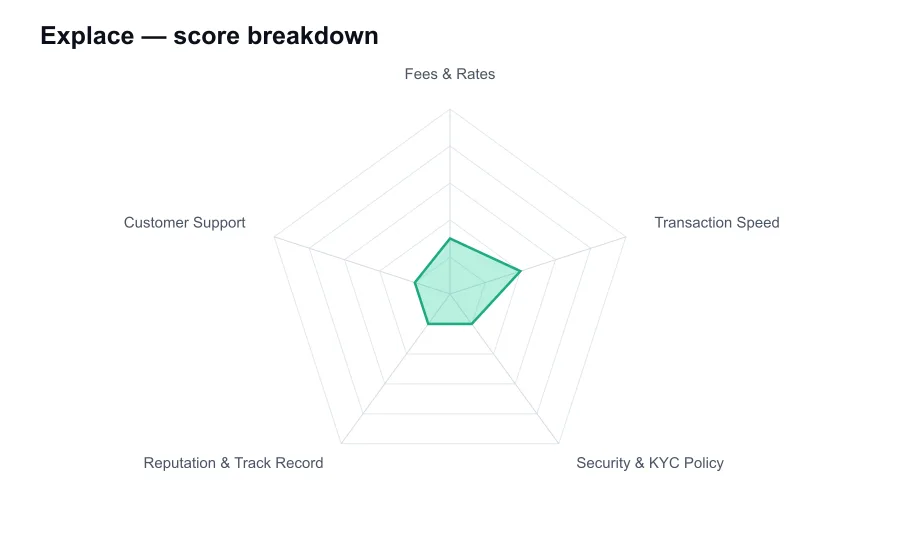
Explace scores 2.5/10 overall in our independent review, measured against every other provider we've compared, strongest on Transaction Speed (4.0/10) and weakest on Customer Support (2.0/10).
2.5/10 ★★★★★ How we score → Status: active (checked 2026-10-13T19:22:23.243Z)| Best for | Not for |
|---|---|
| Simple instant-swap style flow | Limited independently verifiable company information |
| Potentially avoids keeping a standing custodial balance | Fee and spread presentation lacks clarity |
Editorial independence: our scores and rankings are produced using the fixed criteria above and are not influenced by advertisers. This is an independent ranking site and is not operated by, or affiliated with, any provider we list.
Affiliate disclosure: some links on this page may earn us a commission at no extra cost to you. This does not affect our rankings.
What is Explace?
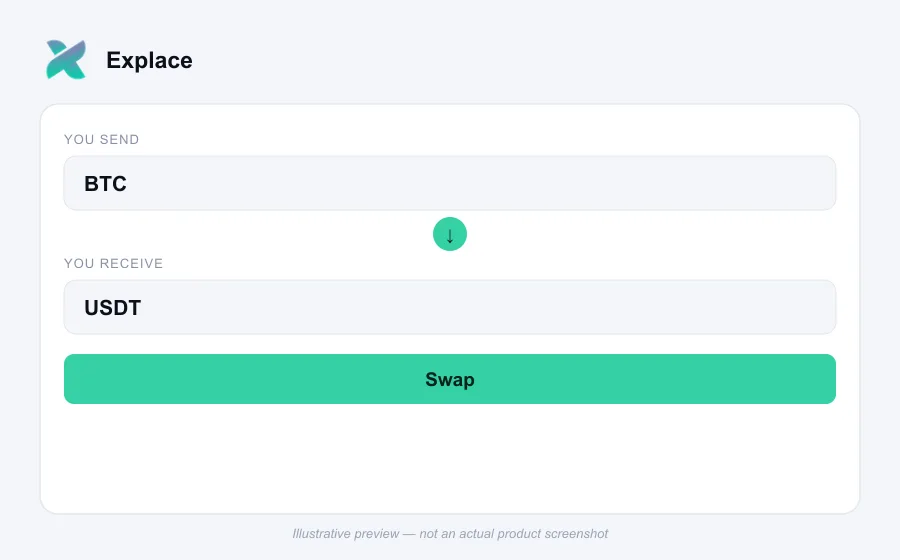
Explace is presented as an instant crypto conversion provider. Users select a pair, send the source asset to a generated address, and receive the destination asset after processing. It is not best understood as a full custodial trading exchange.
In-Depth Review of Explace
Explace appears to position itself as a lightweight instant crypto exchange rather than a full trading venue. That distinction matters. You are not opening an order book, setting limit orders, or parking a balance for months. The usual appeal is a direct conversion flow: choose two assets, send the first, and receive the second. In a crowded market full of similar-looking swap sites, Explace does not have the public profile or independently documented history of larger names such as ChangeNOW, SimpleSwap, or LetsExchange.
That limited public footprint is the central problem with assessing it. A small exchange can be perfectly functional, but a customer has less to work with if a transaction gets delayed or a compliance review starts. There is less third-party reporting, fewer long-running user discussions, and little institutional history to fall back on. For a service handling irreversible blockchain transfers, that lack of a record should affect how much money you are willing to test with.
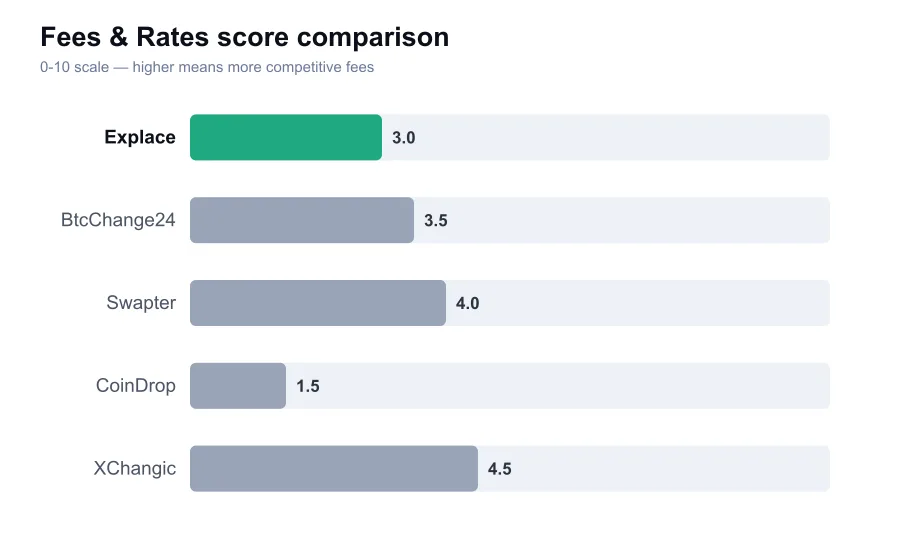
The fee presentation is not strong enough for me to call transparent. Instant exchangers often build their compensation into the quoted rate, along with a liquidity-provider spread and network costs. That model is normal, but users need a clear way to tell whether they are paying a modest spread or a painful one. Explace does not have the widely documented fee disclosures that make comparison shopping easy.
The practical way to assess an Explace quote is to compare the final amount against at least two competitors immediately before sending. Use the same source asset, destination asset, and network. A quote can look attractive until a network fee or a poor conversion rate is folded into the final output. This is particularly important on smaller tokens, where liquidity is thin and a supposedly simple swap may have a substantial embedded cost.
Speed is likely driven more by the chosen blockchain and the liquidity route than by a polished internal matching engine. Bitcoin deposits can take considerably longer than transfers on faster networks, while Ethereum transactions can be delayed by congestion and fee settings. No instant exchanger can honestly promise a uniform settlement time across every asset, but a reliable provider should clearly explain confirmation requirements and show a live status page for the order.
I would not use Explace for a time-sensitive transfer unless I had already completed a successful small test. The service does not have enough widely available operational evidence to justify treating a quoted completion time as a guarantee. If you are moving funds to catch a market entry, pay a loan, or meet an exchange deposit window, a major venue with visible support channels is the safer choice.
Security is another area where public transparency matters as much as technical claims. A noncustodial exchange flow reduces the risk of leaving a standing balance on the platform, which is a genuine advantage over depositing assets at a centralized exchange. It does not remove counterparty risk during the swap itself. You still send coins to an address controlled by the service or its liquidity route and rely on the provider to release the destination asset.
I could not verify enough detailed public material about Explace's operating company, security controls, audit practices, or incident response procedures to award it much credit here. That does not prove wrongdoing. It does mean users should not assume the same controls, reserves, or legal accountability offered by a regulated custodian. The burden is on Explace to earn trust through transparent documentation and consistent public service, not on customers to infer it.
KYC policy can be a source of confusion with instant exchangers. A site may advertise a registration-free flow while retaining the right to pause an order for anti-money-laundering checks. Those are different things. Before sending funds, read the terms that apply to identity requests, source-of-funds checks, and what happens if a customer cannot provide requested documents. A vague policy is a serious weakness because blockchain transfers cannot simply be reversed.
Reputation is where Explace falls furthest behind established competitors. There is not enough long-term, independently corroborated customer history for me to treat it as a proven first-choice provider. A young or little-known business can improve quickly, but trust in this category is earned transaction by transaction, through years of visible uptime and fair resolutions when something goes wrong.
Support should be judged by more than the presence of a chat bubble. The useful test is whether a user can submit an order ID, receive a meaningful explanation of a delay, and get a resolution without being bounced between generic replies. Explace has not built a broad public record of support performance that would give me confidence in difficult cases. That is especially relevant where a swap is held for review or arrives with an incorrect memo or tag.
For a tiny, nonurgent test transaction, Explace may be usable if the rate is demonstrably better and you have verified every address and network. I would keep the amount low enough that a delay would be inconvenient rather than damaging. The service has not earned the level of confidence needed for a large conversion, a business payment, or a transfer involving funds you urgently need.
There is a difference between being an obscure service and being a bad one. Explace may simply be under-documented and under-reviewed. Yet a reviewer should not fill that evidence gap with optimism. The lack of independently verifiable detail affects fees, support expectations, dispute risk, and the ability to judge whether the company can handle an exceptional event.
My view is blunt: Explace belongs in the experimental tier, not the trusted-core tier. Compare its output quote carefully, test with a small amount, and retain transaction hashes and screenshots until the exchange is complete. Users who value a long public record, clear policies, and predictable escalation should choose a more established instant exchange instead.
Score Breakdown
| Criterion | Score | Note |
|---|---|---|
| Fees & Rates | 3.0 | Rate and fee disclosure is too limited for easy comparison. |
| Transaction Speed | 4.0 | Settlement depends on network and routing, with little public evidence. |
| Security & KYC Policy | 2.0 | Limited public detail on controls, company, and review procedures. |
| Reputation & Track Record | 2.0 | Little independently documented long-term operating history. |
| Customer Support | 2.0 | No broad public record of support quality in difficult cases. |
Key Facts
| Fact | Value | Source |
|---|---|---|
| Service model | Instant crypto conversion | - |
| Order book | Not presented as a trading venue | - |
| Public fee schedule | Not clearly independently verified | - |
| Company detail | Limited publicly verifiable detail | - |
| Recommended first use | Small test transaction | - |
Pros and Cons
| Pros | Cons |
|---|
How Explace Works
- Select the asset you want to send and receive
- Enter the destination wallet address
- Review the quoted output and generated deposit address
- Send the source asset on the exact requested network
- Track the order until the destination asset arrives
How to Use Explace Safely
- Start with a small test transfer
- Compare the final output with other providers
- Check the network, address, memo, and tag before sending
- Keep the order ID and transaction hash
- Do not use funds needed for a deadline-sensitive payment
Is Explace a traditional exchange with an order book?
It appears to operate as an instant conversion service rather than a conventional exchange where users place limit orders against an order book.
Should I send a large amount through Explace first?
No. Its public operating record is limited, so a small test transaction is the prudent first step before considering any larger transfer.
How can I check whether an Explace quote is competitive?
Compare the exact final destination amount against at least two established instant exchangers using the same amount, asset pair, and network.
Can a swap be delayed after I send funds?
Yes. Blockchain confirmations, liquidity routing, incorrect network details, or a compliance review can delay an instant-exchange order.
What records should I keep for an Explace swap?
Save the order ID, deposit address, destination address, quoted amount, screenshots, and the blockchain transaction hash until funds arrive.
Editorial independence: our scores and rankings are produced using the fixed criteria above and are not influenced by advertisers. This is an independent ranking site and is not operated by, or affiliated with, any provider we list.
Affiliate disclosure: some links on this page may earn us a commission at no extra cost to you. This does not affect our rankings.