Moneta365
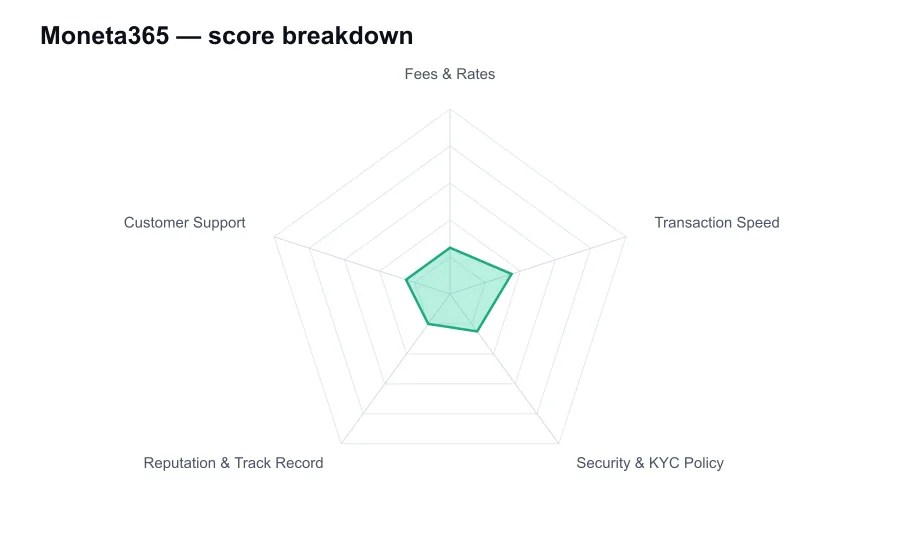
Moneta365 scores 2.6/10 overall in our independent review, measured against every other provider we've compared, strongest on Transaction Speed (3.5/10) and weakest on Reputation & Track Record (2.0/10).
2.6/10 ★★★★★ How we score →| Best for | Not for |
|---|---|
| Potentially straightforward transaction flow | Very limited independently verifiable reputation |
| May be usable for a very small test | Unclear fee and spread transparency |
Editorial independence: our scores and rankings are produced using the fixed criteria above and are not influenced by advertisers. This is an independent ranking site and is not operated by, or affiliated with, any provider we list.
Affiliate disclosure: some links on this page may earn us a commission at no extra cost to you. This does not affect our rankings.
In-Depth Review of Moneta365
Moneta365 is the most concerning name in this group from a due-diligence perspective, largely because a financial service using a broad, generic brand must work very hard to establish exactly who it is and what protections apply. Crypto users should not confuse a professional-looking exchange page with a proven financial institution. The market has a long history of services that borrowed the language of banking, payments, or currency exchange while offering far less transparency than those labels imply. Moneta365 needs to be assessed through verifiable facts, not presentation.
The provider appears positioned as a straightforward route for exchanging or handling digital value, likely aimed at customers who prefer speed and simplicity to an advanced trading environment. That is a familiar pitch. The trouble is that the most important details are not always apparent with smaller providers: legal ownership, operating location, custody arrangements, client-asset treatment, and the exact process for resolving a delayed transaction. A credible exchange should not make customers hunt for those answers. If they are missing or inconsistent, the correct reaction is caution.
Moneta365 does not have the broad, independently documented track record I would expect before recommending a platform for meaningful deposits. There is a huge difference between being visible online and being proven reliable over time. A credible reputation develops through multiple market conditions and includes public interaction with users, clear policies, and evidence that the company can withstand stress. A service that has not shown those things may still perform adequately, but the customer bears more uncertainty. That uncertainty has a financial value, and it should influence where people transact.
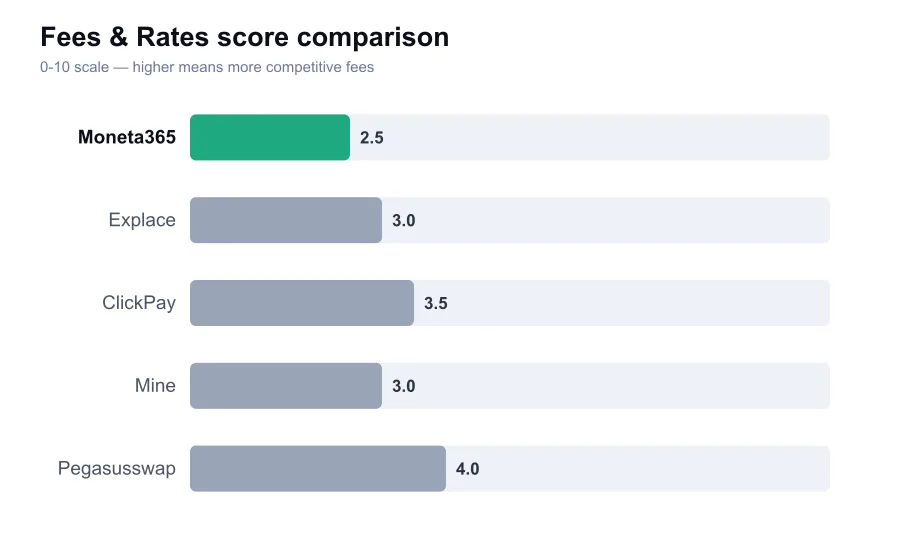
Fees are one of the first places where that uncertainty becomes expensive. Moneta365 users should not assume a transaction is cheap merely because the provider does not emphasize a separate commission. Exchange spreads can be much more significant than a stated fee. The only number that matters is the total amount paid against the total amount delivered, compared at the same moment with a liquid market reference. This is particularly important for card purchases, cross-currency conversions, and smaller transactions where fixed charges take a larger bite.
I would want to see a clear breakdown of quoted rate, service fee, payment-processing cost, and blockchain fee. Without that breakdown, a customer cannot distinguish a fair convenience premium from an uncompetitive route. The problem is compounded by volatility. If a quote is not fixed, the actual result can change while a payment is processing. If a quote is fixed, the service may build protection against price movement into the rate. Neither model is inherently bad. What matters is that Moneta365 explains which one it uses and what the customer can expect before assets leave their wallet.
Speed should also be viewed realistically. The word 365 suggests constant availability, but always-open access is not the same thing as always-fast settlement. Crypto transfers depend on network conditions, confirmation requirements, wallet availability, and the provider's own compliance controls. A transaction can be initiated at any hour and still wait for manual review or a blockchain backlog. Moneta365 may offer a quick path for routine transactions, but there is insufficient public evidence to place much confidence in its performance during exceptions.
This is especially relevant for fiat-linked activity. Banks may have cut-off times. Card issuers may decline or review a payment. Stablecoins can be fast on the right chain but still fail if a user selects the wrong network or omits a required memo. If Moneta365 does not offer unambiguous instructions and transaction tracking, the convenience of its front end disappears at the first mistake. Users should not use an unfamiliar provider to solve an urgent payment need. A deadline turns ordinary operational uncertainty into unacceptable risk.
Security cannot be scored highly without better disclosure. A serious service should make clear whether it is custodial, whether customer balances are pooled, how login protection works, whether two-factor authentication is offered, how withdrawals are secured, and where users should report suspected compromise. It should also have a privacy policy that explains how identity documents are handled. Moneta365 has not established enough public security evidence for me to assume those controls are mature. That is a reason to avoid storing funds there, not an accusation that a breach has occurred.
KYC deserves direct attention because it is often misunderstood. A service can appear accessible until the moment an automated check detects a risk factor. At that point, a user may be asked for identification, a selfie, proof of address, payment confirmation, or source-of-funds information. This can happen even where the initial transaction flow asks for little data. Moneta365 users should read its current terms before transferring crypto and should not treat a low-friction sign-up as a promise that no verification will be needed later.
The support question is where smaller financial services either win loyalty or lose it completely. A person whose transaction finishes normally may never need help. A person whose transfer is paused needs more than a chat widget. They need an order-specific explanation, a knowledgeable agent, and an escalation route. There is not enough strong public evidence that Moneta365 offers this level of support consistently. A listed email address is not a support system. Nor is a generic response that tells a customer to wait without explaining what is being checked.
Before using Moneta365, I would make support part of the screening process. Ask how it handles a deposit on an unsupported network, whether a fixed quote can expire, and what documents can be requested after an order begins. A competent answer should be specific, understandable, and internally consistent with the terms. If the reply is evasive or overly sales-focused, do not deposit. This small effort can prevent a much larger problem later, particularly because blockchain transfers normally cannot be recalled once confirmed.
Moneta365 may have a role for an advanced user who is deliberately experimenting with a small amount and understands that a low-profile service deserves a low exposure limit. Even then, the user should control the receiving wallet, avoid linking a large payment source, and preserve full records of every transaction. It is not the right place to buy a first crypto asset, manage recurring investments, or hold savings. Newcomers need transparent costs and accessible help. Long-term holders need proven custody practices. Moneta365 does not yet demonstrate either strongly enough.
The strongest alternative depends on the user's priority. For execution quality and visible fees, a liquid order-book exchange is better. For an easy retail purchase, a major broker or regulated local platform may be less cheap but easier to understand. For private wallet-to-wallet exchange, users should seek services with a long independent history and clearly documented rate policies. Moneta365 falls short because it asks for trust without supplying enough public material to support it.
My judgment is blunt: Moneta365 should be approached as an unproven service, not a default crypto provider. There may be no need to assume the worst, but there is even less reason to assume the best. The lack of strong independent reputation, limited clarity around fees and security, and uncertain support depth outweigh the appeal of a simple exchange flow. A small test is the maximum sensible exposure. Anyone dealing with serious money should choose a provider whose claims can be checked rather than merely read.
Score Breakdown
| Criterion | Score | Note |
|---|---|---|
| Fees & Rates | 2.5 | Transparent all-in fee and spread disclosure is not sufficiently established. |
| Transaction Speed | 3.5 | Always-available access does not prove reliable settlement under stress. |
| Security & KYC Policy | 2.5 | Custody and account-security practices lack strong public verification. |
| Reputation & Track Record | 2.0 | An unproven independent track record warrants strict caution. |
| Customer Support | 2.5 | There is little evidence of robust escalation for difficult cases. |
Pros and Cons
| Pros | Cons |
|---|
Should I trust Moneta365 with a large crypto balance?
No. The publicly verifiable information available does not support using Moneta365 for large balances or long-term custody. Keep exposure limited to an active test transaction at most.
Can Moneta365 require identity documents after I send funds?
Potentially. Many crypto services reserve the right to request KYC or source-of-funds information after risk screening. Read the current terms before initiating a transfer.
How do I check whether a Moneta365 quote is fair?
Compare the final delivered amount with the price on a liquid market at the same time, then account for the blockchain fee and any payment charges. Do not assess cost from a headline fee alone.
Editorial independence: our scores and rankings are produced using the fixed criteria above and are not influenced by advertisers. This is an independent ranking site and is not operated by, or affiliated with, any provider we list.
Affiliate disclosure: some links on this page may earn us a commission at no extra cost to you. This does not affect our rankings.