Mine
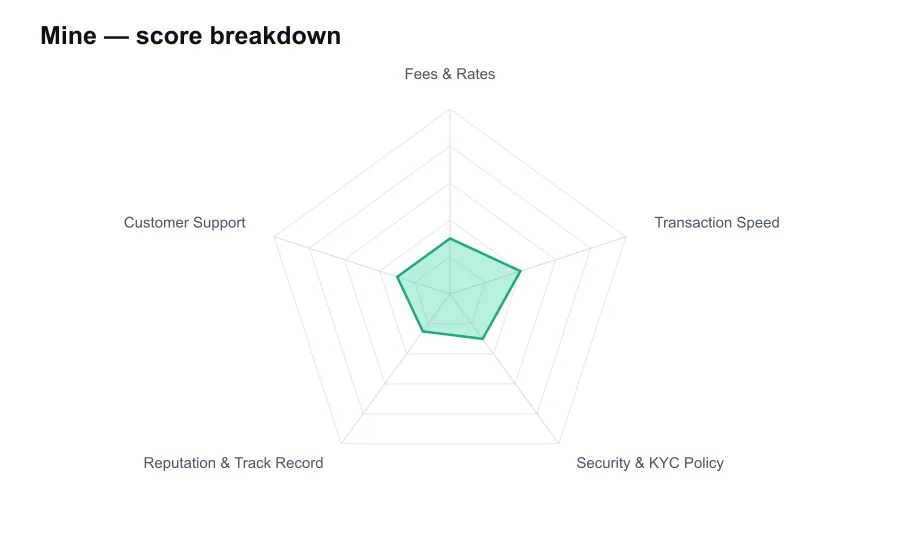
Mine scores 3.1/10 overall in our independent review, measured against every other provider we've compared, strongest on Transaction Speed (4.0/10) and weakest on Reputation & Track Record (2.5/10).
3.1/10 ★★★★★ How we score →| Best for | Not for |
|---|---|
| May offer a low-friction exchange experience | Provider identity requires extra verification |
| Potentially suitable for a small test transaction | Fee disclosure is not sufficiently clear |
Editorial independence: our scores and rankings are produced using the fixed criteria above and are not influenced by advertisers. This is an independent ranking site and is not operated by, or affiliated with, any provider we list.
Affiliate disclosure: some links on this page may earn us a commission at no extra cost to you. This does not affect our rankings.
In-Depth Review of Mine
Mine is a difficult provider to assess with confidence because the name itself is unusually broad and the public information associated with it is not as clear or stable as it should be for a financial service. That is not a minor branding problem. In crypto, where copycat sites, short-lived domains, and similarly named projects are common, a customer needs to know exactly which legal entity and website is handling a transaction. A platform called Mine starts from a disadvantage because users must do more verification before they can even establish that they are dealing with the intended service.
The service appears to sit in the smaller end of the exchange and payment market rather than alongside the major regulated trading venues. That can make it attractive to people who want fewer barriers and a less corporate experience. It can also mean less liquidity, thinner support coverage, and weaker transparency around who operates the platform. I would not infer quality from a polished homepage or a smooth registration process. Those are easy things to build. Durable custody processes, reliable settlement partners, and competent complaint handling are far harder to prove.
A sensible review of Mine has to begin with verification rather than features. Before depositing anything, users should confirm the exact official domain through a trustworthy source, inspect the company information shown in the terms, and make sure support contact details match the site. Search results alone are not enough. Sponsored links and similarly named services can lead people to an unrelated destination. If a provider cannot make its legal identity, operating jurisdiction, and customer contact route easy to establish, that is a serious consumer-risk signal.
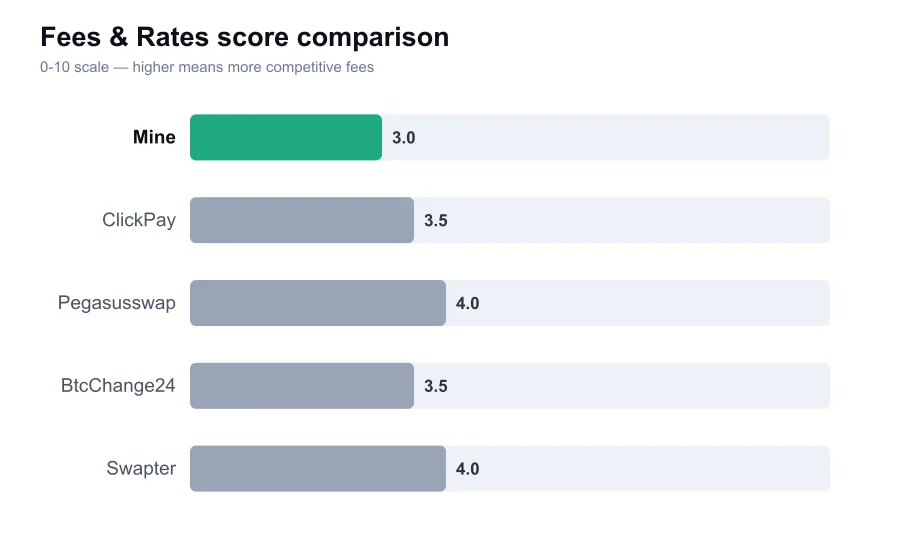
There is also not enough dependable public material to support precise claims about Mine's trading fees. That makes fee comparisons awkward. An exchange that does not publish a complete schedule may still be inexpensive, but the customer has no practical way to know without executing a test. The actual cost can be a visible commission, a spread inside the quoted price, a card-processing charge, a withdrawal fee, or some combination of all four. The last category is particularly important because withdrawing a small balance can become disproportionately expensive if fixed blockchain charges are applied.
Mine should therefore not be chosen because it appears cheap at the first screen. Compare the amount you pay, the amount you receive, and the actual market price at that exact moment. This is especially important for fiat purchases. Many smaller services promote a headline exchange rate while passing card costs or conversion costs into the final quote. A five percent gap may not sound catastrophic until it is repeated every month. Serious buyers should use an exchange with a published maker and taker table, clear withdrawal charges, and an order history that can be exported.
Speed is similarly hard to score well without a documented operating record. A provider can claim near-instant processing, but cryptocurrency settlement is never entirely under the platform's control. Bank transfers have their own timetable. Card purchases can be screened. Blockchain transfers require confirmations. Stablecoin routes can be fast, but only if the asset is sent on the intended network and the receiving wallet supports it. Mine may process normal orders promptly, but public evidence is too sparse to conclude that it handles volume spikes or unusual deposits reliably.
This uncertainty is more than theoretical. A delayed transaction at a well-known exchange is frustrating, but the user usually has established ticketing, public status updates, social-media channels, and documented escalation paths. At a lightly documented provider, a delay can turn into a guessing game. That is why I would never use Mine for rent money, an OTC settlement, a payment to a merchant with a strict deadline, or a transfer that depends on an immediate onward transaction. Crypto's irreversibility makes uncertainty costly.
Security is where the lack of disclosure becomes most problematic. Customers should be able to determine whether a provider holds assets, how account protection works, whether two-factor authentication is available, what it does with personal data, and how it responds to suspicious activity. If these answers are hard to find, the user is being asked to take a leap of faith. Mine does not have the public security reporting, major audit history, or institutional reputation that would make that leap sensible for large balances.
The KYC question needs particular care. Smaller crypto services are sometimes marketed to users who want light-touch onboarding, but no responsible customer should interpret that as a promise of anonymity or guaranteed instant completion. Financial-crime rules, payment-provider requirements, sanctions screening, and internal risk tools can lead to document requests at any point. If Mine offers low-friction onboarding for a routine transaction, that does not mean an atypical payment will avoid review. Read the terms first and assume that identity verification may be requested if the provider decides it needs it.
A weak public reputation is not the same as a bad reputation. Mine's issue is that it has not built enough independently verifiable history to belong in the same trust category as older exchanges. There is a meaningful difference between a platform with thousands of years of combined user feedback, regulator-facing documentation, and public incident reporting, and one where most available commentary is scattered, promotional, or difficult to authenticate. A publication should not fill that gap with optimism. The correct rating reflects the uncertainty.
Customer support is inseparable from that point. For a small platform, personal support can sometimes be excellent because a real person notices a problem quickly. But customers need evidence, not hope. Mine has not established a public record that lets me confidently say it resolves mistaken deposits, account access problems, or verification disputes consistently. Test support before funding the account. Ask a specific question about a deposit network, fee, or verification policy and judge the reply for clarity, speed, and whether it answers the question rather than sending generic promotional text.
There is a possible audience for Mine. A technically confident user who has independently verified the operator, wants to test a small transaction, and understands blockchain wallets may find the service adequate. That is a narrow recommendation. It does not extend to newcomers who need guidance, users who cannot absorb a delay, or people moving large amounts. Smaller services do not get a free pass merely because they are smaller. In fact, they need to be more transparent because customers have fewer external safeguards.
I would also avoid keeping any balance on Mine beyond what is required for an active transaction. This is sensible across the entire crypto market, but it is especially important where the custody model and security controls are not extensively documented. Self-custody has its own risks, including seed-phrase loss and phishing, yet it prevents a small provider's operational issues from becoming a total loss of access. If self-custody is not appropriate, a well-capitalized and heavily scrutinized custodian is the safer compromise.
Mine has not given me enough evidence to recommend it over recognizable alternatives. It may be functional, and a modest test can reveal whether its actual flow suits an individual user. But that is not the same as a positive endorsement. Pricing clarity, corporate transparency, support proof, and public reputation all need improvement before it can be considered a dependable primary exchange. For now, the right approach is verification first, a tiny test second, and a willingness to walk away if any essential detail remains unclear.
Score Breakdown
| Criterion | Score | Note |
|---|---|---|
| Fees & Rates | 3.0 | Insufficient clear public fee information for a confident cost assessment. |
| Transaction Speed | 4.0 | Processing reliability is difficult to verify from public evidence. |
| Security & KYC Policy | 3.0 | Limited public detail on custody, controls, and account protection. |
| Reputation & Track Record | 2.5 | The provider identity and independent track record need careful verification. |
| Customer Support | 3.0 | Test support before funding because escalation evidence is limited. |
Pros and Cons
| Pros | Cons |
|---|
How can I verify that I am using the real Mine service?
Confirm the exact domain, legal entity, terms, and support contacts before funding. Do not rely solely on search listings, ads, or a similar-looking brand name.
Are Mine's fees easy to calculate?
Not from a reliably complete public schedule. Check the final quote, all payment charges, and withdrawal cost before sending a transaction.
Should I leave crypto on Mine?
I would not leave a balance there beyond an active transaction. The public information available does not support treating it as a long-term custody solution.
Editorial independence: our scores and rankings are produced using the fixed criteria above and are not influenced by advertisers. This is an independent ranking site and is not operated by, or affiliated with, any provider we list.
Affiliate disclosure: some links on this page may earn us a commission at no extra cost to you. This does not affect our rankings.