Pegasusswap
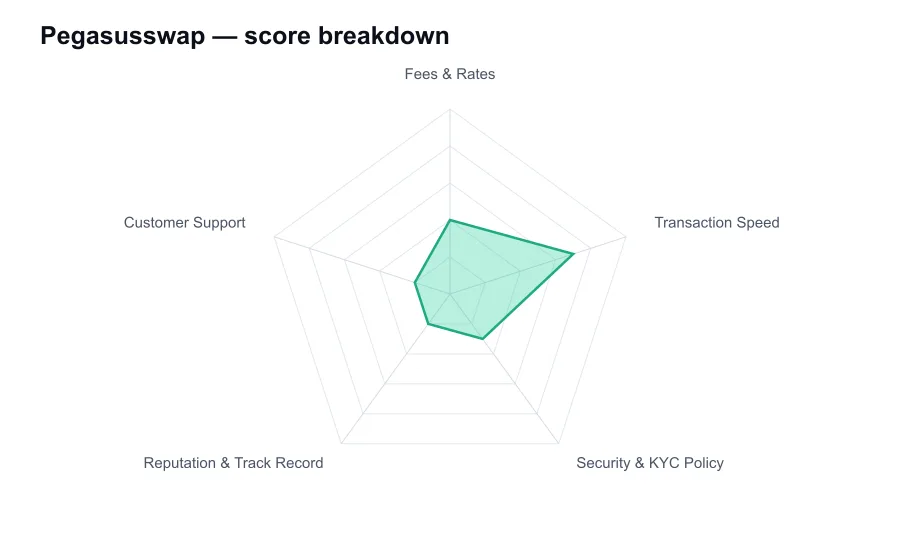
Pegasusswap scores 3.3/10 overall in our independent review, measured against every other provider we've compared, strongest on Transaction Speed (7.0/10) and weakest on Customer Support (2.0/10).
3.3/10 ★★★★★ How we score → Status: active (checked 2026-10-13T19:22:23.312Z)| Best for | Not for |
|---|---|
| Direct wallet-controlled swaps | Limited publicly verifiable security history |
| No conventional custodial account | Thin reputation compared with major DEXs |
Editorial independence: our scores and rankings are produced using the fixed criteria above and are not influenced by advertisers. This is an independent ranking site and is not operated by, or affiliated with, any provider we list.
Affiliate disclosure: some links on this page may earn us a commission at no extra cost to you. This does not affect our rankings.
What is Pegasusswap?
Pegasusswap is a decentralized exchange interface for swapping crypto assets through connected wallets and smart contracts. Users authorize each trade on-chain rather than depositing a balance with a centralized operator. That gives users custody control but also makes mistakes and unsafe approvals harder to recover from.
In-Depth Review of Pegasusswap
Pegasusswap is best understood as a decentralized exchange product rather than an instant-exchange broker or a centralized trading platform. A decentralized exchange, or DEX, uses smart contracts and liquidity pools to let users swap tokens directly from a connected wallet. That model changes the risk profile completely. There is no conventional account recovery desk, no customer-service agent who can reverse a mistaken transaction, and no promise that every token pool is safe.
The attraction is obvious for users already active in decentralized finance. You connect a compatible wallet, approve a token, select a pair, and sign the trade on-chain. Funds remain under your wallet's control until you authorize the contract interaction. That is a meaningful advantage over depositing coins with a small centralized company, but it shifts technical responsibility onto the user.
Pegasusswap has a much thinner public reputation than leading DEX brands such as Uniswap, PancakeSwap, or Curve. It does not have comparable levels of documented liquidity, developer attention, independent research, or long-term community scrutiny. That matters more on a DEX than many users realize. A swap interface may look simple, while the actual risks sit in contract permissions, liquidity quality, token contracts, and the team behind the deployment.
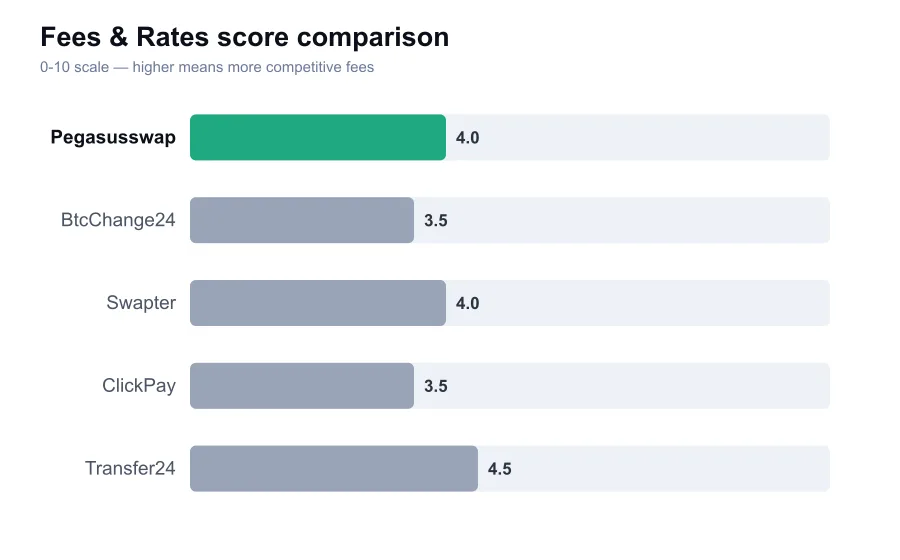
Fees on a DEX are never just one figure. A user may pay a liquidity-pool trading fee, network gas, price impact from limited pool depth, and possibly a token approval transaction before the first swap. On a low-cost chain, gas may be modest, but a poor pool can still make the trade expensive through slippage. Pegasusswap does not have enough transparent, independently verified fee documentation for me to treat its cost structure as especially clear.
The correct way to judge a Pegasusswap trade is to inspect the expected output, the price impact, and the minimum received after slippage before signing. Do not be distracted by a low network fee. If a pool is shallow, the loss from price impact can dwarf the gas charge. For a small swap in a deep, established pool, the cost may be acceptable. For a thin token pair, it can be brutal.
Transaction speed depends largely on the underlying chain rather than Pegasusswap's own infrastructure. A DEX trade can be submitted quickly and settle after network confirmation, which is often faster than waiting for an off-chain support process. Yet a fast confirmation is not the same as a good result. If market conditions move before inclusion, a transaction can fail because of slippage settings or execute at an unfavorable price within the user's permitted limit.
The strongest security feature of the DEX model is wallet custody. Pegasusswap does not need to hold a standing customer balance in the way a centralized exchange does. But smart-contract risk replaces custodial risk. If a contract contains a flaw, if an admin key is misused, or if a malicious token is approved, users can lose assets without the kind of recourse they might seek from a licensed company.
I could not verify a robust public audit history, detailed governance record, or mature security disclosure process for Pegasusswap. That alone makes it unsuitable for large sums. An audit, if one exists, would never be a guarantee anyway, but the absence of readily verifiable security material is a clear negative. Serious DeFi users should demand contract addresses, audit reports, clear ownership controls, and active developer communications.
Token risk is especially high on lesser-known DEX interfaces. A token name and logo are not proof that the asset is authentic. Scammers commonly create copies of popular tokens, seed a pool, and rely on users selecting the wrong contract. Even a legitimate token can have transfer taxes, blacklists, or selling restrictions that make it dangerous to trade. Pegasusswap cannot be separated from those on-chain risks.
KYC generally is not part of the normal DEX wallet-connection flow. That may appeal to privacy-focused users, but it also means responsibility for lawful use, tax reporting, and wallet security stays entirely with the user. No-KYC does not mean risk-free or consequence-free. It means there is less identity friction and much less room for human intervention if something goes wrong.
Reputation is Pegasusswap's weakest area. There is little basis for putting it in the same trust category as established decentralized exchanges with huge public usage and years of contract scrutiny. Smaller DEX projects sometimes serve a narrow community well, but they also face a higher risk of abandoned development, low liquidity, weak governance, or incomplete support.
Customer support should not be a deciding reason to use a DEX like this. At best, community channels may help explain an interface problem. They cannot reverse an approved transaction or recover funds sent to the wrong address. Anyone who needs helpdesk-level protection should use a regulated centralized exchange or a payment service, not an obscure automated market maker.
Pegasusswap may be useful for an advanced user who has independently verified the contract, the token, and the pool liquidity, then wants to make a small on-chain trade. That is a narrow use case. It is not a suitable first DeFi experience, and it is not where I would route a substantial position just because the interface promises a favorable rate.
My verdict is cautious to the point of skepticism. The decentralized model has real benefits, particularly direct wallet control and rapid on-chain settlement. Pegasusswap lacks the public depth, security transparency, and reputation needed to offset the added smart-contract and liquidity risks. Use established DEXs unless Pegasusswap offers a specific, independently verified pool you genuinely need.
Score Breakdown
| Criterion | Score | Note |
|---|---|---|
| Fees & Rates | 4.0 | Pool costs and price impact are not sufficiently transparent. |
| Transaction Speed | 7.0 | On-chain swaps can settle quickly, subject to network confirmation. |
| Security & KYC Policy | 3.0 | Wallet custody helps, but public audit and contract detail are limited. |
| Reputation & Track Record | 2.0 | Far less established than major decentralized exchanges. |
| Customer Support | 2.0 | DEX transactions are irreversible and support has limited power. |
Key Facts
| Fact | Value | Source |
|---|---|---|
| Service model | Decentralized exchange | - |
| Custody model | User wallet controls transaction signing | - |
| Trade execution | On-chain smart-contract swap | - |
| Account model | Wallet connection rather than account | - |
| Transaction reversal | Not generally possible after confirmation | - |
Pros and Cons
| Pros | Cons |
|---|
How Pegasusswap Works
- Connect a compatible self-custody wallet
- Verify the official token and contract details
- Choose the swap pair and enter an amount
- Review price impact, slippage, and minimum received
- Approve the token allowance if required
- Sign the swap transaction in your wallet
- Confirm the received asset after blockchain settlement
KYC
| Requirement | none |
|---|---|
| Notes | A standard DEX wallet-connection flow does not generally use a conventional account-registration or KYC process. Users remain responsible for compliance and tax obligations. |
How to Use Pegasusswap Safely
- Use the verified official contract and interface
- Check token contract addresses, not names or logos
- Inspect price impact and minimum received before signing
- Set limited token approvals where possible
- Use a separate wallet and a small test swap first
- Revoke unused token allowances after trading
Is Pegasusswap a centralized exchange?
No. Pegasusswap is classified as a decentralized exchange, where users connect a wallet and sign on-chain transactions rather than deposit funds into a traditional exchange account.
Can Pegasusswap reverse a swap I approved?
No. Blockchain swaps are generally irreversible once confirmed. A DEX support channel cannot reverse a transaction signed and broadcast from your wallet.
Why can a low-gas swap still be expensive?
Price impact and slippage in a shallow liquidity pool can cost more than the network fee. Check the minimum received and price impact before signing.
Do I need KYC to connect a wallet to Pegasusswap?
A normal decentralized wallet-connection flow does not generally require conventional account KYC. You remain responsible for lawful use and record keeping.
What is the main Pegasusswap risk for a new user?
The main risk is signing an interaction with an unverified token or contract without understanding approvals, liquidity, price impact, or whether the token can be sold.
Should I grant unlimited token approval?
No. Use a limited approval where your wallet permits it, and periodically revoke unused token allowances. Unlimited approvals increase loss exposure if a contract is compromised.
Editorial independence: our scores and rankings are produced using the fixed criteria above and are not influenced by advertisers. This is an independent ranking site and is not operated by, or affiliated with, any provider we list.
Affiliate disclosure: some links on this page may earn us a commission at no extra cost to you. This does not affect our rankings.