ClickPay
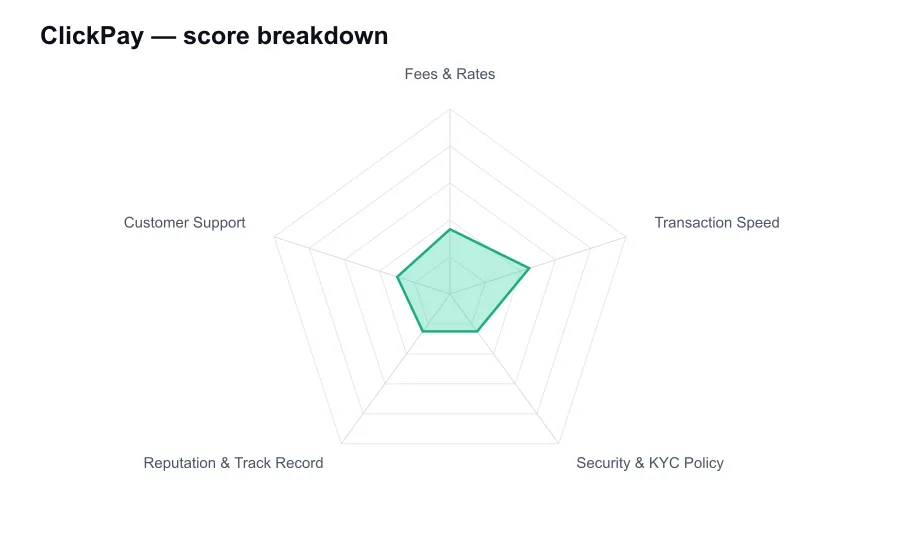
ClickPay scores 3.0/10 overall in our independent review, measured against every other provider we've compared, strongest on Transaction Speed (4.5/10) and weakest on Reputation & Track Record (2.5/10).
3.0/10 ★★★★★ How we score → Status: active (checked 2026-10-13T19:47:48.745Z)| Best for | Not for |
|---|---|
| May support payment-oriented use cases | ClickPay is an ambiguous provider name |
| Potentially simple checkout-style flow | No verified universal fee schedule |
Editorial independence: our scores and rankings are produced using the fixed criteria above and are not influenced by advertisers. This is an independent ranking site and is not operated by, or affiliated with, any provider we list.
Affiliate disclosure: some links on this page may earn us a commission at no extra cost to you. This does not affect our rankings.
What is ClickPay?
ClickPay is a payment-oriented name used by multiple businesses, so users must identify the exact service before treating it as a crypto or exchange provider. A verified ClickPay product may facilitate payments or conversions, but it should not be assumed to be a full crypto exchange.
In-Depth Review of ClickPay
ClickPay is a difficult name to assess because it is used by multiple payment-related businesses, and a name alone does not establish a single crypto exchange operator. For a prospective customer, that ambiguity is not a trivial branding issue. It is a due-diligence problem. Before sending money or cryptocurrency, users need to verify the exact domain, legal entity, payment instructions, and support channel for the ClickPay service they intend to use.
Assuming the relevant service is an online payment and exchange provider, it belongs closer to a payment intermediary than to a full centralized crypto exchange. It may facilitate a purchase, sale, transfer, or conversion, but it should not be evaluated as if it offered the market structure, reserves reporting, liquidity, or regulatory visibility of a major exchange. Its usefulness depends almost entirely on the particular payment route and the entity behind it.
That is why I cannot give ClickPay a generous reputation score. Brand ambiguity creates opportunities for user confusion, copied websites, impersonation, and accidental interaction with an unrelated business. A service handling financial transfers should make its legal name, terms, jurisdiction, and official contact channels easy to verify. If those basics are unclear, the customer is being asked to take too much on faith.
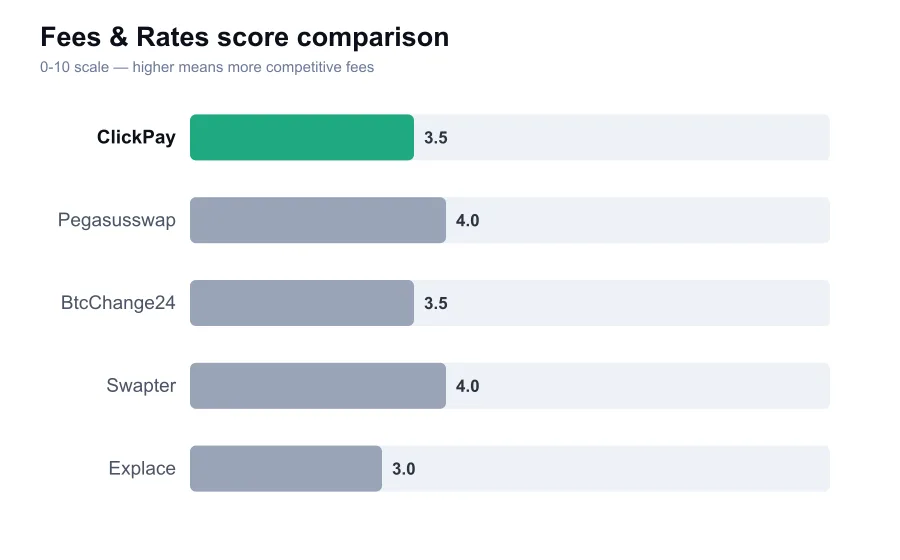
Fees are also hard to score confidently without a verified official fee page for the exact ClickPay entity. Payment providers often make revenue from a mix of merchant fees, card charges, foreign-exchange spreads, withdrawal fees, and route-specific conversion margins. A crypto conversion can have a visible service fee and still contain a weak exchange rate. Conversely, a zero-fee payment claim may exclude bank, card, or blockchain costs.
For that reason, the only sensible way to evaluate a ClickPay quote is by the amount delivered to the recipient. Do not compare a percentage in isolation. Calculate how much cash, stablecoin, Bitcoin, or other asset reaches the destination after every charge. If the provider cannot present the final amount before payment, or leaves material fees undefined, walk away. Financial products do not earn trust by requiring customers to discover their price after funds have moved.
Transaction speed is equally route specific. A card authorization may happen quickly, but settlement can take longer. A bank transfer can be initiated instantly yet arrive next business day or later. A crypto transfer can leave an address quickly and remain unconfirmed during network congestion. ClickPay should be judged by whether it gives clear status updates and realistic processing windows, not by a vague promise of fast payments.
Security is the most serious concern. A payment service can be technically functional while still providing inadequate protection against phishing, account takeover, recipient fraud, and payment disputes. I could not independently verify public evidence of ClickPay's security architecture, external audits, custody arrangements, penetration-test results, or customer-fund protections for a specific crypto product. That lack of confirmation is enough to rule it out for any substantial balance.
Users should be particularly wary if ClickPay asks them to send crypto to an address supplied in a chat message, through social media, or by email without an authenticated order page. Crypto transfers are generally irreversible. A legitimate provider should have a secure order flow, a clear explanation of the receiving entity, and written terms. It should not rely on urgency, private messages, or changing wallet addresses.
KYC policies can be another source of friction. Payment providers are often required to perform identity checks, even if their marketing initially focuses on ease of use. A customer should expect that a card payment, cross-border transaction, larger order, or unusual activity can trigger verification. The important question is whether the provider discloses that possibility in advance and states how it handles a rejected verification review or a failed payout.
Support deserves a low score because there is no strong public basis for expecting a mature support operation from an ambiguously identified provider. In payments, a support team has to do more than answer basic questions. It must investigate recipient details, duplicate payments, blockchain hashes, chargebacks, compliance holds, and refund paths. If you cannot reach a verified support channel before funding, do not create a large transaction in the hope that assistance will appear later.
ClickPay could still serve a legitimate narrow purpose if a known merchant, employer, or counterparty directs you to a verified ClickPay payment page and the exact provider is clearly identified. That is a different situation from discovering an exchange offer through a forum or an ad. Context matters. A payment link from a trusted merchant with matching legal and domain information carries less risk than an unsolicited exchange proposal.
It is not a sensible platform for holding crypto or using as a primary on-ramp. The customer has too little verified information about custody, assets, networks, fees, and withdrawal procedures. Even if an individual payment goes through smoothly, that does not answer the questions that matter for repeat use. A successful first transaction is evidence of execution, not evidence of strong governance.
Anyone considering ClickPay should independently locate the official domain rather than following an ad or direct-message link. Then verify the payment recipient, compare the displayed price with alternatives, and start with a small amount. Check whether the page names the token and blockchain precisely. USDT on TRON, Ethereum, BNB Smart Chain, and other networks is not interchangeable.
My assessment is blunt. ClickPay's identifiable weakness is not merely that it is small. It is that the name does not by itself provide enough certainty about the specific service being reviewed. Until the exact operator and terms are verified, it should be treated as a high-caution payment intermediary. Use it only in a verified, limited context, and choose a clearly regulated exchange for recurring crypto activity.
Score Breakdown
| Criterion | Score | Note |
|---|---|---|
| Fees & Rates | 3.5 | Verified route-by-route pricing is hard to establish. |
| Transaction Speed | 4.5 | Settlement depends on card, bank, or blockchain rail. |
| Security & KYC Policy | 2.5 | Do not assume controls without verified operator details. |
| Reputation & Track Record | 2.5 | Name ambiguity makes operator verification essential. |
| Customer Support | 3.0 | Verify a real support channel before transacting. |
Key Facts
| Fact | Value | Source |
|---|---|---|
| Brand identification | Exact operator must be verified | - |
| Service category | Payment-oriented intermediary | - |
| Custody recommendation | Do not hold material balances | - |
| Pricing check | Compare final delivered amount | - |
| Payment risk | Recipient and domain verification required | - |
Pros and Cons
| Pros | Cons |
|---|
How ClickPay Works
- Independently verify the exact ClickPay domain and operator
- Confirm the merchant or recipient details
- Review the final amount, currency, token, and network
- Complete required payment or identity checks
- Save the payment confirmation and transaction details
- Confirm receipt with the destination account or wallet
KYC
| Requirement | tiered |
|---|---|
| Notes | Payment and crypto services may request verification based on transaction type, amount, payment method, or compliance review. Confirm policies with the identified operator. |
How to Use ClickPay Safely
- Do not follow payment links from unsolicited messages
- Verify the exact website domain independently
- Confirm the legal recipient before paying
- Check token contract and network details
- Use a small amount for a first verified payment
- Never use it as a long-term crypto wallet
Why is the ClickPay name a concern?
The name is used by more than one payment-related business. Verify the exact domain, legal entity, and recipient before sending funds or crypto.
Should I trust a ClickPay link sent through chat?
No. Independently find the official site and compare the domain. Do not send crypto to an address supplied only through chat or social media.
Can a card payment be fast but settlement slow?
Yes. Card authorization and final settlement are different stages. Bank, card, and blockchain rails can each introduce delays.
How do I evaluate a ClickPay conversion price?
Use the final amount received, including all card, bank, network, and exchange-rate charges. A stated percentage alone is not enough.
Should ClickPay hold my crypto?
No. There is insufficient verified public evidence of custody arrangements or customer-fund protections to justify holding a meaningful balance there.
What details should a legitimate payment page show?
Look for the legal operator, secure domain, recipient details, clear amount, currency or token, network where relevant, refund terms, and support contact.
Editorial independence: our scores and rankings are produced using the fixed criteria above and are not influenced by advertisers. This is an independent ranking site and is not operated by, or affiliated with, any provider we list.
Affiliate disclosure: some links on this page may earn us a commission at no extra cost to you. This does not affect our rankings.