ETZ
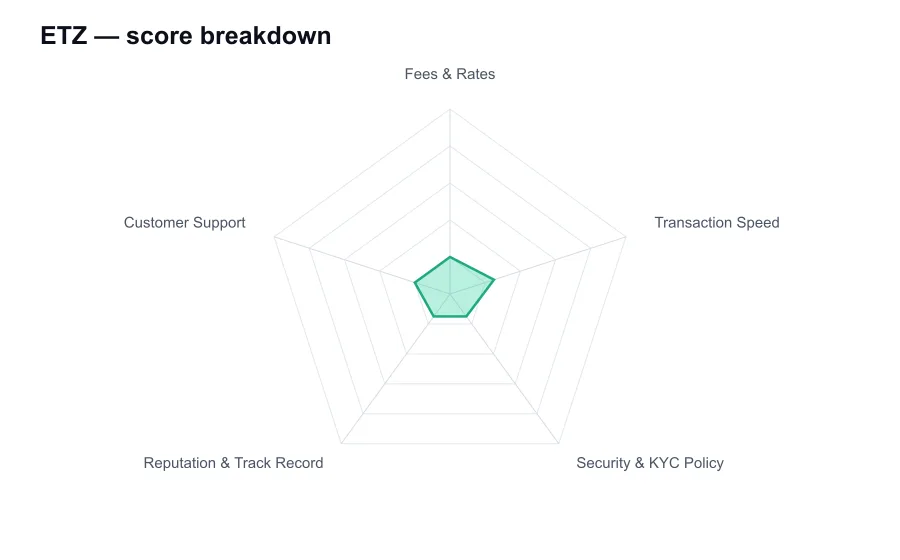
ETZ scores 1.8/10 overall in our independent review, measured against every other provider we've compared, strongest on Transaction Speed (2.5/10) and weakest on Reputation & Track Record (1.5/10).
1.8/10 ★★★★★ How we score → Status: active (checked 2026-10-13T19:36:51.928Z)| Best for | Not for |
|---|---|
| A simple exchange concept may appeal to small test transactions | Operating entity is not clearly verifiable |
| No established evidence of complex trading fees | No dependable public fee documentation |
Editorial independence: our scores and rankings are produced using the fixed criteria above and are not influenced by advertisers. This is an independent ranking site and is not operated by, or affiliated with, any provider we list.
Affiliate disclosure: some links on this page may earn us a commission at no extra cost to you. This does not affect our rankings.
What is ETZ?
ETZ is presented as a crypto exchange provider, but publicly verifiable information about the exact operating business is limited. Prospective users should treat it as a high-uncertainty custodial service until its operator, terms, fees, and security controls can be independently confirmed.
In-Depth Review of ETZ
ETZ is a difficult provider to place with confidence because the name is used by more than one crypto-related project and there is little durable, independently verifiable public material tying a clearly identified operating company to a well documented retail exchange service. That is not a minor research inconvenience. For somebody deciding where to send digital assets, it is a serious warning sign. A brand can have a functioning website and still fail the basic test of accountability.
The first problem is identity. A credible exchange normally makes it easy to establish who runs it, where it is incorporated, which entity accepts customer funds, and how users can contact that entity beyond a web form. ETZ has not built the public record expected from a serious exchange. I could not confidently verify a legal operator, a dependable official fee schedule, or a substantial history of third party reporting about operations.
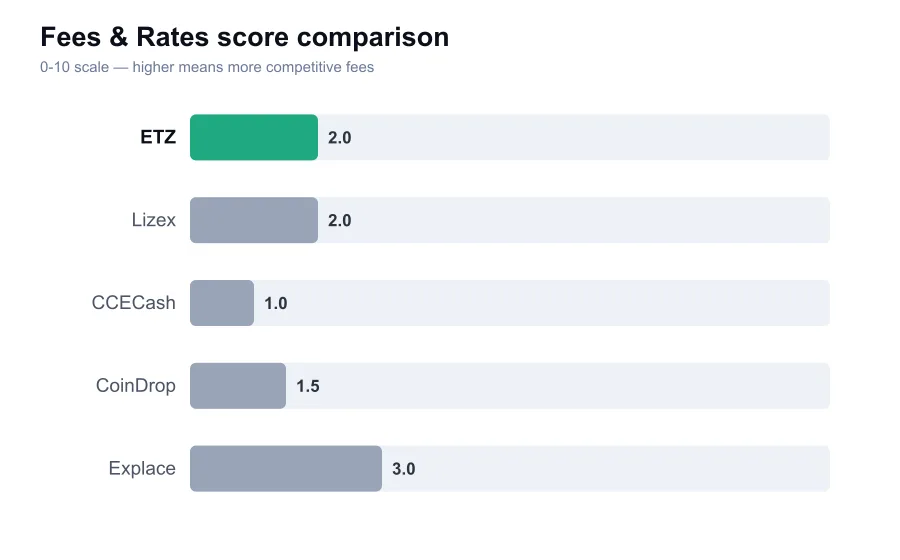
That makes a conventional fee comparison almost impossible. With Binance, Kraken, Coinbase, or even a smaller instant swap service, a user can inspect published spreads, trading charges, withdrawal costs, and network-fee treatment before sending funds. ETZ does not offer that level of clarity in material that can be independently checked. If a service cannot state its price in a way a customer can retain and compare, the apparent exchange rate has very limited meaning.
A quoted swap rate can look attractive while hiding a large spread. This is particularly common with lightly documented crypto sites. The customer sees the amount they will receive, but has no practical benchmark for the provider's markup, no historical fee table, and no assurance that the quote will survive a market move. That is a poor setup for newcomers, who may mistake a simple interface for a cheap one.
Speed is equally hard to judge responsibly. There is no sufficiently established body of customer evidence showing how quickly ETZ processes deposits, trades, swaps, or withdrawals under routine conditions and under stress. A provider can claim instant execution, but blockchain settlement is only one part of the process. The real test is whether the platform credits deposits correctly, honors quoted transactions, and releases outgoing funds without unexplained review delays.
The absence of reliable operational evidence matters most during a dispute. A transfer that takes ten minutes is ordinary. A transfer that remains unresolved for days while the provider offers no case reference, no status page, and no identifiable escalation route is an entirely different experience. I would not assume ETZ has poor execution simply because public evidence is thin. I would say the evidence is far too thin to give it credit for fast execution.
Security disclosures are also below the standard I would expect before recommending a custodial service. I could not verify public details about custody architecture, cold-storage practice, proof of reserves, security audits, insurance arrangements, penetration testing, or a bug bounty. None of those measures guarantees safety by itself. Their absence from public documentation makes it impossible to judge whether ETZ is protecting users competently or merely asking them to trust a black box.
KYC policy needs the same scrutiny. A legitimate service should say when identity checks are required, what documents are accepted, who handles the data, and what can trigger an enhanced review. Vague promises of privacy are not enough. Neither are vague promises of compliance. Users need to know whether a withdrawal can be paused after deposit because the provider suddenly requests identity documents or source-of-funds evidence.
ETZ does not have the sort of long operating record that makes uncertainty easier to tolerate. A relatively new provider can earn trust, but it needs to compensate with unusually good transparency, responsive support, visible leadership, and clear legal documentation. This brand has not established that package publicly. It should not be discussed in the same category as exchanges with years of incident reporting, customer feedback, and regulatory filings.
Reputation is built from more than marketing claims. I look for a coherent archive of product updates, well sourced press coverage, candid communication around outages, and customer reports that are specific enough to evaluate. ETZ has a limited public footprint by those measures. That does not prove misconduct, but it means a prospective user has very little evidence to rely on if something goes wrong.
Support is the point where obscure providers often fail first. Before using ETZ, a careful customer should test every published contact route with a basic question and judge the response. Ask about the legal entity, fee calculation, supported network, cancellation rules, and withdrawal review process. A fast, specific reply from a traceable support team is the minimum. A generic response or silence should end the experiment.
Do not use a large transfer to test an unknown service. If someone is determined to try ETZ, a small amount that they can afford to lose is the only rational starting point. Confirm the destination address, preserve screenshots of the quote and transaction ID, and wait for a completed withdrawal before considering another transaction. Never leave a standing balance with a provider that has not earned custodial trust.
There are better choices for nearly every common use case. Major centralized exchanges offer deeper liquidity, transparent trading fees, security controls, and a real support trail. Established noncustodial swap providers may suit users who value simple conversions, although their spreads should still be checked. ETZ's lack of verifiable detail is not a trade-off that produces a clear user benefit.
My view is blunt. ETZ has not supplied enough independently checkable information to justify a positive recommendation for buying, selling, holding, or swapping meaningful amounts of cryptocurrency. The problem is not that every smaller company needs a famous name. The problem is that customers need facts before they hand over irreversible assets. Until ETZ can show a transparent operator, reliable terms, auditable security practices, and a sustained support record, caution should be the default.
Score Breakdown
| Criterion | Score | Note |
|---|---|---|
| Fees & Rates | 2.0 | No reliably verifiable public fee schedule. |
| Transaction Speed | 2.5 | Too little credible execution evidence. |
| Security & KYC Policy | 1.5 | Custody and KYC disclosures are unclear. |
| Reputation & Track Record | 1.5 | Limited independently verifiable track record. |
| Customer Support | 2.0 | Support quality cannot be established confidently. |
Key Facts
| Fact | Value | Source |
|---|---|---|
| Public fee schedule | Not reliably verifiable | - |
| Legal operator | Not clearly verifiable | - |
| Custody disclosures | Not independently verifiable | - |
| KYC policy | Not clearly documented | - |
| Public track record | Limited verifiable evidence | - |
Pros and Cons
| Pros | Cons |
|---|
How ETZ Works
- Verify the current operator and terms before registering
- Check the quoted rate and every disclosed fee
- Send only a small test amount to any generated address
- Confirm receipt and withdrawal to a wallet you control
- Keep screenshots and transaction IDs for any dispute
KYC
| Requirement | tiered |
|---|---|
| Notes | The publicly verifiable policy is unclear. Assume identity or source-of-funds checks may be requested before a withdrawal is completed. |
How to Use ETZ Safely
- Do not deposit more than you can afford to lose
- Test support before sending crypto
- Save quotes, receipts, and transaction IDs
- Use a wallet you control for withdrawal testing
- Never reuse a deposit address without confirmation
Is ETZ a well established crypto exchange?
I could not verify the kind of long, independently documented operating history associated with established exchanges such as Kraken or Coinbase.
What fees does ETZ charge?
A dependable public fee schedule could not be verified. Do not send funds until you can see the final rate, provider fee, network fee, and amount received.
Does ETZ require KYC?
Its identity-check policy is not sufficiently clear in verifiable public documentation. Ask whether checks can be requested after a deposit before using it.
Can I safely hold crypto on ETZ?
I would not hold funds there. Public information about custody, audits, reserves, and insurance is too limited to assess custodial risk.
How should I test ETZ?
Use only a very small amount, save the quote and transaction ID, then confirm a successful withdrawal to a wallet you control before doing more.
Editorial independence: our scores and rankings are produced using the fixed criteria above and are not influenced by advertisers. This is an independent ranking site and is not operated by, or affiliated with, any provider we list.
Affiliate disclosure: some links on this page may earn us a commission at no extra cost to you. This does not affect our rankings.