Acechange
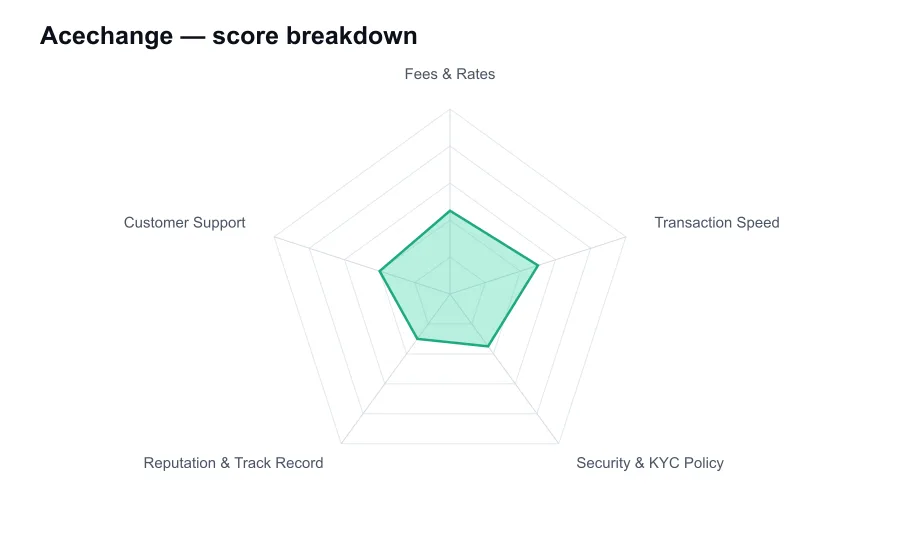
Acechange scores 4.0/10 overall in our independent review, measured against every other provider we've compared, strongest on Transaction Speed (5.0/10) and weakest on Reputation & Track Record (3.0/10).
4.0/10 ★★★★★ How we score →| Best for | Not for |
|---|---|
| Simple swap-focused interface | Limited public operating history |
| No full trading account for basic use | Fee and liquidity routing transparency is weak |
Editorial independence: our scores and rankings are produced using the fixed criteria above and are not influenced by advertisers. This is an independent ranking site and is not operated by, or affiliated with, any provider we list.
Affiliate disclosure: some links on this page may earn us a commission at no extra cost to you. This does not affect our rankings.
In-Depth Review of Acechange
Acechange presents itself as a quick crypto swap service for people who want to exchange assets without opening a full trading account. That puts it in the same broad category as instant exchangers such as ChangeNOW, SimpleSwap, FixedFloat, and StealthEX, rather than in direct competition with deep order-book venues like Kraken or Coinbase. The appeal is obvious: pick two coins, send funds, and receive the destination asset. The problem is that the brand has far less public history and third-party scrutiny than the larger names in this category.
The site experience is built around simplicity, not sophisticated trading. There is no charting package, no resting limit order system, no margin market, and no meaningful portfolio tooling. For a user who simply needs to convert one self-custodied asset into another, that can be refreshing. For anyone who trades regularly, it is a limitation. Acechange looks like a utility, not a marketplace where you can establish price, inspect liquidity, or manage execution carefully.
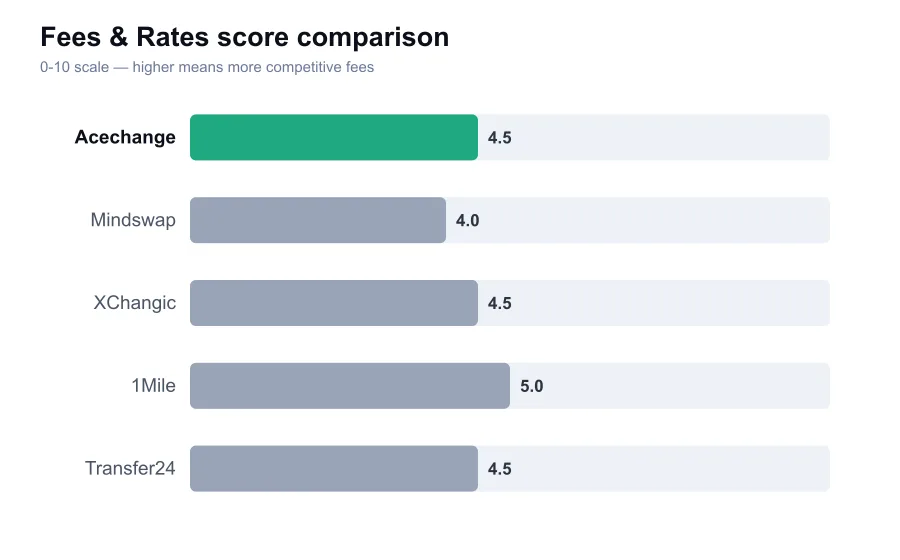
Its pricing needs to be approached with more caution than the clean swap screen suggests. Instant-exchange services commonly build their revenue into the quoted conversion rate, network charge, partner liquidity cost, or all three. Acechange does not have the kind of exhaustive, easy-to-audit fee schedule that an experienced trader expects from a major centralized exchange. That means the quote, not a headline claim of low fees, is what matters.
A floating-rate swap can look cheap at the point of submission and still settle worse than expected if the market moves while deposits are confirming. That is normal for this business model, but it matters more on a smaller service where there is little transparency about the exact liquidity route. Compare the final amount against at least two established alternatives before sending funds. If Acechange is materially worse, there is no reason to pay a premium for a smaller name.
Fixed-rate options, where available, can be useful for users transferring a meaningful amount or paying an invoice in another asset. The catch is that fixed quotes often carry a wider spread because the provider is taking execution risk. A quote is only genuinely competitive if it remains attractive after network fees and the destination amount are considered. I would not use a first transaction with Acechange for a large BTC, ETH, or stablecoin conversion merely because the initial number looked convenient.
Speed is also more conditional than the marketing language around instant swaps implies. Blockchain confirmation time comes first, then any risk screening, then the provider's liquidity execution, and finally the outbound transaction. A straightforward transfer involving commonly supported networks can complete in minutes. Bitcoin deposits, congested Ethereum transactions, and any order that needs manual review can take considerably longer. No swap service can honestly guarantee a clock time across every chain.
Acechange's real weakness is the limited body of independently verifiable operating history. Established competitors have years of public user reports, policy documentation, incident discussion, and business visibility. With Acechange, the information trail is thinner. That does not prove misconduct, but it absolutely changes the risk calculation. In crypto, a lack of reliable public evidence should never be mistaken for a clean record.
The custody model is another issue to understand clearly. A non-custodial-style swap interface does not mean the service never controls funds. Once you send assets to a deposit address, the provider or its liquidity counterpart generally has operational control until the swap is completed and the payout is sent. That is less exposure than parking funds on an exchange indefinitely, but it is still counterparty risk during the transaction window.
Know-your-customer requirements appear to be risk-based rather than universally imposed at the start of every transaction. That is common among instant exchangers. A swap may proceed without account creation, but compliance checks can still be triggered by transaction size, wallet-risk signals, sanctions screening, inconsistent details, or requests from a liquidity partner. Anyone who assumes no sign-up means no possible verification is setting themselves up for an unpleasant surprise.
That policy creates the worst-case scenario familiar to this sector: funds can be paused while the customer is asked to provide identity documents or proof of source of funds. A legitimate compliance process is not itself a red flag. The concern is whether timelines, escalation options, privacy handling, and refund conditions are clearly explained before a user deposits. Acechange does not inspire the same confidence here as a regulated exchange with published compliance procedures and a large support operation.
Security claims are only as useful as the evidence behind them. I could not find the sort of detailed public security architecture, independent audit trail, proof-of-reserves reporting, or mature incident disclosure that would justify a high score. That is not unusual for a small swap broker, but it should affect position sizing. Use a fresh receiving address, verify the asset network twice, save the order ID and transaction hash, and test with a small amount first.
Customer support appears to center on web-based contact channels rather than the extensive live-service infrastructure offered by major exchanges. That can be adequate for a simple completed order. It is much less reassuring if a deposit has the wrong memo, a network is paused, or compliance flags a transaction. A support team is tested by exceptions, not by swaps that complete normally, and there is not enough dependable public evidence to give Acechange much credit on that front.
Reputation is where Acechange most clearly trails the market leaders. It does not have the recognizable longevity of Changelly, the broad user footprint of ChangeNOW, or the institutional credibility of a regulated exchange. New or lesser-known services can be perfectly functional, but a customer should not donate trust merely because a polished website exists. The burden of proof rests with the platform, particularly when handling irreversible crypto transfers.
My view is blunt: Acechange may be usable for a small, routine conversion after you have compared its live quote and tested the path, but it has not earned a role as a primary exchange provider. Keep the amount modest, avoid time-sensitive large transfers, and do not send funds you cannot afford to have delayed. Traders seeking transparent fees, deeper liquidity, or strong recourse should choose a larger exchange. Privacy-focused users should also read the verification terms carefully rather than relying on the word no-KYC.
Score Breakdown
| Criterion | Score | Note |
|---|---|---|
| Fees & Rates | 4.5 | Quotes may include spread and routing costs |
| Transaction Speed | 5.0 | Simple swaps can be quick, exceptions may delay |
| Security & KYC Policy | 3.5 | Limited independently verifiable security detail |
| Reputation & Track Record | 3.0 | Thin public track record versus established rivals |
| Customer Support | 4.0 | Support footprint appears limited |
Pros and Cons
| Pros | Cons |
|---|
Does Acechange require KYC?
It appears to use a risk-based approach. A transaction may not require an account at the start, but compliance checks and identity requests can still occur for flagged or higher-risk activity.
Are Acechange fees fixed?
The effective cost is best judged from the live destination quote. Instant swap services can include spread, network costs, and liquidity-provider charges in the rate.
Should I use Acechange for a large transfer?
I would not make it a first choice for a large or time-sensitive transfer. Test a small amount first and use a more established venue for significant value.
Editorial independence: our scores and rankings are produced using the fixed criteria above and are not influenced by advertisers. This is an independent ranking site and is not operated by, or affiliated with, any provider we list.
Affiliate disclosure: some links on this page may earn us a commission at no extra cost to you. This does not affect our rankings.