XChangic
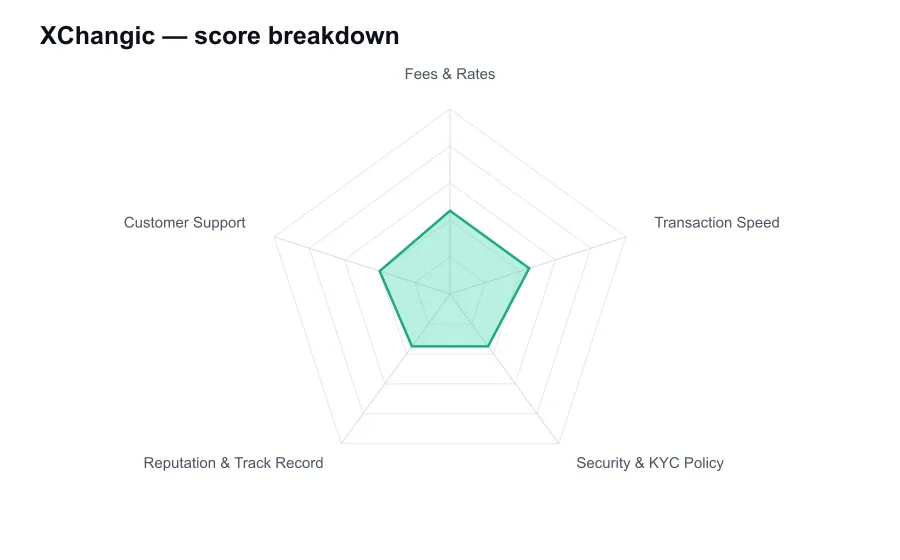
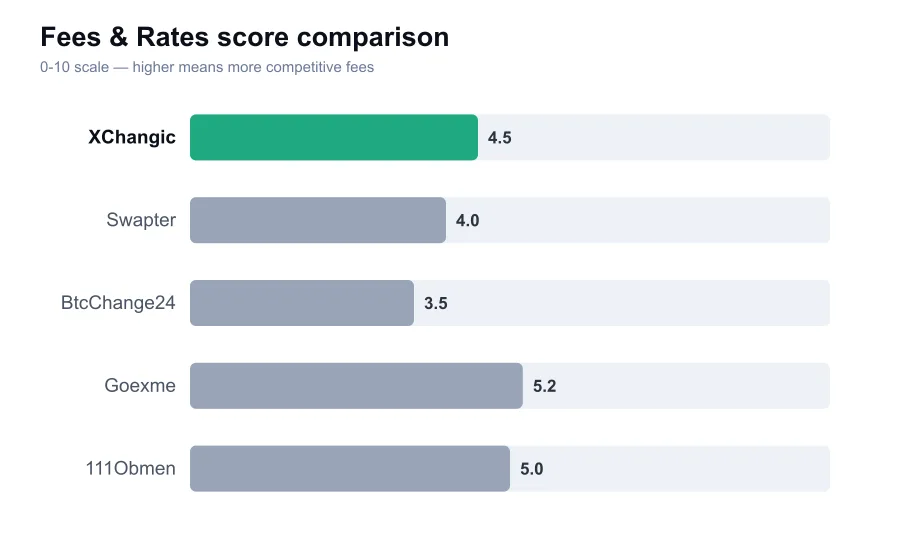
XChangic scores 3.9/10 overall in our independent review, measured against every other provider we've compared, strongest on Fees & Rates (4.5/10) and weakest on Reputation & Track Record (3.5/10).
3.9/10 ★★★★★ How we score → Status: active (checked 2026-10-13T19:49:57.488Z)| Best for | Not for |
|---|---|
| Simple order-based exchange flow | No independently verified fee schedule |
| May suit small one-off conversions | Thin publicly auditable track record |
Editorial independence: our scores and rankings are produced using the fixed criteria above and are not influenced by advertisers. This is an independent ranking site and is not operated by, or affiliated with, any provider we list.
Affiliate disclosure: some links on this page may earn us a commission at no extra cost to you. This does not affect our rankings.
What is XChangic?
XChangic is an instant crypto exchange service that appears to process one-off conversion orders rather than operate a conventional trading exchange. Users typically select an exchange direction, fund a generated order, and receive the payout at a destination address. Its public documentation and independently auditable operating record appear limited.
In-Depth Review of XChangic
XChangic appears to operate as a small instant exchange service aimed at users who want to convert crypto or electronic payment balances without opening an account at a large centralized exchange. It sits in the familiar Russian language exchanger category, where the transaction is built around a one-off order, a deposit address, and a payout destination. That model can be convenient. It also demands more caution than a household-name exchange.
The first problem is not necessarily that XChangic is unsafe. The problem is that there is too little independently verifiable public material to give it the benefit of the doubt. Small exchangers can work perfectly well for years, but a buyer cannot reasonably treat a thin public record as proof of strong operations. Trust needs evidence, and XChangic does not present enough of it in an easily auditable form.
Its likely appeal is simplicity. A visitor picks a direction, enters an amount, supplies a receiving address or payment details, and funds the order. There is no trading terminal to learn, no order book, and generally no need to move money through a personal exchange wallet first. For a small conversion, that is a cleaner route than registering at Binance, Bybit, or Kraken just to make one exchange.
That convenience should not be confused with low cost. Instant exchangers rarely charge a neat, universal percentage that can be compared line by line. Their real charge is normally embedded in the quoted conversion rate. A rate can look reasonable until it is compared with the mid-market price and the destination network fee. XChangic does not have the kind of independently documented fee schedule that lets a reviewer calculate its true spread in advance.
That makes rate shopping essential. Before sending funds, compare the exact delivered amount with several established instant-exchange competitors and at least one large exchange's spot price plus withdrawal fee. A difference of one or two percent can matter far more than a small visible network charge. If XChangic's quote is materially worse, there is no reason to pay a premium simply for an interface that offers little additional protection.
Speed is similarly hard to score generously without a published operational standard. The mechanical part of a crypto swap can be quick after the incoming transaction has enough confirmations. The difficult part is the human element: payment checking, manual review, wallet liquidity, and an operator's response if a transaction is underpaid or sent on the wrong network. Those are the moments that separate a polished exchanger from a fragile one.
For an uncomplicated order on a supported chain, users should expect the blockchain confirmation process to set the floor. Bitcoin can take far longer than a transaction on Tron or a low-fee EVM chain. But XChangic offers no widely verifiable service-level promise that I would treat as a firm settlement commitment. Don't send money needed for an urgent invoice, a liquidation deadline, or a time-sensitive arbitrage trade.
Security and compliance deserve a more skeptical reading. A no-registration or low-friction exchange flow does not mean an order is immune from checks. Crypto exchanges, including small ones, can pause a transaction if AML screening flags a wallet or if payment information conflicts with the order. XChangic does not provide enough clearly verifiable policy detail to tell a customer how such a review is handled, what evidence may be requested, or how quickly disputes are resolved.
That uncertainty affects the KYC score. I would not call XChangic a reliably no-KYC service. The more realistic assumption is conditional verification: a normal order may proceed without identity documents, while a flagged order could be held for questions or evidence of source of funds. Anyone who cannot accept that possibility should use a regulated venue with an explicit onboarding policy, rather than assuming anonymity from a small exchange form.
The service also lacks the visible institutional signals that make a new customer comfortable sending a large sum. I could not establish a robust public record of audited reserves, named corporate leadership, independently documented licensing, or a long archive of authoritative customer-service performance. Those omissions do not prove misconduct, but they do cap the amount of trust a prudent user should place in the service.
Reputation is where XChangic trails recognizable operators. A business can earn credibility through years of consistent public feedback, clear ownership, transparent terms, and a demonstrable history of resolving mistakes. XChangic has not built an easily checkable body of evidence at that level. Treat references on monitoring pages and review aggregators carefully, especially if the reviews are brief, repetitive, or impossible to connect to real completed orders.
Support may be adequate for routine transactions, but I would not rate it highly before seeing dependable response standards and a clear escalation route. A chat icon or messenger contact is useful only if someone takes ownership when an order goes wrong. Test the support channel with a straightforward question before depositing. Ask whether the quoted direction is automatic or manual, which network must be used, and what happens if a transaction arrives late.
There are practical ways to reduce risk. Start with a genuinely disposable test amount. Copy wallet addresses rather than retyping them, then compare the first and last characters. Save the order page, quote, transaction ID, and every message. Never send a deposit on a network that the order does not explicitly name, and never accept a support request to send funds to a different address without independently confirming it through the service's official interface.
My view is blunt: XChangic may suit a small, non-urgent conversion if its live quote is competitive and the user accepts the risk of a lightly documented operator. It is not the place for treasury transfers, large personal savings, or payments with a hard deadline. The service's simple order flow is a positive, but transparency, public reputation, and verifiable security practices need to be much stronger before it earns serious trust.
Score Breakdown
| Criterion | Score | Note |
|---|---|---|
| Fees & Rates | 4.5 | Pricing appears quote-based, with no independently verified fee table. |
| Transaction Speed | 4.5 | Settlement depends on confirmations and possible manual processing. |
| Security & KYC Policy | 3.5 | Limited public evidence of controls, custody practices, or review rules. |
| Reputation & Track Record | 3.5 | Public track record is difficult to independently verify. |
| Customer Support | 4.0 | Test support before funding an order. |
Key Facts
| Fact | Value | Source |
|---|---|---|
| Service model | Order-based instant exchange | - |
| Account model | One-off transaction flow | - |
| Pricing model | Quote-based | - |
| Custody model | Transactional custody | - |
| Recommended use | Small test transactions | - |
Pros and Cons
| Pros | Cons |
|---|
How XChangic Works
- Choose the exchange direction and enter the amount
- Review the quoted payout and destination details
- Provide the receiving wallet address or payment details
- Send the exact required amount to the order deposit address
- Track confirmations and retain the transaction ID
- Check that the payout arrives on the chosen network
KYC
| Requirement | tiered |
|---|---|
| Notes | Do not assume that an account-free order is permanently no-KYC. AML screening or payment discrepancies can lead to a request for information or documents. |
How to Use XChangic Safely
- Run a small test order before sending a meaningful amount
- Verify the coin and network match the order exactly
- Compare the final payout with at least two alternatives
- Save the order page and blockchain transaction hash
- Do not send funds to an address supplied only in a private message
Does XChangic publish a fixed percentage fee?
I could not independently verify a public flat percentage fee. Treat the delivered amount in the order quote as the effective price and compare it with alternatives before paying.
Is XChangic definitely a no-KYC exchanger?
No. A low-friction order flow is not a guarantee that verification will never be requested. A transaction can still face AML or source-of-funds checks.
Should I use XChangic for a large transfer?
No. Its security score is 3.5 out of 10 because public evidence about controls and dispute handling is limited. Start with a small test order instead.
What should I save after creating an order?
Save the quoted payout, order identifier, deposit address, transaction hash, timestamp, and support correspondence. Those records matter if an order needs manual tracing.
Can I send funds on any network for the same coin?
No. Send only on the exact network named by the order. USDT on Tron, Ethereum, BNB Smart Chain, and other networks are not interchangeable.
What is the main risk with a small instant exchanger?
The main risk is operational uncertainty: a rate may be less competitive than it looks, an order may need review, and the public dispute record may be thin.
Editorial independence: our scores and rankings are produced using the fixed criteria above and are not influenced by advertisers. This is an independent ranking site and is not operated by, or affiliated with, any provider we list.
Affiliate disclosure: some links on this page may earn us a commission at no extra cost to you. This does not affect our rankings.