1Mile
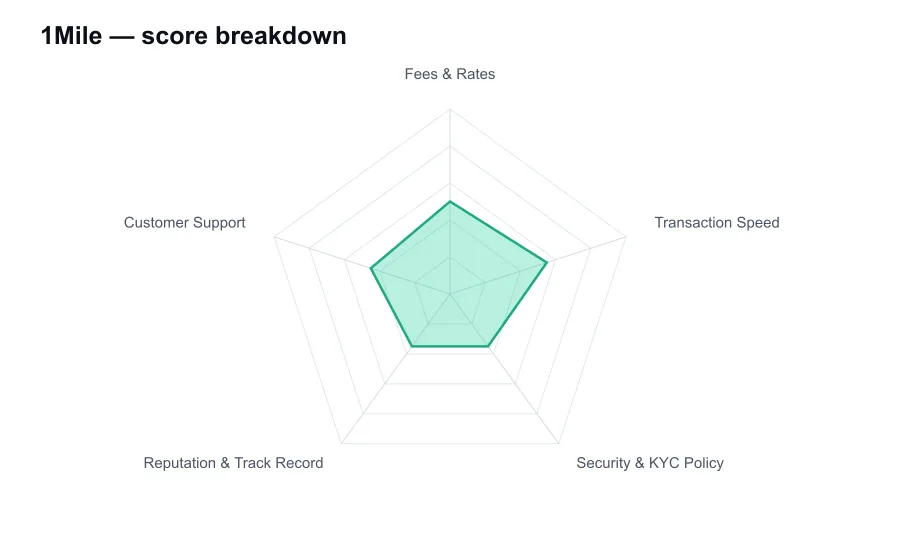
1Mile scores 4.2/10 overall in our independent review, measured against every other provider we've compared, strongest on Transaction Speed (5.5/10) and weakest on Reputation & Track Record (3.5/10).
4.2/10 ★★★★★ How we score → Status: active (checked 2026-10-13T19:47:48.671Z)| Best for | Not for |
|---|---|
| Useful for niche payment-direction exchanges | No clear public fee schedule |
| Simple order-based exchange flow | Limited independently verifiable company information |
Editorial independence: our scores and rankings are produced using the fixed criteria above and are not influenced by advertisers. This is an independent ranking site and is not operated by, or affiliated with, any provider we list.
Affiliate disclosure: some links on this page may earn us a commission at no extra cost to you. This does not affect our rankings.
What is 1Mile?
1Mile is an online exchanger that appears to handle conversion orders involving cryptocurrency and payment-system balances. Customers choose an exchange direction, fund an order, and receive the requested payout. It is not a conventional exchange with a visible trading book.
In-Depth Review of 1Mile
1Mile is a small online exchange brand aimed at users who want to convert crypto, electronic money, and fiat-linked payment balances without opening an account at a large centralized exchange. It occupies the thin end of the market, where convenience and a broad list of payment directions matter more than polished trading tools, deep liquidity, or institutional-grade disclosure. That can suit a practical exchange job. It does not make 1Mile a substitute for Kraken, Coinbase, Binance, or a regulated local money service.
The first thing a prospective customer should understand is that 1Mile appears to operate as a manual or semi-manual exchanger rather than an order-book venue. You select a direction, enter an amount and receiving details, create an order, and send the required funds. The service then processes the payout. That is a familiar model in the exchange-monitoring world, but it puts more responsibility on the customer. A mistaken bank account, wallet address, payment reference, or network choice can be harder to correct than it would be on a conventional exchange.
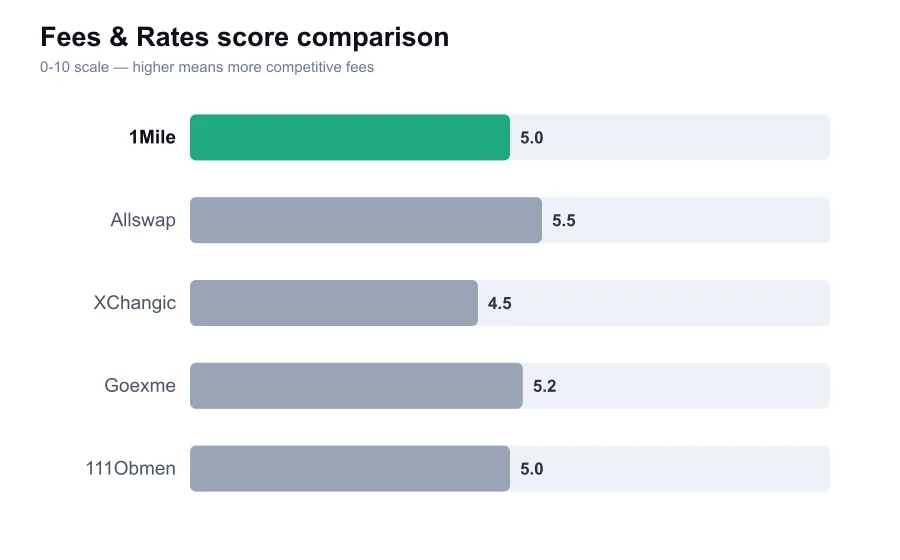
Its pricing is difficult to judge cleanly because the meaningful cost is usually embedded in the displayed exchange rate. That is normal for this category, though it is less transparent than a platform that states a maker fee, taker fee, withdrawal charge, and spread separately. A quoted rate can look attractive while still including a substantial margin against the broader market. Anyone comparing 1Mile with another exchanger should calculate the final amount received, not focus on a headline rate or an advertised zero-fee claim.
That opacity is the main reason I cannot score its fees highly. It may occasionally be competitive for a particular route, especially one involving payment systems that larger exchanges do not support. Still, a buyer has no reason to assume that an obscure exchanger's quote is best. Check at least two alternatives and use a live market reference for the crypto leg. For a Bitcoin, USDT, or Ethereum conversion, a one or two percent difference can be hidden surprisingly easily inside a supposedly convenient quote.
Speed is similarly dependent on the payment direction. Crypto transfers can be processed quickly after the required confirmations arrive, while bank payments, card-related routes, and electronic-wallet transfers may need operator review or depend on the receiving system's schedule. A service such as 1Mile cannot make a congested blockchain move faster, and it cannot force a bank to settle an outgoing payment immediately. The right expectation is same-day processing for straightforward orders, not an unconditional instant exchange promise.
The platform is best used when the order is simple and the payout details are unambiguous. Sending a small test amount is sensible before trusting a larger transaction. That advice is especially important for stablecoins because USDT and USDC exist on several incompatible networks. A low network fee is meaningless if funds are sent through a chain the order did not specify. The exchanger may have no technical way to retrieve an unsupported transfer.
On security, the central issue is less about trading-account hacking and more about counterparty risk. Customers generally send funds first and wait for a payout. That makes the exchanger's operating discipline, support quality, and public record critical. I could not independently verify detailed information about 1Mile's beneficial ownership, reserves, custody arrangements, security audits, or insurance. The absence of public detail is not proof of misconduct, but it is a reason to keep exposure limited.
KYC expectations should also be treated cautiously. Smaller exchangers often advertise streamlined use, yet reserve the right to request identity documents, proof of payment, source-of-funds information, or additional verification where an order triggers compliance checks. That is a legitimate anti-fraud practice in principle. The problem arises if the policy is vague, disclosed only after payment, or applied without a clear timetable for a refund. Customers should read the rules before creating an order and save the quoted terms.
1Mile does not have the public operating history or independently documented regulatory standing needed to earn a strong reputation score. Large exchanges have their own failings, but their corporate entities, licensing claims, public incidents, and support processes are easier to investigate. With 1Mile, the information gap itself is material. Reputation in this niche is often built through monitoring-site reviews and repeat usage, which can be useful signals, but they are weaker than transparent company reporting and a long, verifiable track record.
Customer support matters more here than it does on an ordinary spot exchange because each order can involve payment confirmations, manual checks, and third-party rails. The available public picture does not support confidence in a large, multi-channel support operation with published service-level targets. If you use 1Mile, contact support before funding an unusually large order or a route you have never used. A prompt, specific pre-sale answer is one of the few practical ways to test whether an exchanger is staffed and attentive.
I would also avoid treating a listed reserve figure, if one appears on an exchange-monitoring service, as cash in a segregated customer account. Monitoring-site reserves can be useful for estimating whether a provider can fulfill a routine order, yet they are not an audit and do not establish solvency. They can change quickly. Nor do they answer whether the provider can resolve a disputed payment, a bank reversal, or an address error.
Compared with a mainstream exchange, 1Mile's potential advantage is route flexibility. A customer who needs a particular electronic-money direction may find it more useful than an exchange designed only for card purchases and crypto withdrawals. Compared with a specialist OTC desk, however, it offers little public evidence of the controls that should accompany high-value conversions. Those are very different use cases, and customers should not blur them.
The sensible way to approach 1Mile is transaction by transaction. Confirm the receiving amount, take screenshots of the order, verify the exact payment details on the order page, and do not send a different amount or use a third-party payment account unless support explicitly confirms that it is acceptable. If the rate changes materially before payment, cancel and reassess rather than rushing to complete the transfer. Small exchangers reward care and punish assumptions.
My view is restrained rather than dismissive. 1Mile may be useful as a niche conversion option when it has the best final quote for a route you understand, and a small test order completes cleanly. It has not earned the trust level required for storing funds, making repeated large transfers, or replacing a better documented exchange. Its weak point is not necessarily execution. It is the lack of independently verifiable information around pricing, compliance handling, security controls, and corporate accountability.
Score Breakdown
| Criterion | Score | Note |
|---|---|---|
| Fees & Rates | 5.0 | Cost is mainly embedded in the quoted rate. |
| Transaction Speed | 5.5 | Straightforward orders may be same-day, rail dependent. |
| Security & KYC Policy | 3.5 | Limited public evidence on custody and controls. |
| Reputation & Track Record | 3.5 | Small public footprint and limited verifiable disclosure. |
| Customer Support | 4.5 | Test support before sending a material amount. |
Key Facts
| Fact | Value | Source |
|---|---|---|
| Service model | Order-based online exchanger | - |
| Custody use | Not suited to long-term custody | - |
| Price presentation | Quoted final exchange amount | - |
| Execution dependency | Payment rail and network confirmations | - |
| Public disclosure | Limited independently verifiable detail | - |
Pros and Cons
| Pros | Cons |
|---|
How 1Mile Works
- Choose the payment and payout direction
- Enter the amount and receiving details
- Review the quoted amount and order conditions
- Send funds exactly as instructed
- Wait for payment confirmation and payout
- Verify receipt in your bank, wallet, or payment account
KYC
| Requirement | tiered |
|---|---|
| Notes | Identity or payment-source checks may be requested for risk, fraud, or compliance review. Confirm the terms before funding an order. |
How to Use 1Mile Safely
- Make a small test order before a larger conversion
- Compare the final payout against at least two alternatives
- Use the exact crypto network shown on the order
- Save order details and proof of payment
- Withdraw received crypto to a wallet you control
Is 1Mile an exchange with an order book?
It appears to use an order-based exchange flow rather than a conventional trading order book. You create a conversion order, send funds, and wait for the payout.
Does 1Mile publish a flat trading-fee schedule?
A clear universal maker-and-taker fee schedule is not publicly established. The relevant cost is usually the final amount shown in the quote.
Should I send a test transaction first?
Yes. A small test order is prudent because payout speed, payment references, and supported crypto networks can vary by exchange direction.
Can an order be reviewed after payment?
It can happen with smaller exchangers, particularly for fraud or compliance checks. Read the order rules before paying and retain proof of payment.
Can I keep crypto on 1Mile?
It should be treated as a transaction service, not a custody wallet. Withdraw received crypto to a wallet you control after completion.
Why can a quoted crypto payout change?
A floating quote can move with the market before payment and confirmation. Confirm whether the particular order uses a fixed or floating rate.
Editorial independence: our scores and rankings are produced using the fixed criteria above and are not influenced by advertisers. This is an independent ranking site and is not operated by, or affiliated with, any provider we list.
Affiliate disclosure: some links on this page may earn us a commission at no extra cost to you. This does not affect our rankings.