Allswap
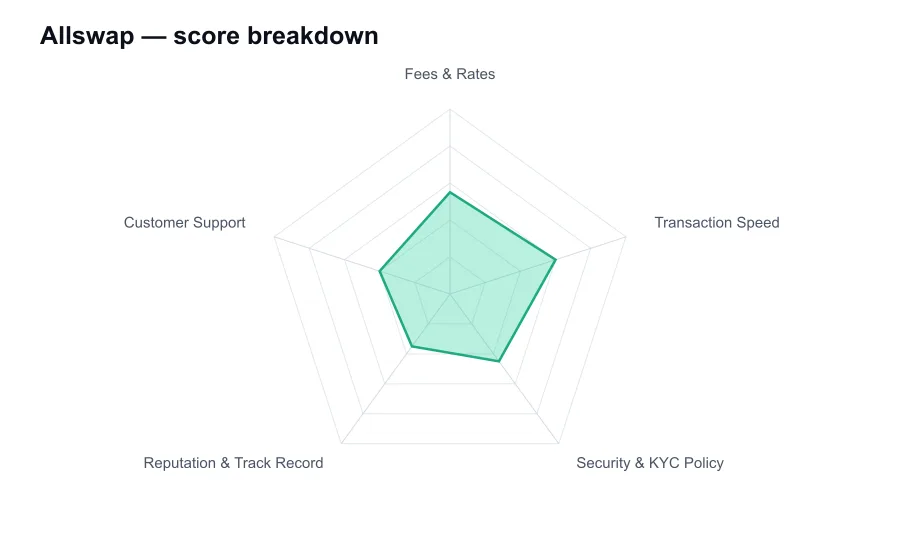
Allswap scores 4.5/10 overall in our independent review, measured against every other provider we've compared, strongest on Transaction Speed (6.0/10) and weakest on Reputation & Track Record (3.5/10).
4.5/10 ★★★★★ How we score → Status: active (checked 2026-10-13T19:25:09.322Z)| Best for | Not for |
|---|---|
| Self-custody wallet-based trading | Limited public reputation and independent assurance |
| No conventional exchange account needed | Route quality and liquidity can be inconsistent |
Editorial independence: our scores and rankings are produced using the fixed criteria above and are not influenced by advertisers. This is an independent ranking site and is not operated by, or affiliated with, any provider we list.
Affiliate disclosure: some links on this page may earn us a commission at no extra cost to you. This does not affect our rankings.
What is Allswap?
Allswap is a decentralized crypto swap service that uses a connected wallet rather than a traditional exchange account. Users interact with blockchain smart contracts to exchange supported tokens. As with other DEX tools, the user remains responsible for wallet permissions, transaction settings, and verifying the route.
In-Depth Review of Allswap
Allswap is presented as a decentralized swap service, but it occupies a much less established part of the market than names such as Uniswap, 1inch, PancakeSwap, or Symbiosis. That distinction should shape how anyone approaches it. The basic promise is familiar: connect a wallet, choose tokens, approve access where needed, and execute a trade through smart contracts. The difficult question is not whether that flow works. It is whether the protocol has enough public history, liquidity, documentation, and independent scrutiny to deserve meaningful funds.
A small DEX can be perfectly functional. It can also create a false sense of safety because the screen looks nearly identical to a major DEX. Wallet connection, token logos, a price quote, and a swap button are easy to reproduce. What cannot be copied overnight is deep liquidity, active developers, clear contract documentation, established community support, and a record of handling market stress. Allswap does not have the public footprint needed for me to treat it as a first-choice venue.
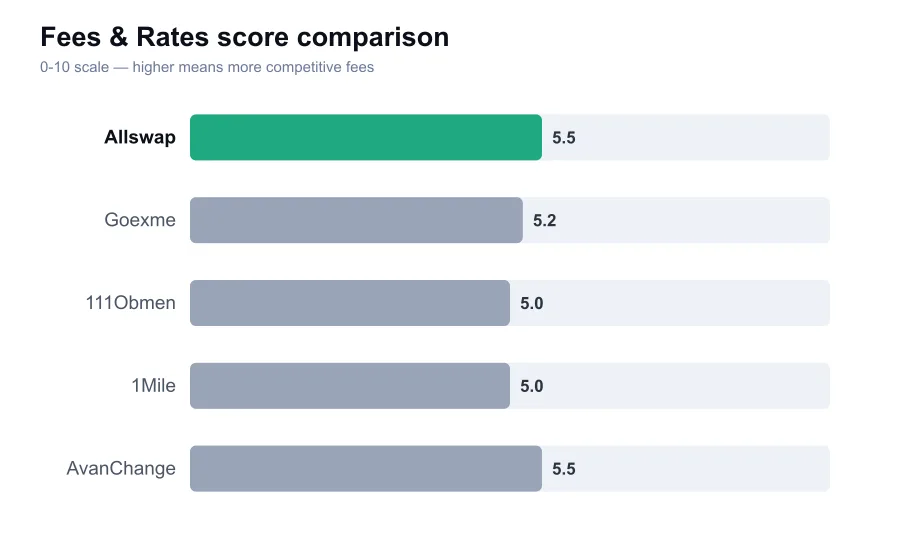
The interface-led nature of the product makes fees harder to assess than on an exchange with a published maker and taker schedule. A user may face a liquidity-pool fee, an aggregator or protocol fee if one applies, token price impact, and chain gas. The percentage shown before confirmation is only one element of the total. On small pools, price impact is usually the real expense. A quoted swap can look acceptable until you compare the output against a route from 1inch or the relevant chain's leading DEX.
That is why the sensible fee score here is middling rather than generous. Low apparent fees are irrelevant if liquidity is thin or the route is poor. Before approving a trade, compare the received amount in at least one established aggregator. This takes less than a minute and can reveal whether the issue is a fee, a stale price, or an illiquid token. If Allswap gives a substantially worse result, there is little reason to reward it simply because its front end is convenient.
Speed depends almost entirely on the underlying network and route. A same-chain swap on a fast network can confirm quickly. A transaction on Ethereum may take longer and cost more, while any route involving a bridge adds separate finality and relayer variables. Allswap itself cannot make a blockchain faster. Its contribution is the quality of routing and the reliability of the contracts. For a smaller protocol, that reliability needs to be demonstrated rather than assumed.
Security deserves extra skepticism. A decentralized exchange does not hold a conventional customer balance, which removes some centralized exchange risks. But every wallet approval is a permission granted to a contract, and every trade depends on the integrity of that contract and its routing logic. The public information available around Allswap is thinner than I would want for a protocol receiving substantial assets. I have not seen the depth of independently verifiable audit history, technical disclosure, and long-running operational evidence that would justify a top security rating.
This does not mean every Allswap transaction is unsafe or that a small project is automatically fraudulent. It means the risk premium is real. Users should verify that they are on the genuine application domain, inspect contract addresses through the relevant blockchain explorer, and avoid unlimited approvals. A browser wallet's warning screen is not a substitute for due diligence. If the transaction asks for permissions that do not match the simple swap you intended, stop.
KYC is generally not part of a typical DEX flow. A wallet connection is usually all that is required to swap. That can be valuable for users who prefer self-custody and do not want to deposit coins with a company. It also means mistakes have fewer remedies. There is no verified profile to restore, no custodial ledger to correct, and no customer-service agent who can reverse a confirmed trade. Decentralization shifts control to the user, along with responsibility.
Reputation is Allswap's weak point. In crypto, a protocol should earn trust through visible usage, open communication, audited contracts, and clear responses when something breaks. Allswap has not accumulated the kind of broadly recognized track record that lets a reviewer recommend it over category leaders. A small community can be enthusiastic, but community posts are not the same thing as an independently tested record. I would not confuse availability with maturity.
Support is similarly hard to rate highly. Smaller DeFi projects often rely on a documentation page, social channels, and community chat. That can be adequate for a basic question, but it is a poor fallback if a high-value transaction is stuck, routed unexpectedly, or signed through the wrong token approval. Good support in DeFi means timely, technically competent public triage. It does not mean recovery from an irreversible blockchain event, and users should plan accordingly.
The safest use case is narrow: a small experimental trade by a user who understands token approvals and can independently validate the output. Keep the transaction small enough that a failed route, high slippage, or unrecoverable mistake will not matter. If the protocol offers an asset that cannot be traded elsewhere, use even more caution. Obscure token availability often comes with shallow pools, volatile pricing, and deceptive copies.
For ordinary swaps of ETH, USDC, USDT, WBTC, or a major chain's native coin, there is usually a stronger alternative. Uniswap offers established Ethereum and layer-2 liquidity. PancakeSwap remains a familiar option in its core ecosystems. 1inch can compare sources rather than asking users to trust a single pool. Allswap needs a compelling route advantage before it should win that comparison. I have not found enough evidence to assume it will.
The fact that a DEX is non-custodial should never be used as a blanket security claim. Your wallet may retain custody of the assets until you sign, but a malicious or poorly designed approval can expose tokens afterward. Check allowance amounts, revoke permissions you no longer need, and use a separate wallet for unfamiliar protocols. Hardware-wallet confirmation screens help, although they cannot tell you whether an economically bad swap is a good idea.
My assessment is blunt. Allswap may be usable as a niche decentralized trading interface, but its public track record is too thin to recommend for meaningful capital. The fee and speed proposition is inseparable from route quality, while the security and support burden falls heavily on the user. Treat it as an experimental tool, not a core trading venue. If you need liquid execution or confidence under pressure, choose a better documented protocol with deeper usage.
Score Breakdown
| Criterion | Score | Note |
|---|---|---|
| Fees & Rates | 5.5 | True cost depends heavily on route, slippage, and gas |
| Transaction Speed | 6.0 | Settlement follows the underlying network and route |
| Security & KYC Policy | 4.5 | Self-custody helps, but public assurance is limited |
| Reputation & Track Record | 3.5 | Thin public track record beside leading DEXs |
| Customer Support | 4.0 | Community-style help is not a recovery service |
Key Facts
| Fact | Value | Source |
|---|---|---|
| Service type | Decentralized token swap interface | - |
| Custody model | User-controlled wallet transactions | - |
| Account requirement | Wallet connection rather than exchange account | - |
| Execution model | On-chain smart-contract execution | - |
| User cost components | Pool fees, slippage, and network gas | - |
Pros and Cons
| Pros | Cons |
|---|
How Allswap Works
- Open the verified Allswap application and connect a wallet
- Select the token and network you are sending from
- Choose the token you want to receive
- Review output, price impact, gas, and contract permissions
- Approve the token amount if approval is required
- Confirm the swap and wait for blockchain confirmation
KYC
| Requirement | none |
|---|---|
| Notes | A decentralized swap flow normally uses a connected wallet rather than a verified customer account. On-chain activity is still publicly observable. |
How to Use Allswap Safely
- Use a separate wallet for unfamiliar DeFi protocols
- Verify the app domain and contract addresses independently
- Compare the quoted output with an established aggregator
- Set limited token approvals instead of unlimited allowances
- Keep slippage low and test with a small transaction first
- Revoke permissions you no longer need
Does Allswap require KYC?
A decentralized wallet-based swap flow generally does not use conventional KYC. You should still assume on-chain activity is public and that fiat platforms may require identity verification later.
Why should I compare an Allswap quote elsewhere?
The total cost can include pool fees, price impact, and gas. Comparing the expected output with a major DEX or aggregator can reveal an expensive or illiquid route before you sign.
Can Allswap reverse a confirmed token swap?
No decentralized exchange can normally reverse a confirmed on-chain swap. Verify the token, chain, amount, and wallet address before confirming in your wallet.
Should I grant unlimited token approval?
No. Use a limited approval where possible, especially with a smaller or unfamiliar protocol. Revoke unused allowances after trading through a reputable approval-management tool.
What does price impact mean on Allswap?
Price impact is the movement caused by your own trade against available pool liquidity. It can make the received amount much worse than the displayed market price, particularly for thin pools.
Is a connected wallet the same as depositing funds?
No. Connecting a wallet does not transfer assets by itself. Signing a token approval or swap transaction is the action that grants permissions or moves funds.
Editorial independence: our scores and rankings are produced using the fixed criteria above and are not influenced by advertisers. This is an independent ranking site and is not operated by, or affiliated with, any provider we list.
Affiliate disclosure: some links on this page may earn us a commission at no extra cost to you. This does not affect our rankings.