Mindswap
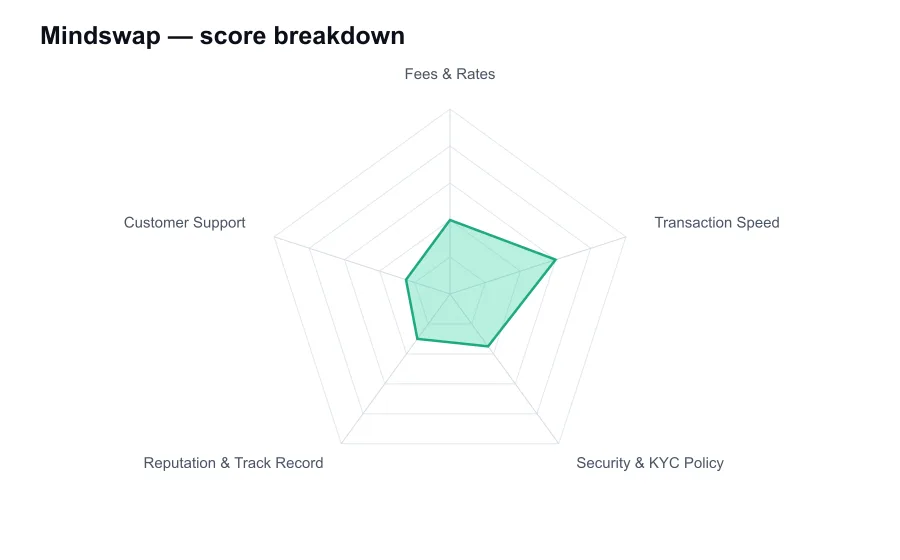
Mindswap scores 3.9/10 overall in our independent review, measured against every other provider we've compared, strongest on Transaction Speed (6.0/10) and weakest on Customer Support (2.5/10).
3.9/10 ★★★★★ How we score →| Best for | Not for |
|---|---|
| Wallet-based, non-custodial access | Thin liquidity can cause severe slippage |
| Low-cost Polygon transactions | Uncertain current maintenance activity |
Editorial independence: our scores and rankings are produced using the fixed criteria above and are not influenced by advertisers. This is an independent ranking site and is not operated by, or affiliated with, any provider we list.
Affiliate disclosure: some links on this page may earn us a commission at no extra cost to you. This does not affect our rankings.
In-Depth Review of Mindswap
MindSwap was a decentralized exchange project associated with the Polygon ecosystem, offering token swaps, liquidity pools, and farming-style incentives around the MIND token. It emerged during the period when new automated market makers were launching rapidly across low-fee chains. The premise was familiar: make swapping cheap, reward liquidity providers, and use token incentives to attract users away from the bigger decentralized exchanges.
The first thing a prospective user needs to understand is that MindSwap is not a current mainstream alternative to Uniswap, QuickSwap, or major centralized exchanges. Its public profile and market relevance have faded sharply from the heights of the Polygon DeFi boom. A project can still have a functioning contract or website while no longer offering the liquidity, development activity, or operational reliability that users reasonably expect from an active exchange.
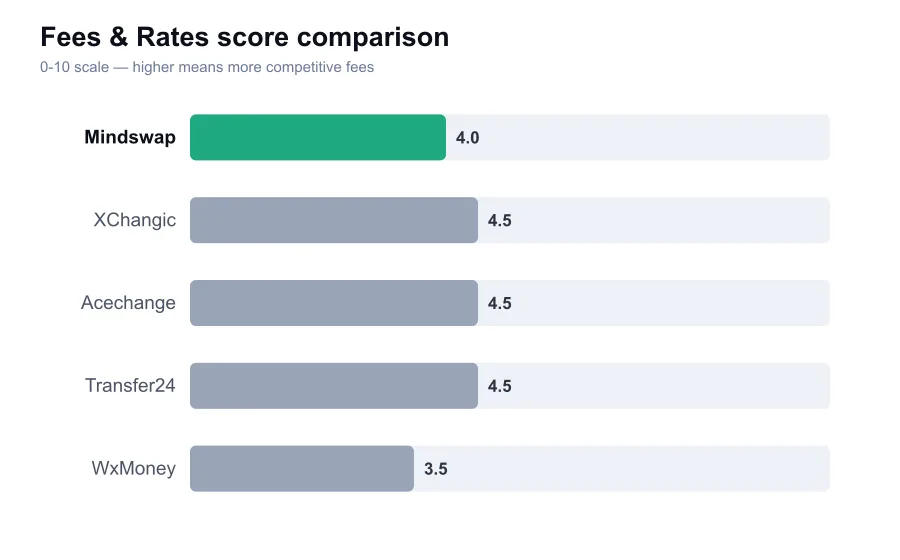
That decline matters more than branding. In an automated market maker, liquidity is the product. A technically available swap is of little value if the pool is thin and the quoted rate is poor. Small pools produce substantial price impact, especially for volatile or obscure tokens. A trader may see an apparently low protocol fee and still lose far more through slippage than they would pay using a deep pool on Uniswap or QuickSwap.
MindSwap's fees were designed in the familiar DEX model, where swap fees reward liquidity providers and an additional share may support protocol incentives or governance. The exact arrangements have changed across versions and pools, which is one reason users should not rely on old social posts or historic guides. Before approving any trade, inspect the current interface, pool depth, trade quote, price impact, and the token approval request in your wallet.
For small, common Polygon swaps, network costs can be extremely low compared with Ethereum mainnet. That used to be a genuine advantage for MindSwap and other Polygon-native venues. Gas is no longer the decisive factor, however. Polygon's cheap transactions do not rescue a trade executed against shallow liquidity. A few cents in gas is irrelevant if the swap is several percentage points worse than the market price.
Speed is similarly easy to misunderstand. Polygon transactions often confirm quickly, so a successful swap can settle in seconds or a few minutes. That is chain speed, not necessarily exchange quality. A transaction can execute rapidly at a terrible price, fail because of stale settings, or be exposed to front-running and sandwich activity depending on the route and market conditions. Fast execution only helps if the execution itself is sound.
MindSwap's permissionless nature is one of its remaining conceptual strengths. A user generally connects a compatible wallet rather than creating an exchange account, submitting identification, or giving a platform custody of long-term balances. For people who value direct wallet control, that is better than depositing funds with an opaque centralized operator. It also means the user bears more responsibility for approvals, fake links, seed-phrase security, and irreversible errors.
No-KYC access should not be confused with zero compliance risk in the broader ecosystem. Wallet providers, bridges, stablecoin issuers, front ends, and fiat ramps can all have their own policies. More importantly, permissionless access offers no customer-service safety net if a user sends assets to the wrong contract or signs a malicious transaction. The trade-off is autonomy for recourse, and MindSwap sits firmly on the autonomy side.
Security is the hardest area to score generously. Like any DeFi protocol, MindSwap exposes users to smart-contract risk, admin-key risk if such controls remain, oracle or routing risk, and liquidity-pool token risk. The fact that a contract has operated before does not prove it is safe today. Security standards, dependency versions, and attacker techniques move quickly. A project with limited current development and limited fresh audit visibility deserves extra skepticism.
The MIND token adds another layer of risk. Governance and reward tokens from the 2021 DeFi cycle frequently experienced severe dilution, collapsing liquidity, and dwindling utility after incentives slowed. Users should not infer lasting value from a token merely because it once powered farms or voting. If a pool's annual percentage yield looks spectacular, ask whether the reward token can actually be sold without moving its market dramatically.
Support is likely to be a weak point for anybody encountering a problem. Active projects tend to maintain responsive development channels, current documentation, status updates, and visible community moderation. A fading protocol may leave historic Telegram, Discord, or social channels online without providing meaningful assistance. That can be enough for a technically capable user who only needs to inspect contracts. It is not enough for a novice who expects help recovering from an error.
Reputation is not the same as a fraud allegation. MindSwap was a recognizable participant in Polygon's DeFi expansion, and that history is more than some anonymous contracts have. But the project did not maintain the enduring market position or liquidity profile of its larger competitors. For an exchange service, relevance is not cosmetic. It determines trade quality, incident response, integrations, and the likelihood that information is current.
If you are researching old MIND holdings, the sensible approach is forensic rather than promotional. Verify token contract addresses from reliable historical sources, inspect current liquidity on a block explorer and reputable analytics tools, confirm that the front end is authentic, and revoke any unneeded token approvals after interacting. Never import a seed phrase into a site or extension because a community account tells you to do so. Dormant brands attract impersonators.
My judgment is that MindSwap is chiefly of historical interest unless you have a very specific reason to interact with a legacy Polygon pool. There is no compelling case for a new trader to choose it over deeper, better-maintained decentralized venues. Cheap Polygon gas and no-KYC wallet access are real benefits, but they do not outweigh weak liquidity, uncertain current maintenance, and a diminished reputation. Treat it as high-risk legacy DeFi, not as a default exchange.
Score Breakdown
| Criterion | Score | Note |
|---|---|---|
| Fees & Rates | 4.0 | Cheap gas cannot offset shallow-pool slippage |
| Transaction Speed | 6.0 | Polygon settles quickly if the route remains usable |
| Security & KYC Policy | 3.5 | Legacy protocol risk and limited current visibility |
| Reputation & Track Record | 3.0 | Known Polygon-era name, now marginal |
| Customer Support | 2.5 | Limited evidence of active support operations |
Pros and Cons
| Pros | Cons |
|---|
Does MindSwap require KYC?
MindSwap has traditionally operated as a wallet-connected decentralized exchange, so standard exchange account KYC was not its core model. Your wallet or fiat provider may have separate rules.
Why can a MindSwap trade be expensive despite low gas?
Low Polygon gas does not guarantee a good trade. Thin liquidity can create large price impact and slippage, which can cost much more than the network fee.
Is MIND a safe investment?
MIND should be treated as a high-risk legacy DeFi token. Check active liquidity, token supply dynamics, and current project activity rather than relying on historical yield claims.
Editorial independence: our scores and rankings are produced using the fixed criteria above and are not influenced by advertisers. This is an independent ranking site and is not operated by, or affiliated with, any provider we list.
Affiliate disclosure: some links on this page may earn us a commission at no extra cost to you. This does not affect our rankings.