Transfer24
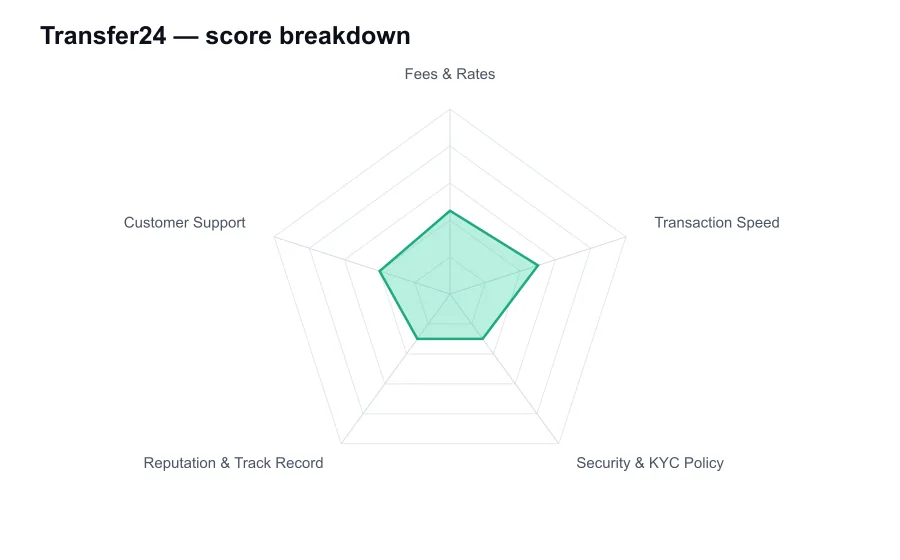
Transfer24 scores 3.7/10 overall in our independent review, measured against every other provider we've compared, strongest on Transaction Speed (5.0/10) and weakest on Reputation & Track Record (3.0/10).
3.7/10 ★★★★★ How we score → Status: active (checked 2026-10-13T19:47:48.694Z)| Best for | Not for |
|---|---|
| Simple conversion-order workflow | Final cost can be difficult to benchmark |
| Potentially useful for unusual payment routes | Limited public security disclosure |
Editorial independence: our scores and rankings are produced using the fixed criteria above and are not influenced by advertisers. This is an independent ranking site and is not operated by, or affiliated with, any provider we list.
Affiliate disclosure: some links on this page may earn us a commission at no extra cost to you. This does not affect our rankings.
What is Transfer24?
Transfer24 is a small online exchange service that appears to process conversion orders between cryptocurrency and payment-system or fiat-related methods. Users fund an individual order and receive a selected payout. It is not a mainstream custodial trading exchange.
In-Depth Review of Transfer24
Transfer24 sits in the same broad category as many small online exchangers that promise quick conversion between crypto, bank-linked payments, and electronic money. It is not a household-name exchange, and that fact shapes this review more than any marketing claim. The service may be useful for a narrow payment route, but it lacks the public scale, disclosure, and independently testable infrastructure of major crypto platforms.
Its model appears to be based on individual exchange orders. A customer selects what they are sending and receiving, enters the payout details, receives payment instructions, and waits for the exchange to be completed. This is straightforward, and it can be less intimidating than a trading terminal. It also means the customer is dealing with a counterparty after sending money, rather than matching directly with market participants in a transparent order book.
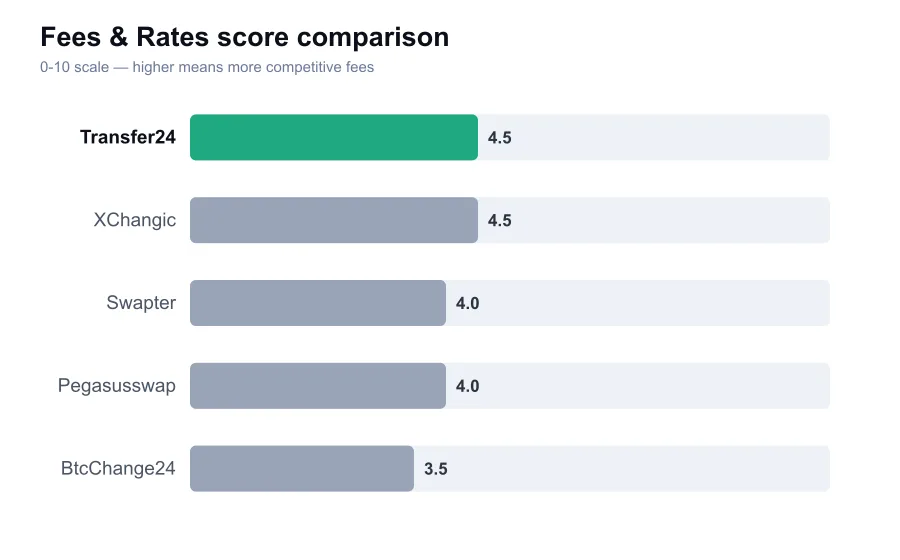
That difference matters most on price. Transfer24's effective fee is likely contained primarily in its exchange rate, perhaps alongside route-specific charges from banks, card processors, wallets, or blockchains. A quoted payout is more useful than a vague percentage, but customers should still benchmark it. Compare the amount you will actually receive after all charges with at least two services. For crypto pairs, compare against a liquid market price as well.
I would not characterize this as a low-cost venue without a route-by-route audit. Smaller exchangers can be excellent on one direction and expensive on the next because they manage their own inventory, payment risk, and liquidity. The same provider may quote a reasonable rate for a stablecoin payout yet a poor rate for a bank transfer. That is why fee scoring here stays in the middle, rather than rewarding an absence of an obvious line-item fee.
Speed claims need similar scrutiny. A crypto deposit is subject to blockchain confirmations. A fiat payout may depend on banking cut-off times, beneficiary-bank checks, holidays, and the provider's own review queue. The phrase instant exchange has a narrower meaning than many customers assume. It might mean an order is created instantly, or that the operator begins processing quickly. It does not guarantee that funds will reach every destination in minutes.
Transfer24 may work well for simple, low-risk orders completed during staffed hours. It becomes less attractive where a deadline matters, such as a time-sensitive invoice, a large arbitrage trade, or a payment that must arrive before a bank cut-off. A larger exchange can be slower at compliance review, but it usually offers better visibility into account status and clearer escalation paths. With a small exchanger, an unresolved order can leave the customer with very little leverage.
Security should be judged through the service's operating model, not by whether its website has HTTPS. Any competent site should have encrypted browsing. The harder questions concern custody, payment reconciliation, fraud monitoring, ownership, incident reporting, and the procedures used when an order is disputed. I could not independently substantiate robust public disclosures from Transfer24 on those subjects. That makes it unsuitable for customers who require institutional safeguards.
The likely KYC approach is conditional rather than completely absent. Many exchangers allow an order to be created with minimal onboarding, then ask for documents if payment data, order size, geography, or transaction patterns trigger a review. This can be reasonable. It becomes a customer problem if the review process, expected response time, and refund conditions are unclear. Before sending money, read the terms for rejected verification and ask support how a refund would work if a transaction cannot proceed.
Transfer24's reputation is its weakest area. There is a major difference between having some favorable customer comments and having a durable, independently verifiable track record. A recognized exchange can point to years of public reporting, licensing records, major security events, and scrutiny from journalists and users. A small exchanger may depend mostly on its own claims and directory listings. That leaves a prospective customer with less evidence and more risk.
Support is therefore a deciding factor rather than an added convenience. A useful support team should answer questions about payment references, network selection, acceptable sender names, delays, verification, and refunds before an order is funded. Generic replies are a warning sign. So is a provider that directs customers to pay first and discuss details later. For a service using manual processing, responsiveness is part of the product.
One practical issue is payment-name matching. Bank transfers and electronic-wallet payments often need to come from an account in the same name as the person placing the order. Third-party payments can create compliance concerns and slow reconciliation. If Transfer24 accepts a route only under particular naming or reference conditions, customers need that information before they transfer. Do not improvise a reference or split a payment unless the operator authorizes it in writing.
The service is also poorly suited to speculative traders. There is no reason to use a small conversion desk for repeated Bitcoin or Ethereum trading if a liquid spot market is available to you. Spreads, processing time, and counterparty uncertainty will usually outweigh any convenience. Transfer24 makes more sense only when the actual route is the point, for example an electronic-money payout not available from your regular exchange.
A careful user can reduce risk. Start small, check the receiving details character by character, keep the transaction hash or bank receipt, and do not send a token through a network that is merely cheaper if it is not named in the order. Do not rely on a chat promise that conflicts with the written order terms. If a rate is unusually better than every competing service, assume there is a catch until you can identify it.
My verdict is that Transfer24 is a limited-purpose tool rather than a relationship provider. It may earn a place in an experienced user's comparison list for a specific conversion direction. It has not earned a place as a primary venue for savings, large transfers, or regular trading. The pricing and speed may be adequate on the right route, but the thin public record and uncertain support depth require a conservative approach.
Score Breakdown
| Criterion | Score | Note |
|---|---|---|
| Fees & Rates | 4.5 | Compare final payout, as spreads are route specific. |
| Transaction Speed | 5.0 | Processing depends on confirmations and payment rails. |
| Security & KYC Policy | 3.0 | Public security and custody disclosures are thin. |
| Reputation & Track Record | 3.0 | Limited independently verifiable operating record. |
| Customer Support | 4.0 | Pre-order response quality should be tested first. |
Key Facts
| Fact | Value | Source |
|---|---|---|
| Service model | Online exchange-order service | - |
| Pricing model | Route-specific quoted payout | - |
| Speed dependency | Banks, wallets, and blockchain confirmations | - |
| Best use | Small, specific conversion routes | - |
| Public track record | Limited independently verifiable detail | - |
Pros and Cons
| Pros | Cons |
|---|
How Transfer24 Works
- Select the asset or payment method to send
- Choose the desired payout method
- Enter amount and beneficiary details
- Review the quote and payment instructions
- Fund the order from an eligible account
- Track the order and confirm the received payout
KYC
| Requirement | tiered |
|---|---|
| Notes | Additional identification or proof of payment may be requested when an order is reviewed. Ask about refund handling before sending funds. |
How to Use Transfer24 Safely
- Use an account in your own name unless approved otherwise
- Confirm bank references before making payment
- Check network and token details before sending crypto
- Avoid urgent, high-value first orders
- Keep receipts, hashes, and order screenshots
Is Transfer24 designed for active crypto trading?
No. Its apparent model is an exchange-order service, not a liquid spot market with a visible order book and advanced trading tools.
How should I compare a Transfer24 quote?
Compare the exact final amount received against at least two alternatives, then check the crypto portion against a live liquid-market reference.
Can bank cut-off times delay a payout?
Yes. A completed exchange order can still be delayed by bank processing schedules, beneficiary-bank checks, weekends, and holidays.
Should the sender name match the order details?
Yes. Name mismatches and third-party payments can cause reconciliation or compliance delays. Confirm any exception with support before paying.
What should I retain if an order is delayed?
Keep the order number, payment receipt, payment reference, correspondence, and any crypto transaction hash. These are essential for support review.
Is a better quote always a better deal?
No. An unusually high payout can reflect slower processing, a floating rate, payment-method risk, or limits that become clear only after the order is created.
Editorial independence: our scores and rankings are produced using the fixed criteria above and are not influenced by advertisers. This is an independent ranking site and is not operated by, or affiliated with, any provider we list.
Affiliate disclosure: some links on this page may earn us a commission at no extra cost to you. This does not affect our rankings.