Whitebit
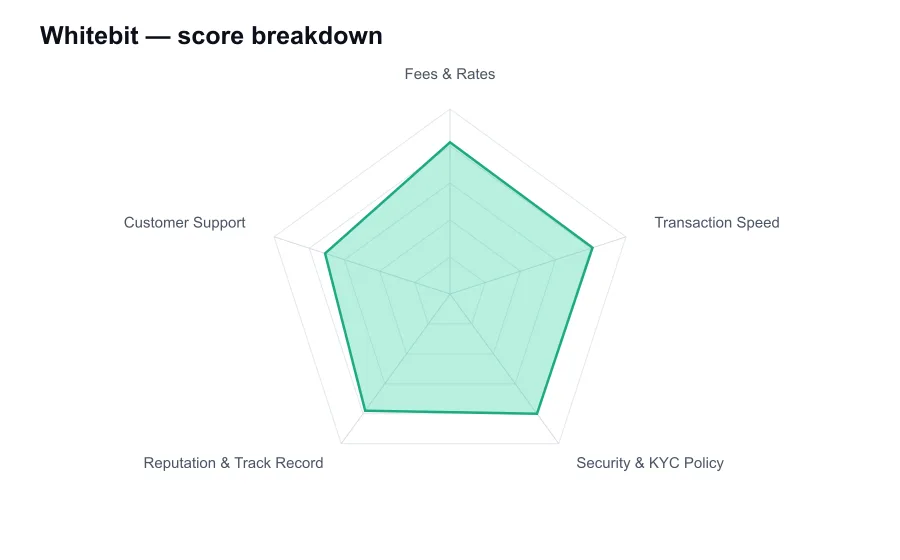
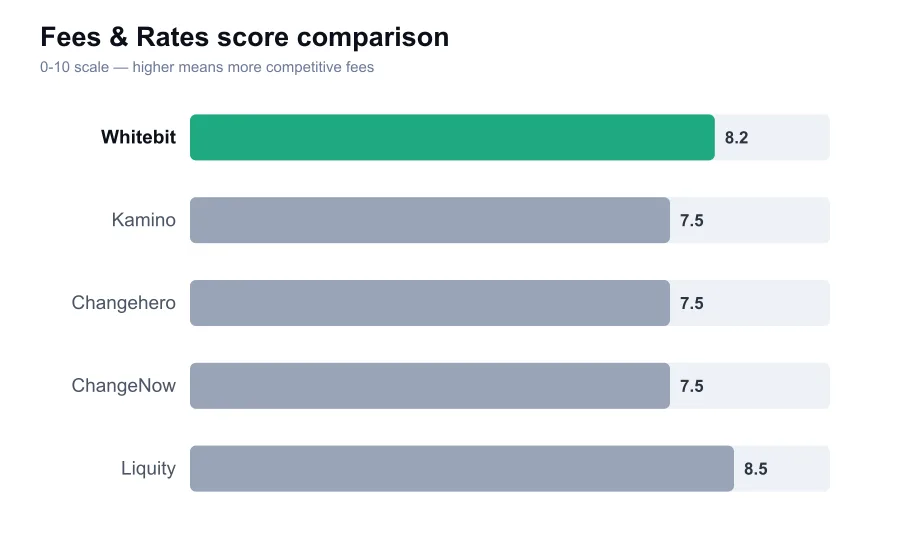
Whitebit scores 7.9/10 overall in our independent review, measured against every other provider we've compared, strongest on Fees & Rates (8.2/10) and weakest on Customer Support (7.1/10).
7.9/10 ★★★★★ How we score → Status: active (checked 2026-10-13T19:41:25.496Z)| Best for | Not for |
|---|---|
| Competitive 0.1% standard spot fee cap | KYC is required |
| Wide trading and account-management toolset | Withdrawal fees can outweigh low trading fees |
Editorial independence: our scores and rankings are produced using the fixed criteria above and are not influenced by advertisers. This is an independent ranking site and is not operated by, or affiliated with, any provider we list.
Affiliate disclosure: some links on this page may earn us a commission at no extra cost to you. This does not affect our rankings.
What is Whitebit?
WhiteBIT is a centralized cryptocurrency exchange offering spot markets, futures, conversions, fiat-related services, and account products. Users deposit assets into a WhiteBIT account and trade through its custodial platform. It is aimed mainly at verified users rather than anonymous on-chain traders.
In-Depth Review of Whitebit
WhiteBIT is a centralized crypto exchange aimed at users who want conventional trading infrastructure, a broad spot market, derivatives, staking-style products, and fiat access under one login. It has become particularly visible in Europe and Ukraine, where its brand partnerships and local presence have given it more public recognition than many offshore competitors. It is not a minimalist exchange. WhiteBIT is trying to be a full-service platform, and that ambition is clear from the product menu.
The exchange's main appeal is its familiar trading setup. Spot markets, limit orders, market orders, convert tools, futures products, earn features, and card-related services appear in the same ecosystem. For an active retail user, that is convenient. You do not need to move funds between several apps merely to convert a position, place a leveraged trade, and withdraw stablecoins. The trade-off is the usual one with centralized platforms: WhiteBIT holds the keys while assets remain on the exchange.
Its spot fee schedule is one of its better attributes. Standard spot trading fees are generally capped at 0.1%, which puts WhiteBIT in competitive territory against mainstream exchanges. High-volume users can qualify for lower rates through its fee tiers. The actual cost of trading still includes spread, order-book depth, and the specific pair's liquidity, but a 0.1% headline rate is fair and easy to understand.
Fees look less attractive once withdrawals enter the picture. Like most centralized exchanges, WhiteBIT sets network-specific withdrawal fees and minimums that can change as blockchain conditions change. Those charges matter far more than the spot fee if you buy a small amount of an asset and immediately move it to self-custody. Before depositing fiat or buying an unfamiliar token, I would always inspect the current withdrawal page. Cheap trading is not much comfort if exit costs are unexpectedly high.
WhiteBIT has decent liquidity in major pairs, especially BTC, ETH, USDT, and its more actively promoted markets. It is less convincing as a venue for institutional-scale execution than Binance, Coinbase Exchange, Kraken, or OKX. Some minor altcoin books can be thin, and a screen full of listed assets should not be mistaken for deep liquidity everywhere. A limit order is the sensible default outside the most liquid markets.
Trade execution is quick in normal conditions. The matching engine is built for exchange-style activity rather than the delayed quote flow seen at instant swap services. Deposits and withdrawals remain subject to network confirmations and internal security checks, so they are a separate question from order execution. Card purchases and fiat transfers can also take longer due to payment-provider processing. For a trader placing a spot order, though, WhiteBIT feels responsive.
Identity verification is mandatory for meaningful use of the platform. That makes WhiteBIT a poor choice for users whose first priority is anonymity, but it is unsurprising for an exchange offering fiat rails and operating publicly in regulated markets. KYC usually involves personal details and document verification, and enhanced checks can arise for higher-risk activity or larger transactions. The exchange's compliance posture is more formal than that of a no-account swap service.
WhiteBIT places significant emphasis on security features, including two-factor authentication, address whitelisting, anti-phishing protections, and cold storage claims. It has also promoted proof-of-reserves reporting through third-party verification. These are positive signs, though proof of reserves should be read as a snapshot and not as a complete audit of liabilities, controls, or solvency. No centralized exchange deserves blind trust simply because it publishes a reserve dashboard.
The company has built a stronger public profile than many similarly sized exchanges. Founded in 2018, WhiteBIT has survived several harsh market cycles and has pursued visible partnerships, including sports and cultural sponsorships. Its Ukrainian roots and support for Ukraine have become a prominent part of its identity. That visibility helps reputation, but it does not erase the normal risks of keeping assets with a centralized platform subject to operational, legal, and banking pressures.
I also think WhiteBIT deserves credit for avoiding the ragged, improvised feel that plagues many secondary exchanges. The interface is polished, order tools are understandable, and the platform appears designed for users who want to stay within one account. Yet its broad product range creates complexity. Earn products, tokens, futures, and promotional offers can encourage users to take risks they do not fully understand. The cleanest use case remains spot trading and controlled withdrawals.
Customer support is better organized than at many small offshore exchanges, with a help center, ticketing, and live chat options. That does not mean every case will be quick or satisfying. Compliance holds and account reviews are nearly always frustrating, because support agents can provide limited detail while an internal team assesses risk. Public complaints about centralized exchanges often focus on those moments rather than on everyday trading, and WhiteBIT is no exception.
For security-conscious users, the practical setup is simple. Enable app-based two-factor authentication rather than relying on SMS, set a unique password, activate anti-phishing code features where available, and whitelist withdrawal addresses. Keep only active trading funds on WhiteBIT. The platform may use cold storage, but the user still carries exchange counterparty risk and should act accordingly.
WhiteBIT's mobile apps are a useful part of the package. They make portfolio checks, spot trading, conversion, and withdrawals accessible away from a desktop. I would not use a mobile device as the only place to manage large balances, especially if the phone is used casually for social apps and email. A desktop session with careful address verification is safer for major withdrawals.
My take is that WhiteBIT is a competent centralized exchange with competitive spot pricing and a more serious public track record than many mid-tier rivals. It is strongest for verified European users who want ordinary exchange functions without moving up to the biggest global venues. It is weaker for privacy seekers, institutions needing the deepest books, and users who want self-custody by default. Treat it as a trading venue, not a vault, and its strengths become much clearer.
Score Breakdown
| Criterion | Score | Note |
|---|---|---|
| Fees & Rates | 8.2 | Standard spot fees are generally capped at 0.1% |
| Transaction Speed | 8.1 | Responsive order execution on major markets |
| Security & KYC Policy | 8.0 | Mandatory KYC, 2FA tools, cold storage claims |
| Reputation & Track Record | 7.8 | Founded in 2018 with strong European visibility |
| Customer Support | 7.1 | Live support exists, compliance cases can be slow |
Key Facts
Pros and Cons
| Pros | Cons |
|---|
How Whitebit Works
- Create an account and complete identity verification
- Secure the account with two-factor authentication
- Deposit crypto or use available fiat funding methods
- Place a spot, convert, or futures order
- Withdraw unused funds to a self-custody wallet
KYC
| Requirement | mandatory |
|---|---|
| Notes | WhiteBIT requires identity verification. Verification and payment availability can depend on a user's country, selected funding method, and the exchange's compliance review. |
Supported Assets
| Notable coins | Bitcoin, Ethereum, USDT, USDC, Solana, XRP, Cardano, Dogecoin |
|---|---|
| Networks | Bitcoin, Ethereum, Tron, Solana, BNB Smart Chain, Polygon |
How to Use Whitebit Safely
- Enable app-based two-factor authentication
- Set an anti-phishing code if available
- Whitelist withdrawal addresses
- Use limit orders in thin markets
- Withdraw long-term holdings to self-custody
Mobile App
| iOS | Yes |
|---|---|
| Android | Yes |
| Notes | WhiteBIT provides mobile applications for iOS and Android. |
What are WhiteBIT's standard spot trading fees?
WhiteBIT states that standard spot trading fees are generally capped at 0.1%. Fee discounts may apply through its volume-based tiers, while withdrawal charges vary by asset and network.
Is KYC mandatory on WhiteBIT?
Yes. WhiteBIT requires identity verification for use of its services. Users should expect document and personal-information checks, with enhanced review possible in some cases.
Does WhiteBIT publish proof of reserves?
WhiteBIT has published proof-of-reserves information through third-party verification. It is useful transparency, but it is not equivalent to a full financial audit of liabilities and internal controls.
Why is my WhiteBIT withdrawal pending?
A withdrawal can wait for security review, address checks, internal processing, or blockchain confirmations. Network congestion can add further delay after WhiteBIT broadcasts the transaction.
Are low-volume altcoin markets safe to trade on WhiteBIT?
They can have wider spreads and thinner order books than BTC or ETH pairs. Use limit orders and inspect market depth before placing a large order.
Can I leave long-term holdings on WhiteBIT?
You can, but it is not the conservative approach. WhiteBIT is a custodial exchange, so long-term holders should consider withdrawing assets they do not need for active trading.
Editorial independence: our scores and rankings are produced using the fixed criteria above and are not influenced by advertisers. This is an independent ranking site and is not operated by, or affiliated with, any provider we list.
Affiliate disclosure: some links on this page may earn us a commission at no extra cost to you. This does not affect our rankings.