Kamino
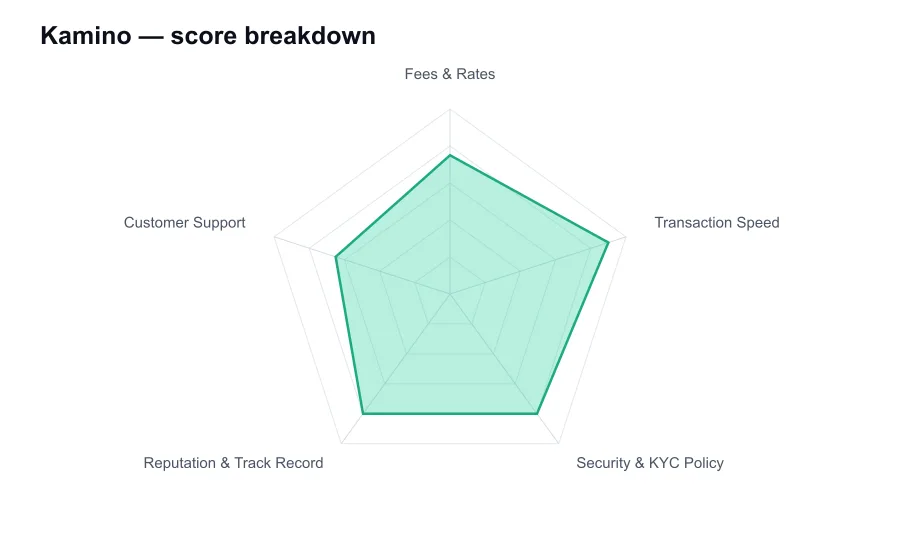
Kamino scores 7.9/10 overall in our independent review, measured against every other provider we've compared, strongest on Transaction Speed (9.0/10) and weakest on Customer Support (6.5/10).
7.9/10 ★★★★★ How we score → Status: active (checked 2026-10-13T19:25:11.239Z)| Best for | Not for |
|---|---|
| Fast, low-cost Solana lending and borrowing | Borrowing and Multiply positions can be liquidated |
| Established reputation in Solana DeFi | Rates and risk parameters vary by reserve |
Editorial independence: our scores and rankings are produced using the fixed criteria above and are not influenced by advertisers. This is an independent ranking site and is not operated by, or affiliated with, any provider we list.
Affiliate disclosure: some links on this page may earn us a commission at no extra cost to you. This does not affect our rankings.
What is Kamino?
Kamino is a Solana DeFi protocol for lending, borrowing, leveraged positions, and automated liquidity strategies. Users connect a self-custody Solana wallet to supply assets, borrow against collateral, or use advanced products. It is not a bank or a custodial exchange.
In-Depth Review of Kamino
Kamino is one of Solana's more serious DeFi platforms, centered on lending, borrowing, leveraged positions, and automated liquidity products. It is not an exchange in the usual sense, even though swapping and leverage are part of its user experience. The closest comparison is to Aave on Ethereum or Marginfi on Solana, with additional vault and liquidity-management tooling. A user deposits assets into permissionless pools, earns lending yield, borrows against collateral, or uses products that package more complex strategies.
That focus makes Kamino more powerful than a simple DEX and more dangerous for anyone who treats it like one. Depositing USDC to earn yield is relatively understandable. Borrowing SOL against SOL-correlated collateral, opening a Multiply position, or depositing into an automated liquidity vault requires an understanding of liquidation, variable rates, and market exposure. The interface is polished enough to make these actions feel routine. They are not routine if the market moves against the position.
Kamino Lend is the core product for many users. Suppliers deposit supported assets into a reserve and receive interest that changes with utilization. Borrowers post collateral and pay a variable borrow rate. The protocol's model is familiar to DeFi veterans, but the details are reserve-specific. Loan-to-value limits, liquidation thresholds, reserve factors, borrow caps, and available liquidity can differ by asset. There is no responsible way to discuss a single permanent interest rate because rates move with market conditions.
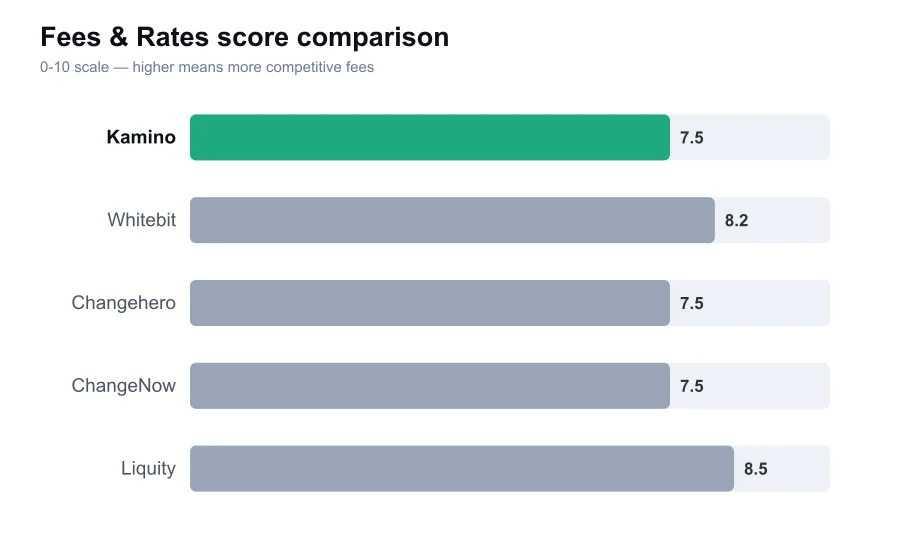
Fees are more nuanced than a standard trading commission. Lenders and borrowers should look at the displayed supply APY and borrow APR after protocol reserve factors and utilization effects, rather than hunt for one universal percentage. Borrowing has interest costs, and liquidation events can carry penalties. Leveraged products can include swap and routing costs on top of borrowing. Kamino can be cost-efficient for a well-managed position, but it is not cheap in the sense of being consequence-free.
The protocol's liquidity products add another layer. Automated concentrated-liquidity vaults can manage ranges and rebalance strategies that would be burdensome to run manually. That is useful for a Solana user who wants liquidity exposure without watching a pool all day. It does not eliminate impermanent loss, smart-contract risk, or the possibility that a strategy underperforms simply holding the assets. Automated should mean managed by rules, not guaranteed to be profitable.
Transaction speed is a genuine Kamino advantage. Solana's low transaction costs and quick confirmations make lending actions, collateral adjustments, and repayments much more practical than similar actions on Ethereum mainnet. During normal conditions, transactions are generally confirmed in seconds. That responsiveness is valuable if collateral needs attention. It should not encourage reckless leverage, because a fast chain can also liquidate a poorly positioned account very quickly.
Kamino does not require KYC for ordinary protocol access. You connect a Solana wallet such as Phantom, Solflare, or Backpack and interact directly with the application. That keeps custody with the user until a transaction is signed, and there is no conventional account password to steal. It also means Kamino cannot reset your wallet, recover a seed phrase, or stop you from signing a bad transaction. Wallet security remains the first line of defense.
Security is strong by DeFi standards, not absolute. Kamino has attracted serious usage in the Solana ecosystem, has published technical material, and has used external security reviews and bug-bounty-style security practices. Its contracts, oracle dependencies, liquidation machinery, and automated strategies still create a complex system. The relevant question is not whether the team appears competent. It does. The question is whether you can absorb the consequences if a smart-contract, oracle, governance, or chain-level failure occurs. For most users, that means avoiding concentration.
The protocol's record through volatile Solana markets gives it more credibility than a new lending fork. Kamino has become a recognizable name among Solana lenders and borrowers, with deeper integration and more public attention than many smaller competitors. It still has a shorter history than Aave and lacks the regulatory wrapper and customer protections of a bank or centralized broker. Reputation should raise confidence in operations, not erase DeFi risk.
Liquidation deserves direct attention because it is the feature users most often underestimate. A position can look safe at entry and become fragile if collateral falls, borrowed assets rise, or both happen together. Kamino shows health information in the app, but a health factor is a live risk indicator, not a comfort certificate. Borrowers should keep a substantial buffer, monitor collateral during sharp moves, and hold enough SOL for transactions. Waiting until the market is already falling is how users discover that liquidity and congestion matter.
Multiply positions deserve even more caution. They package repeated borrowing and swapping to create leveraged exposure in fewer clicks. That convenience can make leverage seem like a normal yield feature. It is a trading position with liquidation risk, recurring borrow costs, and route risk. I would not recommend it to someone whose experience consists only of holding SOL or staking it. A plain deposit or a small collateralized borrow is a much better starting point.
Support is reasonably good for DeFi, with documentation, community channels, and an active public presence, but it is not customer support in the brokerage sense. A team can help explain an interface issue or investigate a transaction hash. It cannot reverse a completed liquidation or restore tokens from a wallet that signed an approval to a malicious site. Users should keep transaction records and read the reserve details before committing funds, rather than expecting a support ticket to repair a risky position after the fact.
For assets, Kamino is most relevant to the Solana economy: SOL, liquid staking tokens, stablecoins such as USDC and USDT, and selected major ecosystem assets. The exact reserve list changes, so users should rely on the live app rather than an old article. That flexibility supports new collateral opportunities, but it also means an asset's risk configuration can matter more than its familiar ticker. Stablecoin collateral is not automatically safe if the borrowed asset is volatile.
My view is that Kamino is a high-quality Solana DeFi platform for users who understand the tools they are touching. The lending side is useful, capital-efficient, and far more responsive than many mainnet alternatives. The more advanced products are not beginner features wearing a friendly interface. Use Kamino for measured lending, borrowing, and liquidity exposure, keep leverage modest, and leave a wide margin before liquidation. If that discipline sounds tedious, earning less through a simpler product may be the better decision.
Score Breakdown
| Criterion | Score | Note |
|---|---|---|
| Fees & Rates | 7.5 | Reserve-specific rates, with low Solana transaction costs |
| Transaction Speed | 9.0 | Solana transactions generally confirm in seconds |
| Security & KYC Policy | 8.0 | Established audited DeFi system, still smart-contract risk |
| Reputation & Track Record | 8.0 | A leading and well-known Solana DeFi protocol |
| Customer Support | 6.5 | Strong docs and community channels, no transaction reversal |
Key Facts
| Fact | Value | Source |
|---|---|---|
| Launch year | 2022 | Source |
| Primary blockchain | Solana | Source |
| Core products | Lending, borrowing, Multiply, liquidity | Source |
| Access method | Connected Solana wallet | Source |
| KYC requirement | No routine KYC | Source |
| Typical chain confirmation | Seconds on Solana | Source |
Pros and Cons
| Pros | Cons |
|---|
How Kamino Works
- Connect a compatible Solana wallet
- Choose a lending reserve, borrowing market, or liquidity product
- Read the displayed APY, APR, collateral limits, and risk settings
- Approve and confirm the Solana transaction
- Monitor the position, particularly if you have borrowed or used leverage
- Repay, withdraw, or add collateral before risk becomes excessive
KYC
| Requirement | none |
|---|---|
| Notes | Kamino normally uses a connected Solana self-custody wallet and does not require conventional account verification for protocol interactions. |
Supported Assets
| Notable coins | SOL, USDC, USDT, JitoSOL, mSOL, bSOL |
|---|---|
| Networks | Solana |
How to Use Kamino Safely
- Keep a wide buffer above the liquidation threshold
- Keep spare SOL for urgent repayments or collateral deposits
- Start with lending before trying Multiply or leveraged liquidity
- Read reserve-specific collateral and borrow parameters
- Use a hardware wallet and verify every transaction
- Do not share your wallet recovery phrase with support accounts
Mobile App
| iOS | No |
|---|---|
| Android | No |
| Notes | Kamino is primarily accessed through its web application with a compatible Solana wallet. |
Does Kamino require KYC?
No routine KYC is required for ordinary protocol use. Kamino is accessed by connecting a Solana self-custody wallet, while later fiat services may have their own verification rules.
How fast are Kamino transactions?
Kamino runs on Solana, where normal transactions generally confirm in seconds. Network disruption, wallet issues, or a complex route can still delay an action.
Can I be liquidated on Kamino?
Yes. If the value of your collateral falls relative to what you borrowed, or the borrowed asset rises, your position can cross its liquidation threshold and be liquidated.
What is Kamino Multiply?
Multiply is a leveraged position tool that combines borrowing and swaps to increase exposure. It adds liquidation risk, borrow costs, and market risk beyond a simple deposit.
Are Kamino lending rates fixed?
No. Supply APY and borrow APR are reserve-specific and change with utilization, available liquidity, and protocol parameters. Check the live reserve screen before depositing or borrowing.
Can support reverse a liquidation?
No. A valid on-chain liquidation is generally final. Support may help explain transaction status, but it cannot restore a position after protocol liquidation rules execute.
Do I need SOL in my wallet after depositing?
Yes. Keep some SOL outside the position for Solana network fees and emergency actions such as adding collateral or repaying a loan during market volatility.
Editorial independence: our scores and rankings are produced using the fixed criteria above and are not influenced by advertisers. This is an independent ranking site and is not operated by, or affiliated with, any provider we list.
Affiliate disclosure: some links on this page may earn us a commission at no extra cost to you. This does not affect our rankings.