1inch
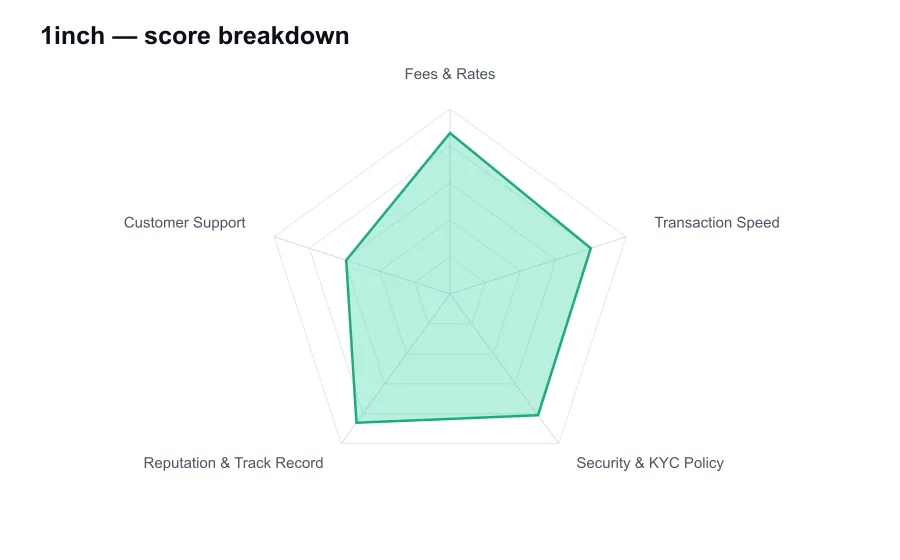
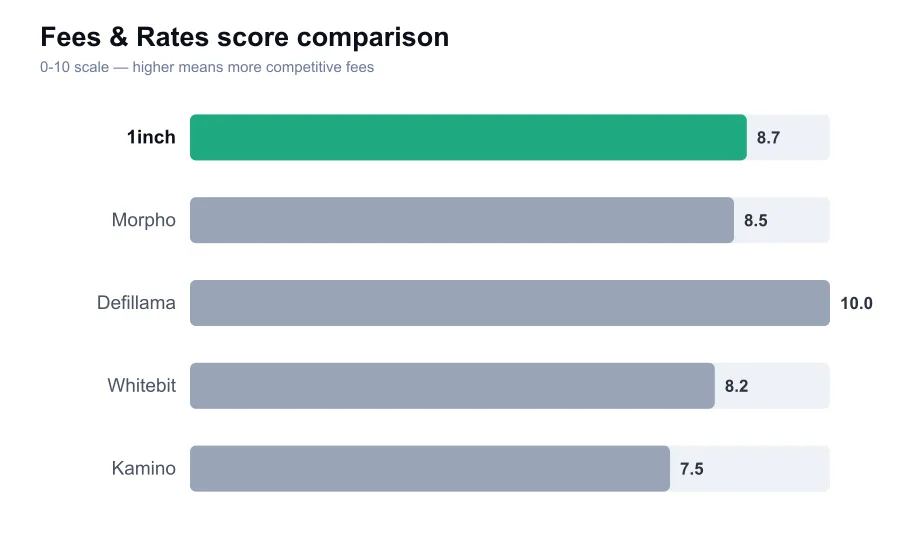
1inch scores 8.2/10 overall in our independent review, measured against every other provider we've compared, strongest on Fees & Rates (8.7/10) and weakest on Customer Support (5.9/10).
8.2/10 ★★★★★ How we score → Status: active (checked 2026-10-13T19:41:25.548Z)| Best for | Not for |
|---|---|
| Finds routes across multiple decentralized liquidity sources | Gas can make small Ethereum swaps uneconomic |
| No standard protocol fee for ordinary swaps | Users must manage approvals and smart contract risk |
Editorial independence: our scores and rankings are produced using the fixed criteria above and are not influenced by advertisers. This is an independent ranking site and is not operated by, or affiliated with, any provider we list.
Affiliate disclosure: some links on this page may earn us a commission at no extra cost to you. This does not affect our rankings.
What is 1inch?
1inch is a decentralized exchange aggregator. It connects a self-custody wallet to liquidity from multiple decentralized exchanges and seeks an efficient route for a token swap. Users retain control of wallet funds but sign their own on-chain transactions.
In-Depth Review of 1inch
1inch is one of the best-known decentralized exchange aggregators in crypto. Rather than operating a conventional order book or holding user balances, it searches liquidity across decentralized exchanges and routes a swap through one or several sources. In practical terms, it is a price-optimization layer for on-chain trading. For users already comfortable with a wallet, token approvals, gas, and smart contract risk, it can be much more useful than manually checking Uniswap, Sushi, Curve, and other venues one at a time.
The central value proposition is routing. A direct swap on one automated market maker may suffer from poor price impact, while splitting the trade across several pools can produce a better result. 1inch's Pathfinder algorithm is designed to find those routes. That can save real money, especially on Ethereum mainnet and other networks where liquidity is fragmented. It also means the interface can look more complicated than a simple swap page, because the trade is often a bundle of on-chain actions.
1inch does not generally impose a standard protocol fee on ordinary swaps. That sounds cheap, and compared with centralized trading fees it often is. But users still pay network gas, liquidity-provider fees charged by the underlying pools, price impact, and any fee configured by a third-party interface or integrator. On Ethereum during a gas spike, the network cost can dwarf the value of a small swap. Anyone calling 1inch free is leaving out the part that usually matters most.
The platform is especially good at exposing the true economics of a transaction before signing. It shows the expected amount, estimated gas, minimum received, route details, and the effect of slippage settings. That transparency is a major advantage over opaque instant exchangers. Still, users must read the transaction screen. The wallet confirmation is the final authority, and malicious sites that imitate familiar swap interfaces are a persistent danger.
Speed is determined by the blockchain you use. A trade submitted on Arbitrum, Base, Polygon, or BNB Smart Chain can confirm relatively quickly under normal conditions. Ethereum mainnet can be slower and expensive when blocks are congested. 1inch cannot accelerate the chain itself, though it can use routing and transaction features intended to make execution more efficient. Comparing it with a centralized exchange's internal matching speed is misleading. One is settlement on a public blockchain, the other is mostly database activity until withdrawal.
The Fusion mode is 1inch's most distinctive execution feature. Instead of the user directly broadcasting and paying for a conventional swap transaction in the usual way, an order can be filled by resolvers competing to execute it. This can provide gasless user experience for supported swaps and can help reduce exposure to certain forms of maximal extractable value. It is clever technology, but users should understand that an order may take time to fill and may not fill if its terms are not attractive enough to resolvers.
There is no account-level KYC in the normal 1inch wallet-connect flow. You connect a self-custody wallet and authorize transactions. That is a genuine privacy advantage over centralized exchanges, although it does not make activity invisible. Public blockchain transactions are traceable, and front-end access or third-party fiat services may be restricted by location. Decentralized access should never be confused with secrecy.
Security is a more nuanced question than it is for a custodial exchange. 1inch does not take custody of your portfolio, so there is no pooled exchange wallet for an attacker to raid in the usual sense. The risk sits with your wallet, your approvals, the smart contracts you invoke, the tokens you trade, and the front end you reach. A bad signing decision can be far more damaging than a weak account password.
1inch has a long enough history to deserve serious consideration. It launched in 2020 and quickly became a major name in the decentralized finance sector. The project has built a recognizable suite around aggregation, limit orders, a wallet, and developer APIs. Its survival through several brutal DeFi cycles counts for something. Still, recognition is not a safety certificate. Smart contracts can contain vulnerabilities, liquidity sources can fail, and scam tokens remain everywhere.
One practical limitation is token quality. 1inch can route trades involving assets that are technically tradable but economically dangerous. A token with a familiar ticker may be a scam copy. A pool may be shallow, taxed, pausable, or structured so that buyers cannot sell. The aggregator can optimize a route, but it cannot turn a fraudulent token into a legitimate investment. Contract-address verification is essential.
Customer support is where decentralized tools feel least like retail finance. 1inch has documentation, community channels, support resources, and transaction explorers, but there is no support agent who can reverse an approved wallet transaction. If you send USDC to the wrong address or sign an unlimited allowance for a malicious contract, the loss is usually final. This is not a defect unique to 1inch, but it should shape who uses it.
For serious users, the best setup is a separate browser wallet or hardware wallet account dedicated to DeFi. Keep only the working amount in that wallet, verify 1inch's domain, review approvals periodically, and revoke permissions that are no longer needed. Use conservative slippage, particularly for thin assets. If a quote looks bizarrely favorable, the token or route may be the problem rather than the opportunity.
1inch remains one of the strongest choices for noncustodial swaps because its routing technology is genuinely useful rather than cosmetic. It has a better reason to exist than a simple branded swap interface. The downside is that it rewards competence. Beginners who do not understand gas, approvals, and token contracts can lose money in ways no fee comparison will reveal.
My judgment is clear: 1inch is excellent infrastructure for experienced on-chain users, but it is not a beginner-friendly substitute for a regulated exchange. Its direct protocol fees are low, execution can be very efficient, and self-custody is a meaningful advantage. Yet every user carries more operational responsibility. If you can manage that responsibility, 1inch is among the first decentralized swap tools I would check. If you cannot, start with simpler assets and small transactions before trusting it with meaningful funds.
Score Breakdown
| Criterion | Score | Note |
|---|---|---|
| Fees & Rates | 8.7 | No standard swap protocol fee, gas still matters |
| Transaction Speed | 8.0 | Chain-dependent, with efficient multi-source routing |
| Security & KYC Policy | 8.1 | Self-custody reduces custody risk, contract risk remains |
| Reputation & Track Record | 8.6 | Major DeFi aggregator active since 2020 |
| Customer Support | 5.9 | Good documentation, no recovery from bad signatures |
Key Facts
Pros and Cons
| Pros | Cons |
|---|
How 1inch Works
- Connect a compatible self-custody wallet
- Select the network, token pair, and swap amount
- Review the route, expected output, gas, and slippage
- Approve the token if required
- Sign the swap transaction and wait for blockchain confirmation
KYC
| Requirement | none |
|---|---|
| Notes | The standard on-chain wallet flow does not require account KYC. Network activity is public, and third-party services or front-end access may impose their own restrictions. |
Supported Assets
| Notable coins | Ethereum, USDC, USDT, Wrapped Bitcoin, Chainlink, Uniswap, Aave, DAI |
|---|---|
| Networks | Ethereum, Arbitrum, Base, Polygon, BNB Smart Chain, Optimism, Avalanche |
How to Use 1inch Safely
- Use the official 1inch domain and bookmark it
- Verify token contract addresses from trusted sources
- Review gas, slippage, and minimum received before signing
- Use a separate wallet account for DeFi activity
- Revoke old token approvals you no longer need
- Never sign a wallet prompt you do not understand
Does 1inch charge a trading fee?
1inch generally does not charge a standard protocol fee for ordinary swaps. You still pay blockchain gas and fees charged by the underlying liquidity pools used in the route.
Does 1inch require KYC?
The normal wallet-connect swap flow does not require an account or KYC. Blockchain transactions remain public, and access to certain services can be restricted depending on location.
What is 1inch Fusion?
Fusion is an order-based swap system where resolvers compete to fill orders. It can provide a gasless user experience for supported trades, though an order may take time to fill.
Why is a 1inch swap expensive on Ethereum?
Ethereum gas is paid to the network and can rise sharply during congestion. For small swaps, gas may cost more than any price improvement found by the aggregator.
Can 1inch reverse a transaction I approved?
No. 1inch is noncustodial, and confirmed blockchain transactions generally cannot be reversed. Check the wallet prompt, recipient contract, and token before signing.
Why should I review token approvals after using 1inch?
Token approvals let a smart contract spend specified assets from your wallet. Revoke allowances you no longer need, especially if you interacted with unfamiliar tokens or applications.
Editorial independence: our scores and rankings are produced using the fixed criteria above and are not influenced by advertisers. This is an independent ranking site and is not operated by, or affiliated with, any provider we list.
Affiliate disclosure: some links on this page may earn us a commission at no extra cost to you. This does not affect our rankings.