Independentreserve
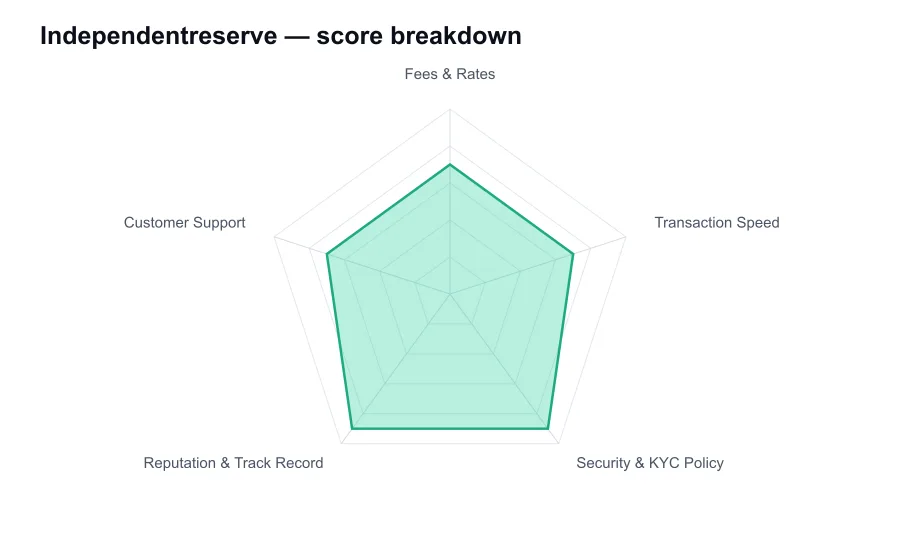
Independentreserve scores 7.9/10 overall in our independent review, measured against every other provider we've compared, strongest on Security & KYC Policy (9.0/10) and weakest on Customer Support (7.0/10).
7.9/10 ★★★★★ How we score →| Best for | Not for |
|---|---|
| Established Australian exchange since 2013 | Casual trader fees are not market leading |
| AUD bank transfer and PayID support | Smaller asset range than offshore giants |
Editorial independence: our scores and rankings are produced using the fixed criteria above and are not influenced by advertisers. This is an independent ranking site and is not operated by, or affiliated with, any provider we list.
Affiliate disclosure: some links on this page may earn us a commission at no extra cost to you. This does not affect our rankings.
In-Depth Review of Independentreserve
Independent Reserve is a regulated Australian cryptocurrency exchange aimed at investors and self directed traders who care more about reliable fiat access and compliance than meme coin speculation. Founded in 2013, it is one of the longer standing names in the Australian market. The service also has a presence in Singapore, giving it a more serious regional profile than many exchange brands that appeared during a bull market and disappeared shortly after.
This is a platform built around Australian dollars, established assets and a conservative operating style. That positioning has clear strengths. Investors who want to move money from an Australian bank account, buy Bitcoin or Ethereum, and retain a sensible audit trail will find it far more reassuring than an offshore exchange. It is not designed to thrill traders hunting the newest low cap token.
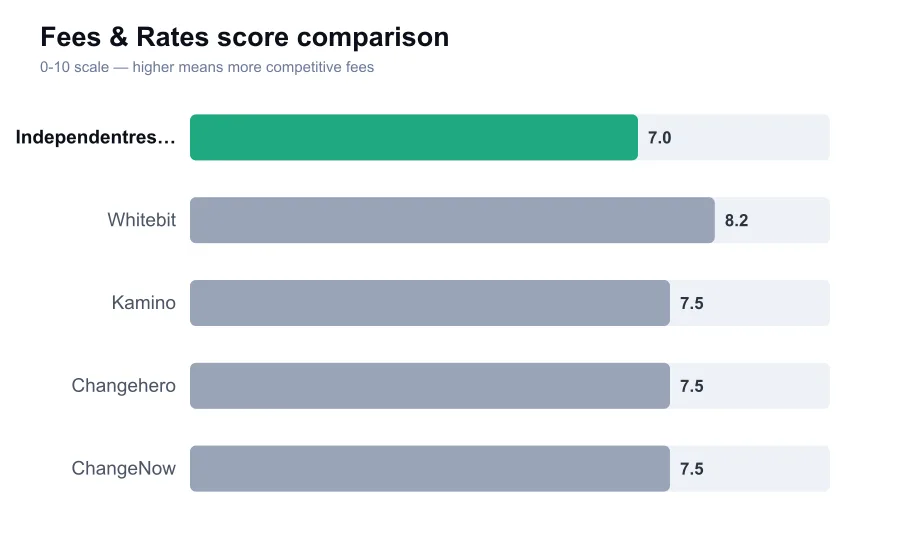
Its fee schedule deserves careful reading because the headline can sound expensive or cheap depending on how you trade. Standard trading fees use a tiered model, with rates historically starting around 0.5 percent for lower volume users and falling significantly as monthly volume rises. Active traders can access much lower rates, reaching around 0.02 percent at the highest tiers. That is a credible structure, but the typical casual customer will not trade enough to enjoy the sharpest pricing.
For an ordinary investor making occasional purchases, 0.5 percent is acceptable but not exceptional. Australian competitors such as Kraken, Swyftx and CoinSpot offer different combinations of convenience, spread and commission, while large global venues can be cheaper for those comfortable with their regulatory and banking tradeoffs. Independent Reserve earns its fee rather than winning purely on price. You are paying for a mature local infrastructure and a more restrained approach.
Bank deposit options are a genuine practical benefit. Australian dollar transfers through PayID or bank transfer are normally inexpensive and can arrive quickly, often within minutes for PayID once accounts are properly set up. Settlement can still depend on the sending bank, compliance checks and cut off times. Deposits should never be judged by the most optimistic advertised time, particularly on a first transfer.
Trade execution is generally prompt for liquid pairs, but speed depends on liquidity and order type just as it does anywhere else. Major markets such as BTC and ETH against AUD are the sensible place to trade. Less active pairs can have thinner order books, and that can cost more than the stated fee through spread and slippage. Use limit orders if price matters, rather than treating an instant market order as a harmless convenience.
Crypto withdrawals are not as immediate as a chart update, and that is often a deliberate security decision. Exchanges need blockchain confirmations, wallet controls and occasional manual reviews, especially for unusual activity. Independent Reserve has a record of treating account and withdrawal safeguards seriously. That can feel slow when the market is running, but I would rather see an established exchange ask questions than act as if moving customer assets has no risk.
KYC is mandatory for a functioning account. That is no surprise for an Australian regulated exchange, and anyone looking for no identification access is simply shopping in the wrong category. Identity verification, source of funds checks and transaction monitoring can be inconvenient, particularly for larger balances or unusual payment patterns. They are also part of why Independent Reserve is a viable option for investors who want a compliant on ramp.
On security, the exchange has one of the better reputations in its home market. It has long emphasized offline asset storage, security controls and independently reviewed processes. Its partnership history and use of mechanisms such as insurance arrangements for certain custodial risks have helped it stand apart from anonymous offshore operations. No centralized exchange should be treated as risk free, but this is a materially more credible custody proposition than a newly launched platform promising impossible yields.
The company also deserves credit for longevity. Surviving since 2013 in crypto is meaningful. It has operated through multiple boom and bust cycles, regulatory shifts, banking friction and the collapse of several supposedly untouchable global brands. Longevity is not proof of perfection, but it is a stronger signal than flashy marketing or a large social media following.
That said, Independent Reserve's selection is fairly measured. The range of assets and advanced products does not match Binance or the more aggressive offshore exchanges. Some customers will consider that a limitation, and they are right if their strategy involves constant rotation into emerging tokens. I see it as an intentional tradeoff, though the platform could communicate more clearly about why a cautious listing standard is valuable.
Customer support has the tone of a financial service rather than a consumer app. Help materials are useful, account issues can be handled by real people, and the company has a local reputation to protect. But it is not a 24 hour instant chat playground, and compliance cases can take time. Users expecting a fast answer while a transaction is under review may be disappointed, even if the review itself is justified.
The user experience is clean and less intimidating than a pro derivatives terminal. The AutoTrader feature and recurring purchase options are useful for investors who want rule based accumulation rather than screen watching. Sophisticated traders may find the feature set restrained, but that restraint is consistent with the exchange's character. Independent Reserve is selling trust and utility, not adrenaline.
My view is straightforward. Independent Reserve is one of the better choices for Australian residents who want a serious, compliant gateway to major crypto assets and can accept middle of the road retail fees. It is not the cheapest venue, the broadest market or the fastest route into every fashionable coin. Its value lies in having survived, stayed regulated and kept its priorities relatively boring. In crypto, boring can be a premium feature.
Score Breakdown
| Criterion | Score | Note |
|---|---|---|
| Fees & Rates | 7.0 | Tiered trading fees, retail pricing starts around 0.5% |
| Transaction Speed | 7.0 | Fast AUD transfer options, security checks can slow withdrawals |
| Security & KYC Policy | 9.0 | Strong compliance posture and established custody controls |
| Reputation & Track Record | 9.0 | Australian exchange operating since 2013 |
| Customer Support | 7.0 | Local service reputation, not instant help for every case |
Pros and Cons
| Pros | Cons |
|---|
What fees does Independent Reserve charge?
Trading fees are tiered by 30 day volume. Lower volume users have historically paid about 0.5 percent, while high volume rates can fall substantially.
Does Independent Reserve require identity verification?
Yes. Customers must complete identity checks to use the regulated exchange and its fiat services.
How fast are AUD deposits?
PayID and bank transfers can be fast, often arriving within minutes, but bank processing and account reviews can affect timing.
Editorial independence: our scores and rankings are produced using the fixed criteria above and are not influenced by advertisers. This is an independent ranking site and is not operated by, or affiliated with, any provider we list.
Affiliate disclosure: some links on this page may earn us a commission at no extra cost to you. This does not affect our rankings.