Liquity
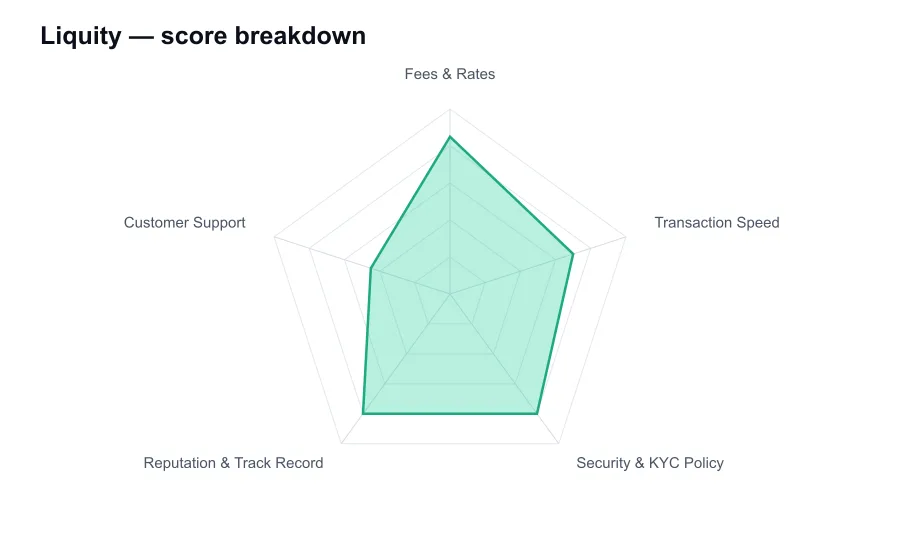
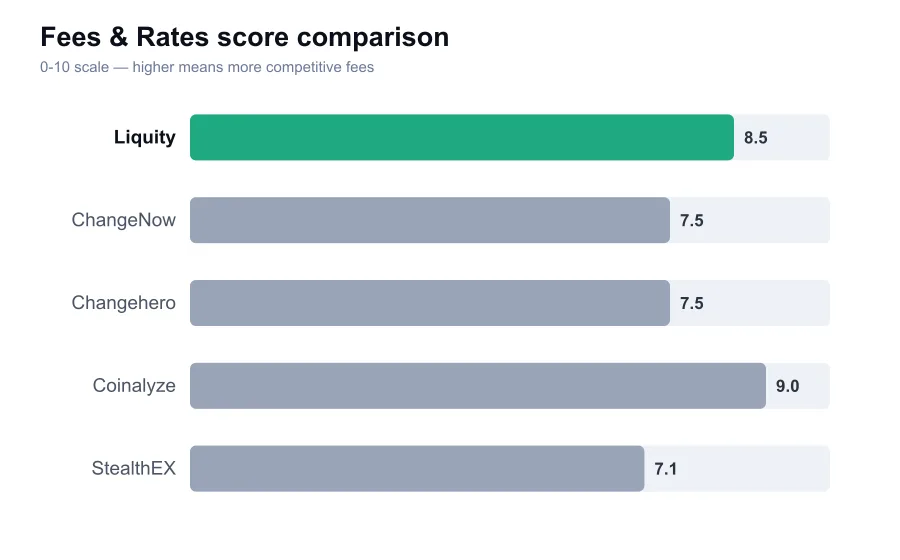
Liquity scores 7.7/10 overall in our independent review, measured against every other provider we've compared, strongest on Fees & Rates (8.5/10) and weakest on Customer Support (4.5/10).
7.7/10 ★★★★★ How we score → Status: active (checked 2026-10-13T19:43:31.530Z)| Best for | Not for |
|---|---|
| No recurring interest in original LUSD borrowing | 110% liquidation threshold can punish aggressive borrowers |
| Immutable original protocol design | Borrowing fee rises with the base rate |
Editorial independence: our scores and rankings are produced using the fixed criteria above and are not influenced by advertisers. This is an independent ranking site and is not operated by, or affiliated with, any provider we list.
Affiliate disclosure: some links on this page may earn us a commission at no extra cost to you. This does not affect our rankings.
What is Liquity?
Liquity is a decentralized borrowing protocol centered on Ether collateral and stablecoins. In its original version, users lock ETH in a Trove and borrow LUSD without recurring interest. Liquidation rules and repayments are enforced by smart contracts rather than a lender's credit department.
In-Depth Review of Liquity
Liquity made its name by offering an unusually clean proposition in DeFi borrowing. Deposit Ether collateral, borrow the LUSD stablecoin, pay no recurring interest in the original protocol, and maintain enough collateral to avoid liquidation. That was a meaningful departure from variable rate lending pools. The protocol's focus on ETH backed borrowing gave it a clearer identity than many broad, multi asset platforms.
The original Liquity protocol is deliberately rigid. Borrowers open a Trove using ETH as collateral and can borrow LUSD against it. The minimum collateral ratio is 110%, which means a position can be liquidated if its collateral value falls below that threshold. In practice, borrowing at 110% is reckless. Ether can move violently enough to erase a thin buffer in minutes.
Liquity's fee model is one of its best features, though it is often misunderstood. LUSD borrowing has no ongoing interest rate in the original system. Instead, borrowers pay a one time borrowing fee that has a 0.5% minimum and rises with redemptions through the protocol's base rate mechanism. Redemptions also carry a fee. The cost is transparent, but it is not always fixed at 0.5%.
That structure can be very attractive for a borrower who expects to keep a position open for a long time. A 0.5% or modestly higher upfront cost can beat paying a variable annualized borrow rate for months. It can be unattractive for short term users if the base rate has risen sharply after heavy redemptions. Check the live borrowing fee before opening a Trove, not a blog post written during a quiet market.
Liquity's Stability Pool is the other half of the design. LUSD holders can deposit into it and absorb debt from liquidated Troves. In exchange, they receive a share of liquidated ETH collateral and LQTY rewards. This is not the same as holding a stablecoin in a savings account. Depositors can lose LUSD during liquidations and receive ETH instead, so their asset mix changes precisely when markets are stressed.
The original protocol has a 200 LUSD minimum net debt. That small detail matters because it makes tiny test positions less practical than they might appear. There is also a 0.0375 ETH gas compensation reserve attached to each Trove, designed to make liquidations economically workable. Users get that reserve back when they close the Trove, assuming the position was not liquidated.
Speed is pure onchain speed. Opening, adjusting, or closing a Trove requires an Ethereum transaction, and redemptions and liquidations are handled by the protocol's rules. During a fast Ether selloff, a borrower should not assume they can always add collateral at the perfect moment. Network congestion, wallet errors, and a rapidly changing price can turn a manageable position into a liquidation.
Liquity's security posture is stronger than its no governance design might initially sound. The original protocol was built to be immutable and avoids a conventional admin key that can alter core rules. That sharply limits governance capture and emergency intervention risk. It also means there is no team that can change the liquidation ratio, freeze a bad decision, or rescue users from a market event.
The protocol has maintained a respectable record since its 2021 launch, especially given the stress stablecoin systems have endured. LUSD has generally held up better than many lightly collateralized alternatives because it is backed by Ether and has an onchain redemption mechanism. Still, LUSD can trade below or above one dollar in secondary markets. A stablecoin's peg mechanism is not an iron promise of a one dollar market price.
Liquity V2 and the BOLD stablecoin expand the project beyond the original LUSD model, with user chosen interest rates and a different borrowing structure. That is a meaningful evolution, but it also makes the Liquity name less simple than it once was. Prospective users should identify whether they are using the original LUSD protocol or Liquity V2, then read the specific documentation for that system.
No KYC is required for the protocol. Users interact with a wallet and smart contracts, without a Liquity account, password reset path, or identity review. That suits privacy minded DeFi users. It also makes phishing resistance and wallet hygiene entirely the user's job. There is nobody to call after a seed phrase compromise.
Support is limited in the conventional sense. Liquity provides documentation and community resources, but it cannot reverse a liquidation, cancel a confirmed transaction, or restore a compromised wallet. The mechanics are transparent enough for a patient reader, yet the consequences of misunderstanding them are real. This is not a product to use after watching a thirty second social media clip about borrowing against ETH.
Liquity is best for an ETH holder who understands collateralized debt and wants a stablecoin loan without recurring interest in the original protocol. It can also suit a Stability Pool participant who consciously wants ETH liquidation exposure. It is a poor place for someone who thinks a 110% ratio is a recommended setting, or who needs dollar stability without any crypto market risk.
I still admire Liquity's original design. The absence of recurring interest, immutable rules, and direct redemption mechanism are elegant choices. The trade is unforgiving liquidation risk and a stablecoin that must be understood as a DeFi asset, not cash. Borrow conservatively, keep collateral well above the minimum, and treat the Stability Pool as an active risk position. For the right user, Liquity remains one of DeFi's most coherent borrowing systems.
Score Breakdown
| Criterion | Score | Note |
|---|---|---|
| Fees & Rates | 8.5 | No recurring LUSD interest, 0.5% minimum borrow fee |
| Transaction Speed | 7.0 | Ethereum settlement can be slow during volatility |
| Security & KYC Policy | 8.0 | Immutable original protocol, liquidation risk is user borne |
| Reputation & Track Record | 8.0 | Established ETH backed stablecoin protocol since 2021 |
| Customer Support | 4.5 | Documentation and community, no intervention capability |
Key Facts
Pros and Cons
| Pros | Cons |
|---|
How Liquity Works
- Connect an Ethereum self custody wallet
- Deposit ETH as collateral into a Trove
- Choose a conservative LUSD borrowing amount
- Pay the displayed one time borrowing fee and confirm
- Monitor the collateral ratio and repay or add ETH if needed
KYC
| Requirement | none |
|---|---|
| Notes | Liquity's protocol does not require an account or identity verification. Users are responsible for wallet security and tax or legal obligations. |
Supported Assets
| Notable coins | ETH, LUSD, LQTY, BOLD |
|---|---|
| Networks | Ethereum |
Limits
| Minimum | 200 LUSD minimum net debt |
|---|---|
| Notes | Original Liquity Troves also include a 0.0375 ETH gas compensation reserve. |
How to Use Liquity Safely
- Keep collateral far above the 110% liquidation threshold
- Check the live borrowing fee before opening a Trove
- Understand that Stability Pool deposits gain ETH exposure
- Use the official interface and verify wallet approvals
- Keep ETH available for network gas during volatility
Does borrowing LUSD have interest?
The original Liquity protocol charges no recurring interest. It charges a one time borrowing fee with a minimum of 0.5%, plus a variable base rate.
What is Liquity's minimum collateral ratio?
A Trove can be liquidated below a 110% collateral ratio. Borrowing close to that threshold is highly risky because ETH price moves can be rapid.
What is the minimum LUSD debt?
The original protocol requires a minimum net debt of 200 LUSD per Trove.
Why does Liquity lock 0.0375 ETH in a Trove?
The original protocol includes 0.0375 ETH as a gas compensation reserve for liquidation operations. It is returned when a Trove is closed normally.
Can Stability Pool depositors lose LUSD?
Yes. Stability Pool deposits are used to offset liquidated debt. Depositors receive ETH collateral and LQTY rewards, so their LUSD balance can decrease.
Does Liquity require KYC?
No. The protocol does not require identity verification. Users connect a self custody wallet and interact directly with smart contracts.
Editorial independence: our scores and rankings are produced using the fixed criteria above and are not influenced by advertisers. This is an independent ranking site and is not operated by, or affiliated with, any provider we list.
Affiliate disclosure: some links on this page may earn us a commission at no extra cost to you. This does not affect our rankings.