Swapter
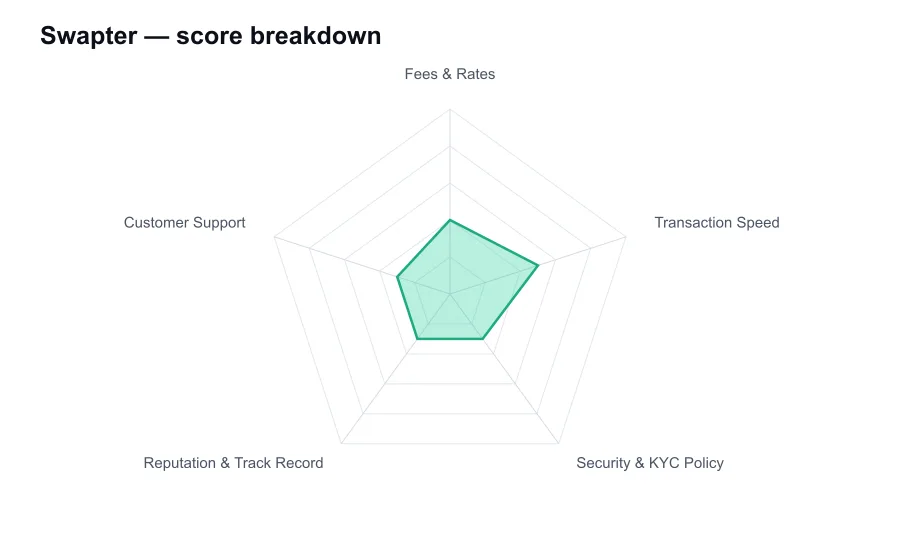
Swapter scores 3.5/10 overall in our independent review, measured against every other provider we've compared, strongest on Transaction Speed (5.0/10) and weakest on Customer Support (3.0/10).
3.5/10 ★★★★★ How we score → Status: active (checked 2026-10-13T19:22:23.276Z)| Best for | Not for |
|---|---|
| Direct crypto conversion flow | Limited public track record |
| No trading terminal required | No clearly documented pricing benchmark |
Editorial independence: our scores and rankings are produced using the fixed criteria above and are not influenced by advertisers. This is an independent ranking site and is not operated by, or affiliated with, any provider we list.
Affiliate disclosure: some links on this page may earn us a commission at no extra cost to you. This does not affect our rankings.
What is Swapter?
Swapter is an instant crypto exchange service intended for direct wallet-to-wallet conversions. Rather than offering a full trading account, it presents a swap quote and generates instructions for sending the source asset. Users should evaluate the final output amount and the provider's terms before funding an order.
In-Depth Review of Swapter
Swapter is another service in the instant-exchange category, a segment built for users who want a crypto conversion without creating a full trading account or learning an exchange terminal. That can be convenient. You choose a pair, provide a receiving address, and fund a one-off order. The service is closer to a conversion broker than a conventional centralized exchange, and it should be judged by the quality of its quotes, routing, disclosures, and handling of exceptions.
The immediate challenge is that Swapter does not have the same volume of independently verifiable public information as leading instant-swap brands. A sparse public profile does not automatically mean the service is unreliable, but it gives a reviewer fewer ways to assess it. The crypto industry has too many examples of polished websites outlasting their customer service. Public evidence matters because a user needs to know what happens after an ordinary swap turns into a delayed one.
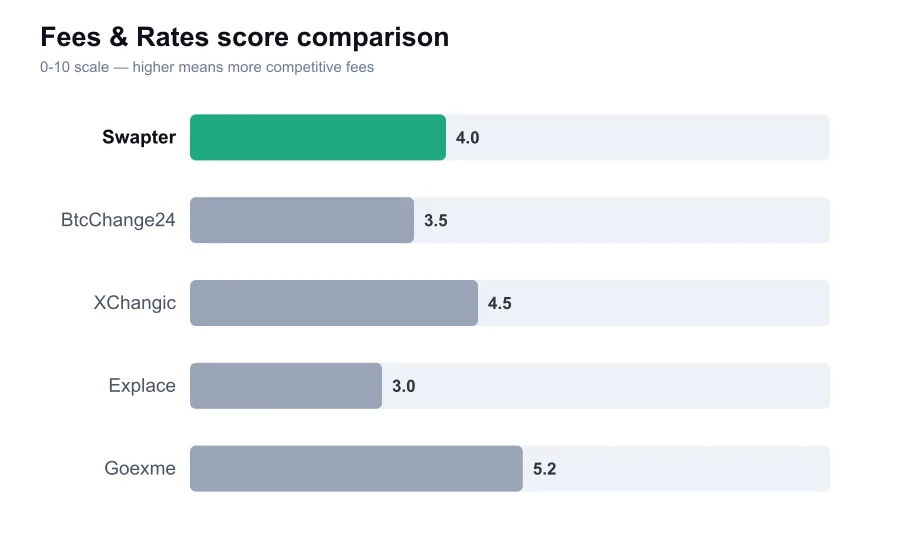
Pricing is the first thing I would scrutinize. Instant exchange providers commonly quote a final amount rather than displaying a clean commission line. That final figure can contain a service margin, a liquidity-provider spread, and network costs. This is a valid structure if the quote is competitive and the terms are clear. It becomes a problem when the user cannot tell whether a low headline fee is being offset by a weak rate.
Swapter should therefore be treated as a quote-comparison tool rather than a default route. Open two or three reputable alternatives at the same time and compare the amount you will actually receive. Do not compare a vague percentage or a market-price chart. Compare the final output after all estimated costs. For larger swaps, even a one percent difference can be more important than the convenience of a familiar interface.
Speed claims from any instant exchanger need context. The provider can process an order quickly after it has received enough confirmations, but it does not control Bitcoin block production, Ethereum gas conditions, or the confirmation rules of the destination platform. A transfer can also slow down if the liquidity route needs to change. Swapter may handle routine orders promptly, but there is not enough public operational data for me to rate its speed as proven.
The safest assumption is that a simple swap is fast until it is not. That is not cynicism. It is the basic reality of routed crypto transactions. If your destination exchange requires a specific memo, a particular token contract, or a strict deposit window, check those details twice. An instant exchange cannot fix a transfer sent over the wrong chain, and support may have very limited options once funds have moved.
The custody model is relatively attractive in principle. A one-off swap is generally safer than leaving a permanent balance on a little-known platform, because the provider does not need to hold your funds before or after each transaction. Yet that advantage has limits. During the transaction, users still rely on Swapter and its counterparties to complete the conversion and send the destination asset.
The important security question is not whether a service calls itself noncustodial. It is whether it explains its identity-verification policy, transaction monitoring, dispute process, and method for handling a transfer that cannot be completed. Swapter does not provide enough widely corroborated public material for a high security score. I would assume that anti-money-laundering checks may be possible unless the terms explicitly state otherwise.
That issue deserves emphasis because a surprise verification request is much more painful after you have sent coins. Some instant exchanges reserve broad discretion to request identification if transaction monitoring is triggered. A legitimate compliance process is understandable, but users deserve a clear explanation of the possible hold, the documents requested, and the route for recovering or returning funds if verification cannot be completed.
Swapter's reputation remains its weak point. It has not accumulated the years of broad community discussion, comparison coverage, and externally visible service history that make a provider easier to trust. A small operator can build a good record over time. Until then, customers should limit exposure and avoid treating a smooth first transaction as proof that every future case will be handled well.
Support is hard to praise without evidence from difficult cases. Fast responses to a simple pre-sale question are not the benchmark. The benchmark is a useful answer when a transaction has several confirmations, the order status has not changed, and the destination asset has not arrived. Swapter needs a clearer visible record of that kind of problem resolution before it can compete credibly with better-known services.
I would consider Swapter for a low-value swap only if it produces a clearly superior final rate and the pair uses an uncomplicated, well-supported network. It is not the place to experiment with obscure token contracts, cross-chain edge cases, or a payment that has to settle today. The convenience is real, but the information gap is real too.
A cautious user can reduce most avoidable errors. Confirm the destination chain, copy the deposit details rather than typing them, and watch for token lookalikes. Keep a record of every screen before funding the order. That discipline matters more on smaller services because the support trail and public escalation options are thinner.
My final take is that Swapter has a familiar and potentially useful product format, but it remains insufficiently proven. It earns a slightly better score for basic usability than for trust. Until it provides clearer pricing detail and builds a durable public reputation, I would use an established provider for any amount that would hurt to have delayed.
Score Breakdown
| Criterion | Score | Note |
|---|---|---|
| Fees & Rates | 4.0 | Final-rate comparison is necessary because pricing is not highly transparent. |
| Transaction Speed | 5.0 | Standard instant-swap flow, but limited public completion data. |
| Security & KYC Policy | 3.0 | One-off swaps reduce standing custody, yet policy detail is thin. |
| Reputation & Track Record | 3.0 | Limited long-term independent customer and company record. |
| Customer Support | 3.0 | Hard to verify performance on delayed or reviewed orders. |
Key Facts
| Fact | Value | Source |
|---|---|---|
| Service model | Instant crypto conversion | - |
| Trading terminal | Not the primary product | - |
| Price display | Final quote should be compared | - |
| Public track record | Limited independently verified history | - |
| First transaction | Use a low-value test | - |
Pros and Cons
| Pros | Cons |
|---|
How Swapter Works
- Choose the crypto asset and amount to send
- Select the asset you want to receive
- Enter and verify your receiving wallet address
- Review the final quote and deposit instructions
- Send funds and retain the order details until settlement
How to Use Swapter Safely
- Test the service with a low-value transaction
- Compare the final output against other exchangers
- Verify chain selection and any memo or tag
- Never send unsupported tokens to the deposit address
- Save order screenshots and blockchain hashes
Is Swapter designed for active trading?
No. It is better understood as an instant conversion service than as a venue for order-book trading, charting, or limit orders.
How should I compare Swapter's cost with another exchanger?
Use the same source amount, asset pair, and network, then compare the exact destination amount shown immediately before confirming each order.
Can a blockchain confirmation delay my Swapter order?
Yes. An order cannot generally proceed until the provider sees the required confirmations, and confirmation time varies sharply by network.
What is the biggest practical risk with a small exchange service?
The main risk is a difficult exception, such as a delayed order or compliance review, where there is little independently verified evidence about support outcomes.
Should I use Swapter to send funds to an exchange deposit address?
Only if you have confirmed the exact destination network and any required memo or tag. A wrong network or missing tag can create a costly recovery issue.
Editorial independence: our scores and rankings are produced using the fixed criteria above and are not influenced by advertisers. This is an independent ranking site and is not operated by, or affiliated with, any provider we list.
Affiliate disclosure: some links on this page may earn us a commission at no extra cost to you. This does not affect our rankings.