Morpho
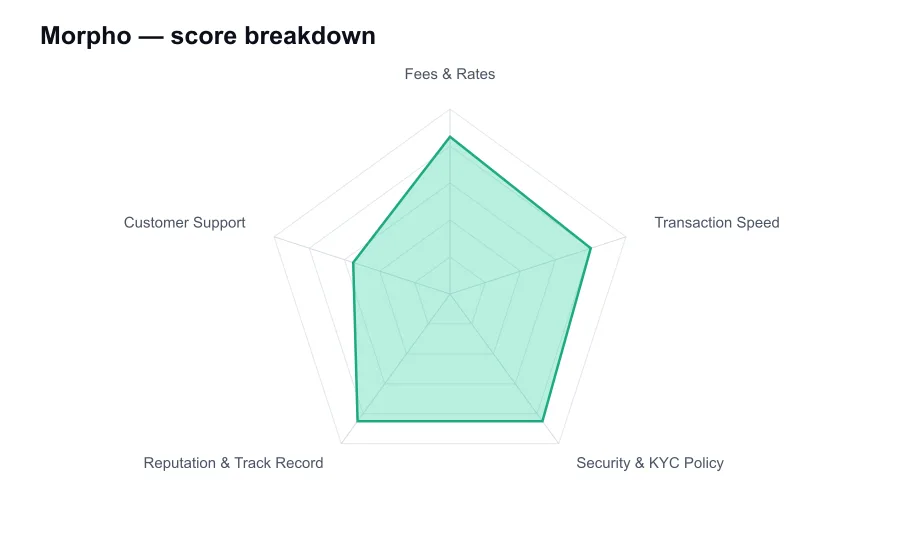
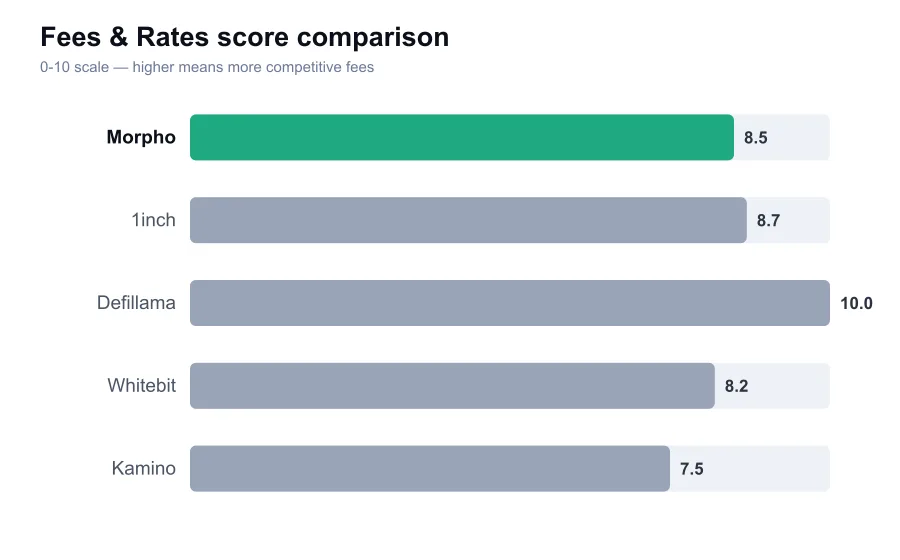
Morpho scores 8.2/10 overall in our independent review, measured against every other provider we've compared, strongest on Fees & Rates (8.5/10) and weakest on Customer Support (5.5/10).
8.2/10 ★★★★★ How we score → Status: active (checked 2026-10-13T19:43:31.454Z)| Best for | Not for |
|---|---|
| Isolated, permissionless lending markets | Market quality varies sharply |
| No default Morpho Blue protocol fee | Vault curators add a trust decision |
Editorial independence: our scores and rankings are produced using the fixed criteria above and are not influenced by advertisers. This is an independent ranking site and is not operated by, or affiliated with, any provider we list.
Affiliate disclosure: some links on this page may earn us a commission at no extra cost to you. This does not affect our rankings.
What is Morpho?
Morpho is a decentralized lending protocol where users supply crypto assets for yield or borrow against collateral. Its Morpho Blue system lets anyone create isolated lending markets with predefined risk settings. Users retain custody through their wallet rather than opening an exchange account.
In-Depth Review of Morpho
Morpho is one of the more important lending protocols to emerge from Ethereum's DeFi sector. It started by optimizing rates on top of Aave and Compound, then made a much bolder move with Morpho Blue, a permissionless lending primitive where anyone can create a market around a collateral asset, loan asset, oracle, interest rate model, and liquidation threshold. That shift made Morpho less like a lending app and more like financial infrastructure.
The appeal is obvious if you understand the limitations of pooled lending. On Aave, depositors share a pool and inherit its collective risk profile. Morpho Blue isolates each market. A borrower using wstETH as collateral against USDC does not automatically share risk with a borrower using a more exotic collateral type. Sophisticated users can choose their risk parameters rather than accept a platform's default basket.
That freedom is also Morpho's biggest trap. A market being visible in a frontend does not mean it is sensible. Permissionless deployment means markets can use unfamiliar collateral, questionable oracles, or aggressive loan to value settings. Morpho's architecture is clean, but it transfers more due diligence to the user than Aave, Coinbase, or a conventional exchange ever would.
Fees are strong, particularly at the protocol level. Morpho Blue has no mandatory protocol fee by default. A market creator can configure a fee of up to 25% of interest paid, though the actual cost a user sees depends on the selected market or vault. Curated MetaMorpho vaults may also charge management or performance fees set by their curator. This is not a simple flat price list, and anyone claiming Morpho is always cheap is skipping the important part.
For borrowers, the meaningful number is the displayed borrow APR after interest and any market fee. For lenders, it is the supply APR after the curator's cut and after accounting for idle liquidity in a vault. Direct lending through Blue can be capital efficient, but lenders may wait for a matching borrower. Vaults solve much of that usability problem by allocating capital across markets, yet they introduce curator judgment as a new risk.
Transaction speed is dictated by the chain, not a Morpho customer service desk. On Ethereum mainnet, actions settle once confirmed onchain, usually within minutes under normal network conditions. Morpho deployments on Base and other supported networks can feel materially faster and cheaper. There is no withdrawal queue in the exchange sense, but withdrawing from a vault still depends on available liquidity in its underlying markets.
The protocol's security model deserves respect. Morpho Blue is deliberately compact and immutable, a sensible design choice for lending code that will hold significant value. Immutable contracts reduce governance attack surface because nobody can quietly upgrade the core logic after deposits arrive. Audits, bug bounties, and public code help, but none of that removes smart contract, oracle, liquidation, or curator risk.
Morpho's own history is cleaner than many DeFi peers, but that should not be confused with a guarantee. Lending protocols fail in several ways without a dramatic protocol exploit. Bad oracle behavior, a collapsing collateral asset, poor liquidation depth, or a curator allocating into a risky market can all hurt lenders. The market isolation model contains contagion better than a shared pool, but it cannot make bad collateral good.
KYC is not required to interact with Morpho's contracts. A wallet is enough. That privacy is valuable to DeFi natives, though access through a hosted frontend can still be affected by local compliance restrictions or wallet screening practices. Users should distinguish between the open contracts and any specific interface, vault curator, analytics site, or wallet provider around them.
Morpho has built a serious reputation among DeFi lenders, asset managers, and protocol researchers. Its Vaults and Blue markets have attracted recognizable curators and integrations, which says more than flashy marketing ever could. Still, it is less forgiving than Aave for a newcomer. The interface explains positions reasonably well, but it cannot fully teach users how liquidation thresholds, oracle selection, and utilization curves interact.
Support is where the decentralized model feels thin. Morpho has documentation, community channels, governance resources, and teams behind its frontends, but there is no account recovery department and no agent who can reverse a transaction sent to the wrong address. That is normal in DeFi, yet it matters. A user who wants ticket based support and transaction intervention should use a regulated centralized service instead.
The best way to use Morpho is to start with a highly liquid, established market or a well understood curator vault. Check the loan to value ratio, liquidation loan to value, oracle, utilization, and whether a vault has idle liquidity or exposure to many markets. Borrowers should leave room below liquidation thresholds. Lenders should not chase a briefly elevated APY without reading the market configuration.
Morpho's strengths are real: granular risk isolation, permissionless markets, lean core contracts, and often attractive rates. Its weakness is that it assumes the user can make adult credit decisions. That is a fair trade for professionals and experienced DeFi users. It is not a fair trade for somebody who merely wants to earn yield and expects the platform to have made every difficult decision for them.
My view is that Morpho is among the best designed decentralized lending systems available, but it should be approached as a toolkit rather than a savings account. The protocol earns a high security score for architecture, not because risk disappears. Use established markets, avoid leverage that depends on perfect execution, and treat curator selection as seriously as protocol selection. Done carefully, Morpho is excellent. Used carelessly, its flexibility can be expensive.
Score Breakdown
| Criterion | Score | Note |
|---|---|---|
| Fees & Rates | 8.5 | No default Blue protocol fee, market fees vary |
| Transaction Speed | 8.0 | Onchain settlement, faster on low cost networks |
| Security & KYC Policy | 8.5 | Immutable core, but market and oracle risk remains |
| Reputation & Track Record | 8.5 | Respected lending infrastructure with major integrations |
| Customer Support | 5.5 | Good docs, no conventional account support |
Key Facts
Pros and Cons
| Pros | Cons |
|---|
How Morpho Works
- Connect a self custody wallet to a Morpho interface
- Choose a direct market or a curated vault
- Review collateral, oracle, loan to value, and interest settings
- Approve the token and submit the onchain transaction
- Monitor health factor, rates, and available liquidity
KYC
| Requirement | none |
|---|---|
| Notes | The protocol does not require identity verification. Access to a particular website interface can vary by jurisdiction or provider policy. |
Supported Assets
| Notable coins | USDC, USDT, WETH, wstETH, cbBTC, DAI |
|---|---|
| Networks | Ethereum, Base |
How to Use Morpho Safely
- Use the official Morpho interface or verify contract addresses
- Check a market's oracle and liquidation loan to value
- Leave a substantial buffer below liquidation thresholds
- Read vault curator disclosures before depositing
- Revoke token approvals you no longer need
Does Morpho charge a protocol fee?
Morpho Blue has no mandatory protocol fee by default. A market creator can set a fee of up to 25% of interest paid, so check the individual market or vault.
Is Morpho Blue a pooled lending protocol?
No. Each Blue market is isolated and defined by its loan asset, collateral asset, oracle, interest rate model, and liquidation loan to value setting.
Can I lose funds in a MetaMorpho vault?
Yes. Vault assets are allocated by a curator into underlying Morpho markets. Smart contract, oracle, collateral, liquidity, and curator allocation risks still apply.
Why can a vault withdrawal be unavailable immediately?
A vault may have capital lent out in active markets. Withdrawals depend on available liquidity, even though there is no centralized withdrawal approval process.
Does Morpho require KYC?
No KYC is required by the protocol. You interact with smart contracts using a self custody wallet, though a particular frontend may apply access restrictions.
What can trigger liquidation on Morpho?
A borrower can be liquidated if debt relative to collateral exceeds the market's liquidation loan to value threshold, often after collateral falls or debt accrues interest.
Editorial independence: our scores and rankings are produced using the fixed criteria above and are not influenced by advertisers. This is an independent ranking site and is not operated by, or affiliated with, any provider we list.
Affiliate disclosure: some links on this page may earn us a commission at no extra cost to you. This does not affect our rankings.