Magnatus
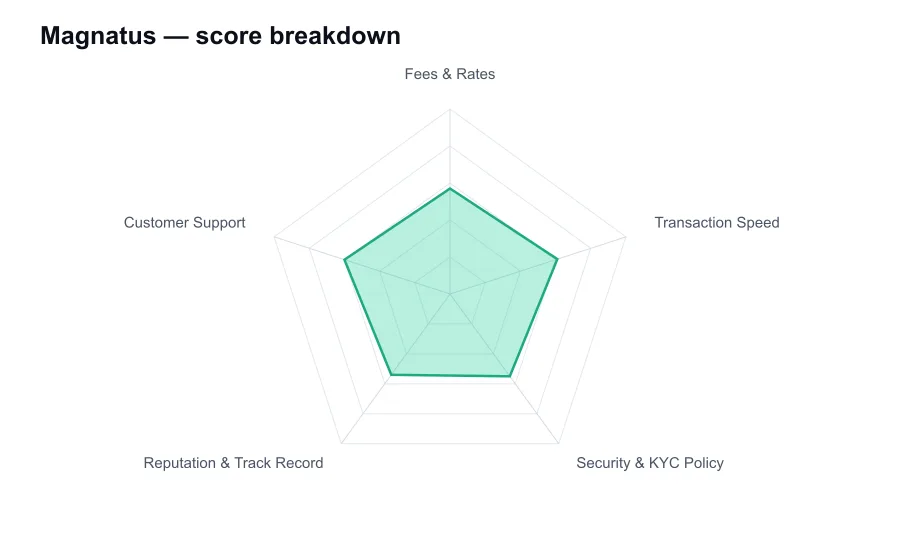
Magnatus scores 5.6/10 overall in our independent review, measured against every other provider we've compared, strongest on Transaction Speed (6.1/10) and weakest on Reputation & Track Record (5.4/10).
5.6/10 ★★★★★ How we score → Status: active (checked 2026-10-13T19:28:54.914Z)| Best for | Not for |
|---|---|
| Direct conversion-order workflow | Smaller public reputation footprint |
| May cover useful niche payout routes | No major-exchange level of transparency |
Editorial independence: our scores and rankings are produced using the fixed criteria above and are not influenced by advertisers. This is an independent ranking site and is not operated by, or affiliated with, any provider we list.
Affiliate disclosure: some links on this page may earn us a commission at no extra cost to you. This does not affect our rankings.
What is Magnatus?
Magnatus is an online exchange service for direct conversion orders between supported crypto assets and payment-related methods. It is intended for completing a specific exchange, rather than for long-term custody or exchange-based trading.
In-Depth Review of Magnatus
Magnatus is a small online exchange service focused on direct conversion orders rather than full-scale crypto trading. Its operating model is familiar to anyone who has used an exchanger listed on monitoring sites: choose a direction, submit the payout details, send the source funds, and wait for the service to complete the other side. It is built for utility, not for traders.
That narrow role is both its attraction and its limitation. Magnatus can be convenient if it supports the exact payment direction a user needs. It does not offer the market depth, self-service controls, reserve disclosures, or formal regulatory footprint that many people now expect from major exchanges.
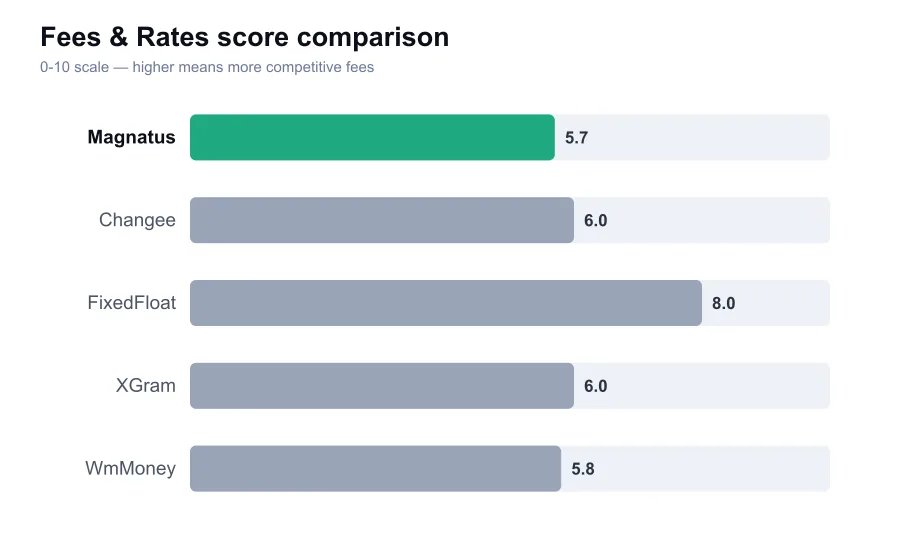
The first thing I would examine is the quote. Smaller exchangers often compete through rates, but a rate is only useful if the order completes at that rate and the receiving method works as expected. On Magnatus, as with peers in this category, the spread can change by route, reserve position, and the cost of the underlying payment rail.
There is little reason to assume it will be cheapest for every transaction. Bitcoin and major stablecoins have deep global liquidity, so a large exchange or established crypto swap provider may deliver a better final amount. Magnatus is more likely to earn its place where a customer values a particular payout option or wants to avoid moving through multiple services.
A visible quote does not remove market risk. If the transaction is processed at a floating rate, the amount can be affected by price movement between deposit and payout. If a fixed-rate option is available for a chosen direction, it may be worth the slightly less attractive quoted amount for users who need certainty.
Speed is adequate for the category but should not be romanticized. An order can move quickly once the incoming payment is recognized, yet blockchain confirmations, banking delays, reserve checks, and manual fraud screening all sit outside a simple countdown timer. A fast route today can be slower tomorrow if a payment provider or network is congested.
Magnatus is best used with a clear understanding of those dependencies. If you are moving crypto, check the selected network twice. If you are paying by bank or card method, confirm whether a comment, order number, or account-name match is required. The most frustrating support cases often start with an otherwise correct payment that lacks one requested identifier.
Security is the category where small exchangers need to earn trust rather than borrow it from a logo. The user temporarily hands control of value to the service during processing. There may be no public proof of reserves, no named external auditor, and no practical insurance comparable to what a regulated financial institution might offer.
Magnatus can still implement normal operational protections, including AML screening and transaction review, but those controls have a customer cost. A flagged transaction may require documents and can become a hold rather than a quick exchange. This is not unusual, though customers should understand that no-KYC advertising, where encountered in the sector, does not prevent a compliance request later.
The right response is to avoid sending funds with an unclear origin, to use your own accounts, and to retain evidence. If you cannot substantiate the source of an unusually large transfer, do not attempt to force it through a small exchanger. That is a recipe for a painful dispute.
Magnatus has a more limited public reputation than the best-known instant exchange brands. I would neither treat that as proof of danger nor ignore it. A smaller reputation means there is less independent evidence to fall back on, so recent transaction-specific feedback, monitoring-site status, and responsive support become more important.
Support is therefore a meaningful factor in the score. For a normal order, a ticket system may never be needed. For a wrong network, delayed deposit, reserve issue, or compliance request, support determines whether the experience remains manageable. Magnatus should be approached with the expectation that manual resolution may take longer than the initial exchange promise.
This is not the provider I would choose for storing crypto, recurring purchases, or a large conversion where legal and operational certainty are the priority. It can serve a narrower purpose well: a direct payment or crypto exchange where the route, rate, and reserve are clearly acceptable.
My assessment is guarded. Magnatus is potentially useful as a route-specific exchanger, but its smaller public profile means users should apply a higher standard of caution than they would at an internationally established platform. Start with a small order, compare the real payout, and do not confuse convenience with robust counterparty protection.
Score Breakdown
| Criterion | Score | Note |
|---|---|---|
| Fees & Rates | 5.7 | Quoted spreads vary by payment direction and liquidity |
| Transaction Speed | 6.1 | Completion depends on confirmations, reserves, and manual checks |
| Security & KYC Policy | 5.5 | Small-provider counterparty risk and possible AML holds |
| Reputation & Track Record | 5.4 | Limited public profile compared with established global exchanges |
| Customer Support | 6.0 | Support is especially important for exceptions and delayed orders |
Key Facts
| Fact | Value | Source |
|---|---|---|
| Service model | Online direct exchanger | - |
| Trading model | Quoted orders, no public order book | - |
| Pricing model | Route-dependent exchange spread | - |
| Settlement factors | Confirmations, reserves, payment rails | - |
| Intended custody use | Transaction settlement only | - |
Pros and Cons
| Pros | Cons |
|---|
How Magnatus Works
- Select the source and destination payment directions
- Review the quote and enter payout details
- Create the conversion order
- Send the required deposit or payment
- Wait for confirmation and the destination payout
KYC
| Requirement | optional |
|---|---|
| Notes | Verification may be requested where AML or fraud controls require further information. Users should be prepared to document a transaction if it is flagged for review. |
How to Use Magnatus Safely
- Use a small test order before sending a larger amount
- Compare the final payout with competing providers
- Confirm the exact crypto network and any required memo
- Use only accounts and payment instruments in your own name
- Keep transaction hashes, receipts, and the order ID
Is Magnatus an order-book crypto exchange?
No. Magnatus uses direct conversion orders with a quoted payout. It is not designed for placing limit orders, margin trading, or active market making.
How does Magnatus make money on an exchange?
The effective charge is generally incorporated into the quoted conversion rate and can vary with the payment method, asset, reserve conditions, and network costs.
Why might a Magnatus transaction be held?
A hold can result from AML or fraud screening, unclear payment details, an unusual transaction pattern, or a payment rail that requires manual confirmation.
Should I send a large first transaction to Magnatus?
No. Its reputation score is 5.4 out of 10, reflecting a smaller public footprint than major exchanges. Test the exact route with a modest amount first.
Can blockchain congestion delay a Magnatus payout?
Yes. The service generally must recognize the incoming transaction after required confirmations, and congested Bitcoin or Ethereum conditions can extend that stage.
What records should I retain for a Magnatus order?
Keep the order ID, deposit transaction hash or payment receipt, destination details, quoted rate, and any support correspondence until the transaction is fully settled.
Editorial independence: our scores and rankings are produced using the fixed criteria above and are not influenced by advertisers. This is an independent ranking site and is not operated by, or affiliated with, any provider we list.
Affiliate disclosure: some links on this page may earn us a commission at no extra cost to you. This does not affect our rankings.