WmMoney
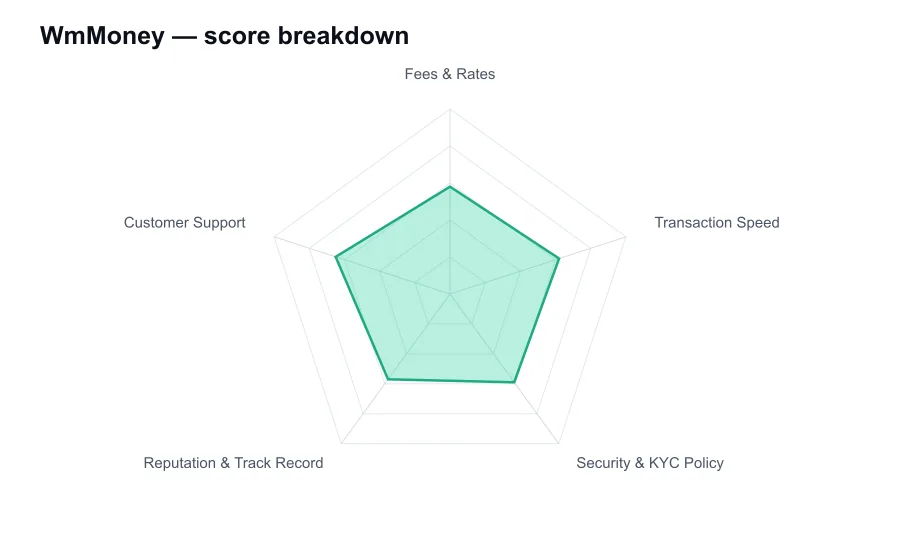
WmMoney scores 5.9/10 overall in our independent review, measured against every other provider we've compared, strongest on Customer Support (6.5/10) and weakest on Reputation & Track Record (5.7/10).
5.9/10 ★★★★★ How we score → Status: active (checked 2026-10-13T19:28:54.788Z)| Best for | Not for |
|---|---|
| Useful for payment-method exchange routes | All-in pricing can be difficult to compare |
| Can bridge electronic money and crypto | Manual processing may delay some directions |
Editorial independence: our scores and rankings are produced using the fixed criteria above and are not influenced by advertisers. This is an independent ranking site and is not operated by, or affiliated with, any provider we list.
Affiliate disclosure: some links on this page may earn us a commission at no extra cost to you. This does not affect our rankings.
What is WmMoney?
WmMoney is an electronic-money exchange service used to move value between payment methods, digital wallets, and selected crypto routes. It is designed around conversion requests rather than active spot trading or long-term asset custody.
In-Depth Review of WmMoney
WmMoney sits in a different corner of the exchange market from a pure crypto swap service. It is best understood as an electronic-money and currency-exchange provider, with crypto conversions forming part of a broader payment-exchange proposition. That distinction matters because the customer experience can involve payment systems, bank transfers, cards, or electronic wallets rather than only on-chain assets.
Services in this category can be extremely useful in markets where people move between local payment rails, WebMoney-style balances, bank cards, and crypto. They can also be difficult to evaluate from the outside. The quality of the experience depends less on polished marketing and more on current reserves, payout availability, manual processing practices, and whether support answers a problem quickly.
WmMoney's strongest appeal is convenience for users who need a bridge between payment systems rather than a sophisticated trading venue. A customer who already understands electronic-money exchangers may find the flow familiar. Someone expecting a regulated broker, a bank-like app, or a full crypto platform may be disappointed.
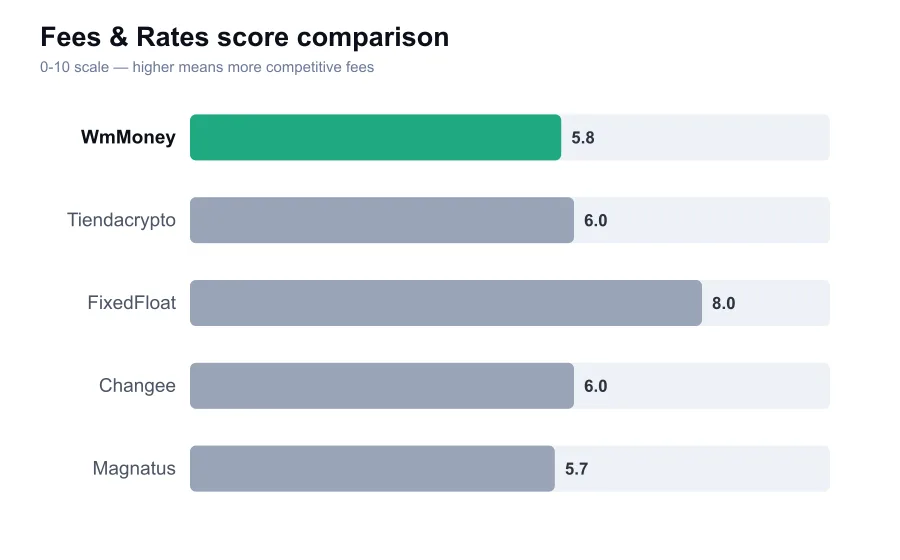
The fee question requires more caution here than it does at a large exchange. The rate displayed on an electronic-money exchanger frequently contains the service margin, payment-processor costs, card-acquiring costs, and the value of maintaining liquidity in a particular direction. Comparing a visible percentage alone is not enough. The only number that matters is the amount that reaches the receiving account.
WmMoney can make sense when a particular payment direction is scarce or urgent. In those cases, paying a higher effective rate may be rational. It is less compelling for common crypto conversions where global instant exchangers and centralized exchanges offer many competing routes. Users should not assume that an exchanger specialized in payment methods will beat a crypto-native provider on BTC or USDT pricing.
Processing speed is variable by design. A blockchain transaction can be automated once confirmed, but a bank-card payment, manual wallet check, or payment-system transfer may require an operator to verify the incoming funds. That means the word instant should be treated carefully. Some directions may complete quickly, while others depend on working hours, reserve status, and payment-provider settlement.
This is also a category where a small typo can become expensive. A wrong card number, incorrect wallet identifier, or missing memo can create a support case that is harder to solve than a normal blockchain swap. Before paying, users should check whether the selected receiving method accepts the exact account format they have entered.
WmMoney's KYC position should not be confused with an assurance of anonymity. Payment-related transfers can trigger verification under fraud controls, anti-money-laundering rules, or a payment partner's policies. A customer using a third-party card, an account in another person's name, or a high-risk transaction pattern is more likely to face delays or a request for documents.
This is an area where I would be conservative. Do not send an amount you cannot document, and do not use a payment instrument belonging to somebody else. If a provider has to freeze a transaction for a review, the user may have limited leverage until the requested evidence is supplied.
WmMoney's public reputation is more niche than Kingex's. That does not automatically make it unreliable, but it means prospective users should do more of their own checking. Look for recent feedback tied to the exact payment direction, rather than treating a general rating as proof that every route is working smoothly.
Customer support is central to the value proposition. With a simple on-chain swap, support is mainly a backup. With electronic-money transfers, it is part of the product because exceptions happen more often. A provider that replies quickly and can identify an incoming payment by reference is far more useful than one that merely publishes a contact form.
I would use WmMoney for a specific payment-exchange need, not as a default venue for every crypto purchase or sale. It may solve awkward conversion paths that a large exchange does not support. But the higher operational complexity, less transparent all-in pricing, and potential for manual review make it unsuitable for users who simply want the cheapest liquid crypto market.
The sensible approach is to start small. Test the exact direction, preserve your payment receipt, and verify the payout method before increasing the amount. That advice is not paranoia. It is the correct way to use a smaller electronic-money exchanger.
My verdict is cautious. WmMoney can be useful where its payment-method coverage addresses a genuine local need, but it deserves less blind trust than a major exchange with formal disclosures and deep liquidity. It is a specialist tool, and specialist tools should be used deliberately.
Score Breakdown
| Criterion | Score | Note |
|---|---|---|
| Fees & Rates | 5.8 | Rates can include payment-rail costs and route-specific margins |
| Transaction Speed | 6.2 | Automated directions can be quick, manual payment checks slow others |
| Security & KYC Policy | 5.9 | Payment and AML reviews can interrupt transfers |
| Reputation & Track Record | 5.7 | Niche exchanger with less public institutional transparency |
| Customer Support | 6.5 | Support matters greatly for payment-reference and payout issues |
Key Facts
| Fact | Value | Source |
|---|---|---|
| Service model | Electronic-money exchanger | - |
| Exchange types | Payment, wallet, and crypto routes | - |
| Pricing method | Route-specific quoted rate | - |
| Processing model | Automated and manual directions | - |
| Key operational risk | Incorrect payment details | - |
Pros and Cons
| Pros | Cons |
|---|
How WmMoney Works
- Select the payment method or asset you are sending
- Choose the receiving payment method or crypto asset
- Enter the receiving account, card, or wallet details
- Pay the order using the stated instructions
- Retain the payment reference while the payout is processed
KYC
| Requirement | optional |
|---|---|
| Notes | Verification may be requested for fraud prevention, AML review, payment-provider rules, or transactions that require manual confirmation. |
How to Use WmMoney Safely
- Use payment accounts and cards registered in your own name
- Verify every wallet, card, and account number before paying
- Keep the payment receipt and order reference
- Test a new payment direction with a small amount
- Check the final payout amount, not just an advertised fee
Is WmMoney a conventional crypto exchange?
No. WmMoney is better treated as an electronic-money and payment exchange service that may support crypto conversion routes, rather than an order-book trading platform.
Does WmMoney have one flat fee?
No universal flat fee should be assumed. The effective cost can be included in the displayed exchange rate and may vary with the payment method and conversion direction.
Why might a WmMoney exchange be processed manually?
Card payments, electronic-wallet transfers, reserve checks, and incoming-payment verification can require an operator to confirm the transaction before issuing the payout.
Can I use another person's bank card or wallet?
That is a poor idea. Third-party payment instruments can trigger fraud or AML checks and may complicate a refund or verification request.
What should I save after sending payment?
Keep the order number, payment receipt, transaction reference, the receiving account details, and screenshots of the quoted rate until the exchange is complete.
Is a small test transaction sensible?
Yes. WmMoney's score for speed is 6.2 out of 10 because different payment directions may involve manual checks, so testing the exact route is prudent.
Editorial independence: our scores and rankings are produced using the fixed criteria above and are not influenced by advertisers. This is an independent ranking site and is not operated by, or affiliated with, any provider we list.
Affiliate disclosure: some links on this page may earn us a commission at no extra cost to you. This does not affect our rankings.