XGram
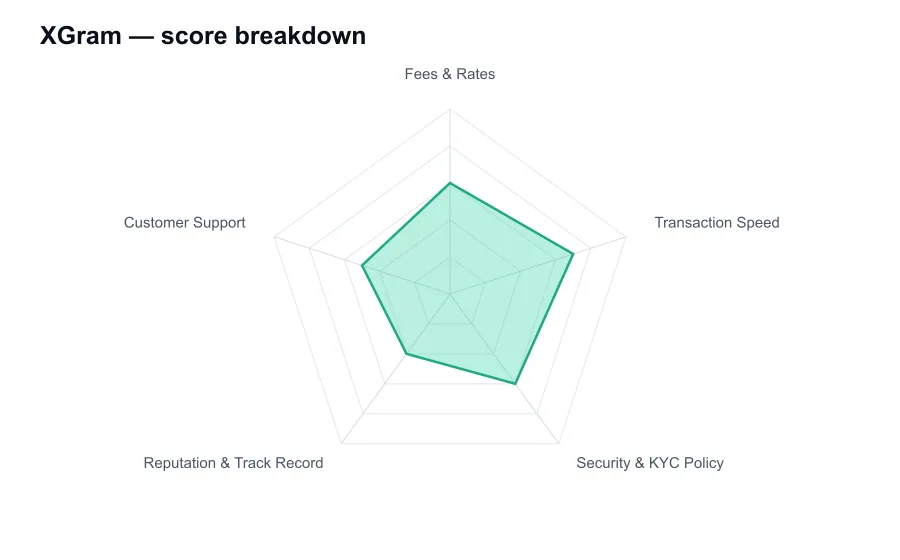
XGram scores 5.3/10 overall in our independent review, measured against every other provider we've compared, strongest on Transaction Speed (7.0/10) and weakest on Reputation & Track Record (4.0/10).
5.3/10 ★★★★★ How we score → Status: active (checked 2026-10-13T19:32:37.608Z)| Best for | Not for |
|---|---|
| Simple no-account swap flow | Quote-based spread can vary materially by pair |
| Useful for one-off crypto conversions | Limited independently established track record |
Editorial independence: our scores and rankings are produced using the fixed criteria above and are not influenced by advertisers. This is an independent ranking site and is not operated by, or affiliated with, any provider we list.
Affiliate disclosure: some links on this page may earn us a commission at no extra cost to you. This does not affect our rankings.
What is XGram?
XGram is an instant cryptocurrency exchange that routes a user's deposited crypto into another asset and sends the result to a specified wallet. It is built for simple conversions rather than order-book trading or long-term custody. The service uses live exchange quotes that vary by pair and network conditions.
In-Depth Review of XGram
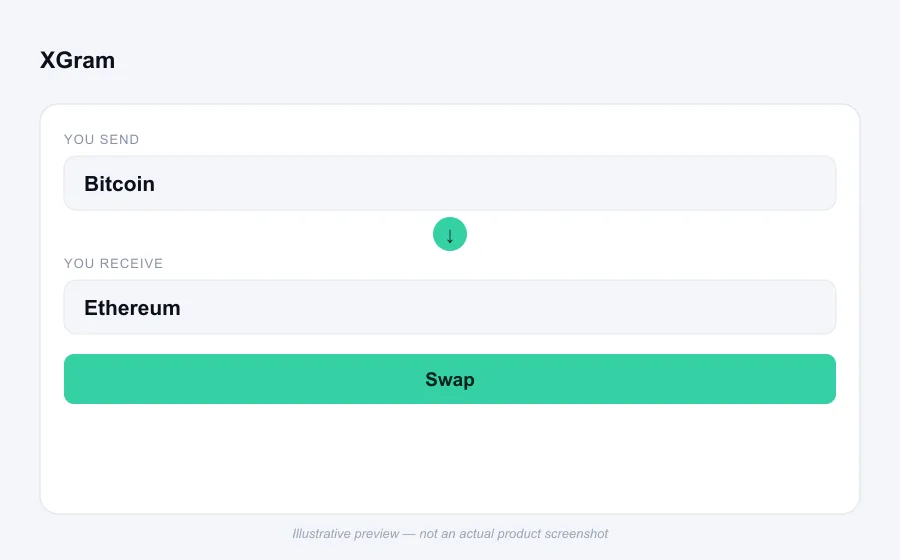
XGram is a smaller instant crypto exchange aimed at users who want a direct swap without a trading dashboard, order book, or account-opening ritual. The basic experience is familiar: choose a pair, enter a receiving address, send the deposit, and wait for delivery. It occupies the crowded middle ground between polished large aggregators and obscure one-page exchangers, which means its real test is not whether it can quote a swap, but whether it can reliably handle problems.
The platform presents itself as a straightforward exchange service rather than a full custodial exchange. There are no advanced trading tools, no staking desk, and no reason to keep a balance on the platform after an order is done. That narrow focus is sensible. A user who simply wants to convert BTC to USDT or ETH to BTC may prefer it to a centralized exchange that asks for documents, login security setup, and a withdrawal wait.
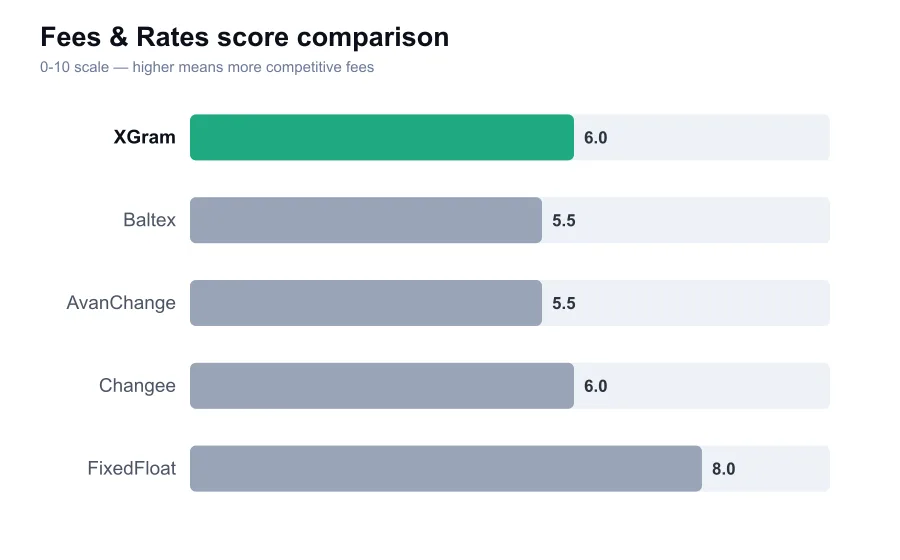
Its pricing is quote-based rather than a simple universal tariff that can be applied to every asset pair. That is normal for an instant exchanger, since network fees, market liquidity, and the service's partner route all affect the number shown on screen. The drawback is that it makes a quick marketing comparison difficult. A quote that looks attractive on a liquid Bitcoin pair can be weak on a thin token or an expensive Ethereum transaction.
I would never use XGram's first displayed quote as the only reference point. Open a competing quote from ChangeNOW, SimpleSwap, or Changee at the same time, then compare the exact amount arriving at your destination. This is especially important for stablecoin conversions, where a service can advertise a low fee but retain value through a wide spread. The user sees the output amount, so that is the number that matters.
Speed is acceptable for the type of service. The exchange can move quickly once an incoming transfer has the necessary confirmations and liquidity is available. Fast networks can complete in minutes, while Bitcoin and Ethereum may take far longer during congestion. XGram cannot control block production, and neither can its competitors. A promise of instant exchange should be read as automated processing, not immediate final settlement.
The website's stripped-back workflow is a benefit for confident users. There is less opportunity to click through the wrong trading screen or leave a balance sitting in a custodial account. Yet simplicity also means fewer visible guardrails. The customer needs to understand which network is being selected, whether the recipient wallet supports that asset, and whether the displayed rate is fixed or subject to movement while the deposit confirms.
XGram does not have the public operating history or independent visibility of major names such as Kraken, Coinbase, or even some of the larger instant-swap brands. That does not prove it is unsafe. It does mean that a reviewer has less external evidence to rely on, fewer long-running public discussions to examine, and less reason to recommend it for a life-changing amount. Reputation in crypto is earned slowly and lost in one bad withdrawal.
The KYC question needs a precise answer. XGram's ordinary exchange flow is designed to work without a conventional account and without routine identity collection. However, like virtually every service touching external liquidity and compliance providers, it can screen transactions and ask for documents if an order is flagged. A user seeking guaranteed anonymity should not assume any centrally operated swap service offers it.
That policy has practical consequences. If funds have a problematic transaction history, are sent from a sanctioned source, or trigger an automated risk rule, the swap may be stopped after the deposit has already been made. In that situation the relevant questions are how clearly the service communicates, what evidence it requests, and whether it returns funds if verification is declined. XGram does not provide the same public policy depth or regulatory disclosures that a major licensed exchange does.
Customer support is available through the service's online channels, and basic transaction tracking should cover a large share of routine questions. A good instant exchanger is judged by exceptions, though. Users want fast human replies when a deposit is not recognized or the outgoing payment is delayed. XGram has not built a support reputation strong enough for me to treat it as a premium feature. Keep screenshots, your order reference, and the deposit transaction hash.
The absence of account custody reduces one kind of risk. There is no exchange balance to lose because you forgot to withdraw it after a trade. But it does not eliminate counterparty exposure. Between your deposit and your payout, XGram is responsible for execution. That is why users should never confuse a no-login interface with a decentralized protocol.
For common assets and modest values, XGram's product is easy enough to recommend with basic precautions. The quote flow is uncomplicated, and it can save time for users who do not want a full exchange account. Its appeal weakens as trade size rises. Better liquidity, formal compliance channels, and proven support start to matter more than saving a few clicks.
There is also no obvious reason to use a small instant exchange for repeated trading. If you swap every week, the accumulated spread and network fees can become expensive compared with spot trading on a reliable exchange. XGram is best treated as a convenience service for one-off conversions, not as a daily trading venue or a wallet.
My take is measured but firm. XGram looks serviceable for routine swaps after you compare the live quote and verify the chain. It has not earned the kind of public trust that justifies sending a very large amount without a test transaction. Use it for convenience, not for custody, and choose a larger regulated platform if fast escalation and a deep track record are part of your requirements.
Score Breakdown
| Criterion | Score | Note |
|---|---|---|
| Fees & Rates | 6.0 | Quote-based pricing requires live comparison |
| Transaction Speed | 7.0 | Automated swaps after network confirmations |
| Security & KYC Policy | 6.0 | No routine account KYC, AML checks remain possible |
| Reputation & Track Record | 4.0 | Limited public track record versus larger rivals |
| Customer Support | 5.0 | Online support, limited evidence of premium escalation |
Key Facts
| Fact | Value | Source |
|---|---|---|
| Service type | Instant cryptocurrency exchange | - |
| Account requirement | No standard trading account | - |
| Pricing model | Live quote by asset pair | - |
| Custody model | Temporary custody during swaps | - |
| Verification model | AML review may be requested | - |
Pros and Cons
| Pros | Cons |
|---|
How XGram Works
- Choose the cryptocurrency pair and input amount
- Enter a receiving wallet address
- Review the live quote and order conditions
- Send crypto to the generated deposit address
- Use the order ID to track the payout
KYC
| Requirement | optional |
|---|---|
| Notes | The standard flow does not require a normal account or routine identity check. AML and compliance screening can result in a transaction review and a request for documents. |
Supported Assets
| Notable coins | Bitcoin, Ethereum, USDT, Litecoin |
|---|
How to Use XGram Safely
- Compare the final output with at least one competing quote
- Send a small test transaction on an unfamiliar route
- Confirm the token network in your destination wallet
- Save the order ID and deposit transaction hash
- Do not use an instant exchanger as long-term storage
Does XGram require an account before a swap?
XGram's basic exchange flow is designed to be used without opening a conventional trading account. You still need to provide a destination wallet address.
Are XGram rates fixed?
Rates are presented as live quotes and can be affected by market movement, liquidity, and blockchain fees. Check whether the order screen specifies a fixed or floating execution condition.
Why would an XGram order need verification?
A no-account swap can still be subject to AML screening. A transaction that triggers compliance controls may be paused while the service requests information or reviews the source of funds.
Should I send a test transaction to XGram?
Yes, particularly with a new token, network, or large amount. A small test confirms that the receiving wallet, selected chain, and order details are correct.
Can I keep crypto in an XGram account?
XGram is designed for direct exchanges rather than maintaining a trading balance. Send the output to a wallet you control rather than treating the service as storage.
What details help support find a delayed order?
Keep the order ID, deposit transaction hash, asset, amount, and the network used. Those details are more useful than a screenshot alone if the deposit is delayed.
Editorial independence: our scores and rankings are produced using the fixed criteria above and are not influenced by advertisers. This is an independent ranking site and is not operated by, or affiliated with, any provider we list.
Affiliate disclosure: some links on this page may earn us a commission at no extra cost to you. This does not affect our rankings.