FixedFloat
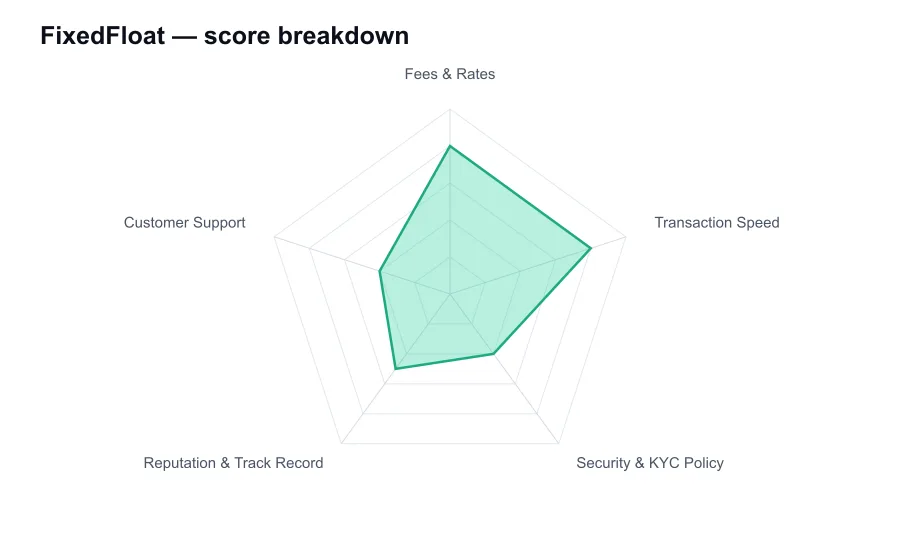
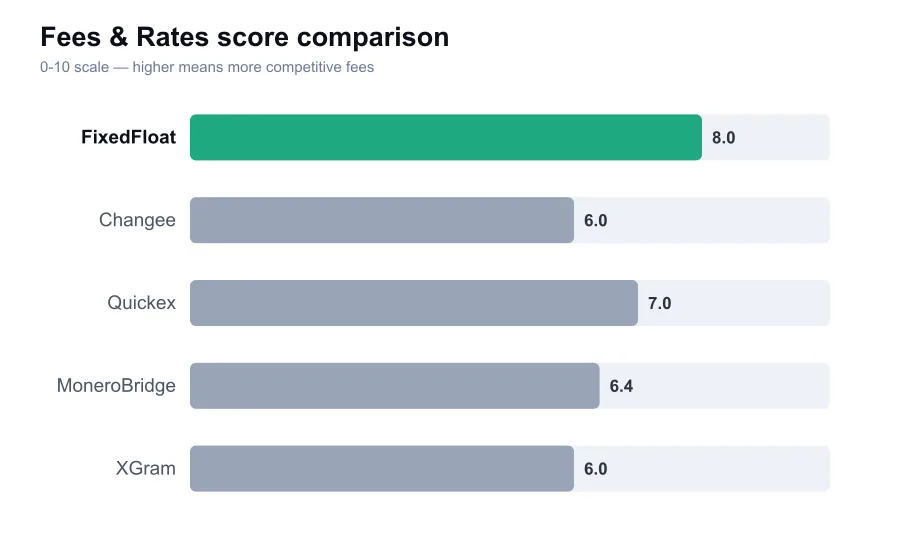
FixedFloat scores 5.8/10 overall in our independent review, measured against every other provider we've compared, strongest on Fees & Rates (8.0/10) and weakest on Customer Support (4.0/10).
5.8/10 ★★★★★ How we score → Status: active (checked 2026-10-13T19:32:37.582Z)| Best for | Not for |
|---|---|
| Clear 0.5% floating and 1% fixed fee model | Linked to a major 2024 security incident |
| Useful Bitcoin Lightning Network support | AML checks can still lead to an identity request |
Editorial independence: our scores and rankings are produced using the fixed criteria above and are not influenced by advertisers. This is an independent ranking site and is not operated by, or affiliated with, any provider we list.
Affiliate disclosure: some links on this page may earn us a commission at no extra cost to you. This does not affect our rankings.
What is FixedFloat?
FixedFloat is a non-custodial-style instant cryptocurrency exchange, although it temporarily receives funds to complete each swap. It lets users exchange crypto without creating a normal trading account and offers floating or fixed-rate quotes. It is particularly known for Bitcoin Lightning Network support.
In-Depth Review of FixedFloat
FixedFloat is one of the better known no-account crypto swap services, built for people who want to exchange coins quickly without opening a trading account or handing over a passport before every transaction. It sits closer to ChangeNOW, SimpleSwap, and SideShift than to a conventional exchange. You pick a pair, send funds to a one-time address, and receive the output coin. That simple proposition made it popular with privacy-minded users and Bitcoin Lightning Network users in particular.
The site offers two pricing modes, Float Rate and Fixed Rate. Float Rate tracks the market while the swap is processed and charges a stated 0.5% service fee. Fixed Rate locks the quoted amount for a limited time and charges 1%, with the spread and network costs still influencing the final quote. The arithmetic is easy to understand, which is more than can be said for many instant exchangers that advertise zero fees while burying their margin in the rate.
The floating option is usually the sensible choice for small, liquid trades. On a BTC to ETH or LTC to BTC exchange, 0.5% is competitive, though it is not automatically the cheapest outcome. FixedFloat sources liquidity externally, so the effective rate can still be worse than Binance, Kraken, or a self-custodied DEX route. Anyone swapping a meaningful amount should compare the actual output, not just the headline fee.
Fixed Rate has a real purpose during fast market moves. If you are paying an invoice, moving into a stablecoin, or exchanging an amount where a sudden Bitcoin move would hurt, paying the extra half percent can be reasonable. The catch is timing. You must send the exact amount to the displayed address before the rate-lock window expires. A delayed confirmation, a wrong network, or an underpayment can turn what looked like a fixed transaction into a support case.
Speed is one of FixedFloat's strongest qualities, especially on networks with fast confirmations. The service processes many common swaps automatically, and Lightning transactions can be remarkably quick. Bitcoin mainnet is naturally slower because the service cannot create output before it has enough confidence in the incoming payment. Ethereum and token swaps also depend heavily on gas conditions. FixedFloat is fast for an intermediary, not magic.
The Lightning support remains a meaningful differentiator. A user can move between on-chain Bitcoin and Lightning, or exchange Lightning BTC for another asset, without dealing with a conventional custodial Lightning exchange. That is useful for experienced Bitcoin users who understand invoice expiry, routing, and inbound liquidity. It is less friendly for newcomers, since an expired invoice or a misunderstood payment flow can be stressful when real money is involved.
The difficult part of assessing FixedFloat is security history. In February 2024, blockchain investigators linked suspicious flows of roughly $26 million to addresses associated with the service, followed by a period in which its website displayed maintenance messaging. FixedFloat later attributed the incident to an external attack. The exact technical account has not been independently documented in the depth users would want from a service handling large volumes.
That incident matters more than a polished website or an automated support bot. Instant exchangers are custodial during the swap, even if only briefly. You send coins to an address they control and trust that their wallets, liquidity partners, and internal controls will deliver the output. FixedFloat's breach is a serious mark against it, and users should not treat its no-registration model as evidence that it carries less counterparty risk.
Its privacy policy is also frequently misunderstood. FixedFloat does not ordinarily demand account registration or routine KYC for a standard exchange. Yet it runs AML controls and reserves the right to pause a transaction and request identifying information where a risk flag is triggered. That is common across the sector. No-KYC means there is no universal front-door identity check, not that every transaction is guaranteed to be anonymous or irreversible.
The service has been around long enough to have a substantial name-recognition advantage over many anonymous swap sites. Its interface is clean, quotes are understandable, and the company has built a following among users who value Lightning. Still, reputation is not simply a matter of longevity. The 2024 security event and limited public company transparency make it difficult to put FixedFloat in the same trust tier as long-established regulated exchanges.
Support is functional but not a reason to choose the platform. The site provides a transaction identifier and status page, and the automated flow handles uncomplicated swaps well. When something goes wrong, particularly a late deposit, incorrect amount, AML hold, or network mismatch, users may find that resolving the case takes longer than the original exchange. There is no phone desk, named account manager, or consumer-style complaint route.
Network selection deserves close attention. Wrapped assets, USDT variants, and similar ticker names are a common source of errors across instant exchangers. FixedFloat can only credit the exact asset and chain shown on its order page. Sending USDT through an unsupported chain to an ERC-20 deposit address is not a minor typo. Recovery, if technically possible, can be slow and may involve a fee.
For small and medium swaps where convenience matters, FixedFloat still has a compelling formula. Its rates are plainly presented, the fixed-rate option does what it says, and Lightning support is genuinely useful. But I would not use it as a primary venue for large conversions, nor would I leave a transaction unattended during a volatile period. The breach changed the risk calculation.
My view is blunt. FixedFloat is a capable specialist tool, not a place to place blind trust. It suits experienced users who can verify addresses, compare quotes, and tolerate the possibility of an AML review. If your priority is institutional safeguards, transparent corporate accountability, and stronger recovery options, use a regulated exchange instead. The convenience is real, but the counterparty risk is real too.
Score Breakdown
| Criterion | Score | Note |
|---|---|---|
| Fees & Rates | 8.0 | 0.5% floating fee or 1% fixed-rate fee |
| Transaction Speed | 8.0 | Automated swaps and strong Lightning support |
| Security & KYC Policy | 4.0 | No routine KYC, but 2024 breach weighs heavily |
| Reputation & Track Record | 5.0 | Established name with a serious security incident |
| Customer Support | 4.0 | Transaction support exists, escalation can be slow |
Key Facts
| Fact | Value | Source |
|---|---|---|
| Floating-rate fee | 0.5% | - |
| Fixed-rate fee | 1% | - |
| Account requirement | No account for routine swaps | - |
| Lightning support | Bitcoin Lightning supported | - |
| Security incident | 2024 | - |
Pros and Cons
| Pros | Cons |
|---|
How FixedFloat Works
- Choose the asset you are sending and receiving
- Select Float Rate or Fixed Rate
- Enter the destination wallet address
- Send the exact amount to the generated deposit address
- Track confirmations and receive the exchanged asset
KYC
| Requirement | optional |
|---|---|
| Notes | No standard registration or routine KYC is required for ordinary swaps. AML screening can trigger a hold and an identity request on a flagged transaction. |
Supported Assets
| Notable coins | Bitcoin, Ethereum, Litecoin, USDT, Monero |
|---|---|
| Networks | Bitcoin, Lightning Network, Ethereum |
How to Use FixedFloat Safely
- Test a new asset and network route with a small amount
- Verify the destination address and chain before sending
- Keep the order ID and transaction hash until completion
- Do not send late if using a fixed-rate order
- Avoid using an instant exchanger for storage
What are FixedFloat's published service fees?
FixedFloat states a 0.5% fee for Float Rate exchanges and a 1% fee for Fixed Rate exchanges. The final quote can also reflect liquidity and blockchain network costs.
Does FixedFloat require KYC?
Routine swaps do not require account registration or standard KYC. Its AML system can flag an order and request identity information before releasing funds.
What happened to FixedFloat in February 2024?
Blockchain analysts linked about $26 million in suspicious crypto movements to FixedFloat-associated wallets. The service temporarily showed maintenance messaging and later said an external attack was involved.
Can I use the Lightning Network on FixedFloat?
Yes. FixedFloat supports Bitcoin Lightning flows alongside on-chain Bitcoin, making it useful for users who can handle Lightning invoices and payment timing.
What if I send the wrong amount to a FixedFloat order?
The order may require manual support handling. Underpayments, overpayments, late deposits, and deposits on the wrong network can delay completion or require a recovery process.
Is the fixed rate guaranteed if Bitcoin moves sharply?
The quote is protected only if the exact amount arrives within the displayed rate-lock period. A late or incomplete deposit can invalidate the intended fixed-rate execution.
Editorial independence: our scores and rankings are produced using the fixed criteria above and are not influenced by advertisers. This is an independent ranking site and is not operated by, or affiliated with, any provider we list.
Affiliate disclosure: some links on this page may earn us a commission at no extra cost to you. This does not affect our rankings.