HotExchange
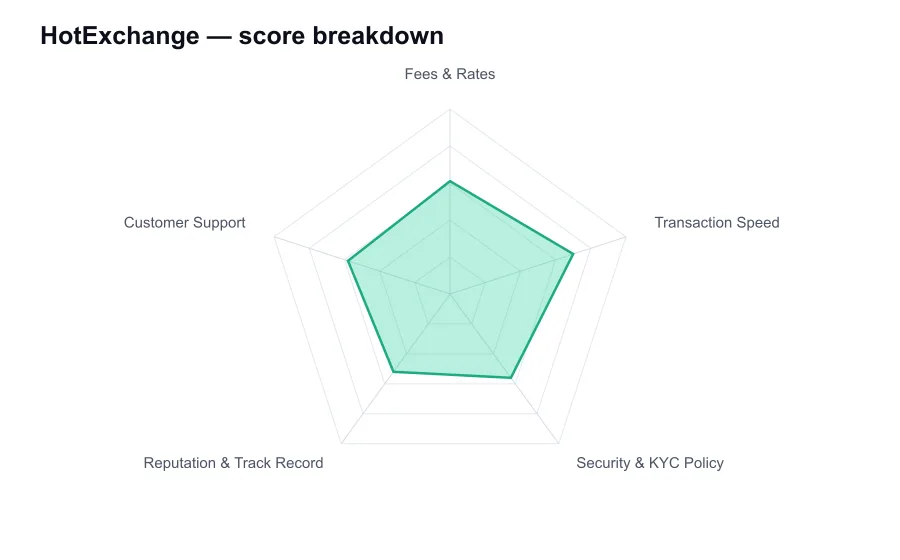
HotExchange scores 5.9/10 overall in our independent review, measured against every other provider we've compared, strongest on Transaction Speed (7.0/10) and weakest on Reputation & Track Record (5.2/10).
5.9/10 ★★★★★ How we score →| Best for | Not for |
|---|---|
| Focused one-order conversion process | Rates can be difficult to compare at a glance |
| Potentially quick crypto settlement | Limited independently documented track record |
Editorial independence: our scores and rankings are produced using the fixed criteria above and are not influenced by advertisers. This is an independent ranking site and is not operated by, or affiliated with, any provider we list.
Affiliate disclosure: some links on this page may earn us a commission at no extra cost to you. This does not affect our rankings.
In-Depth Review of HotExchange
HotExchange is a compact online exchange service rather than a conventional spot market. Its purpose is to convert one asset or payment method into another through a single order, with the operator handling the settlement. That puts it closer to the BestChange ecosystem of exchangers than to Binance, Kraken, or Bitstamp. It is a practical distinction because the customer is buying a completed exchange, not accessing an order book.
The site is geared toward people who value a quick route between supported currencies and do not want the ceremony of a full trading platform. There are no charting tools, margin products, staking dashboards, or portfolio analytics to distract from the core task. That simplicity can be refreshing. It also means the user must take more responsibility for checking the quote, recipient details, network, and restrictions before money leaves their wallet.
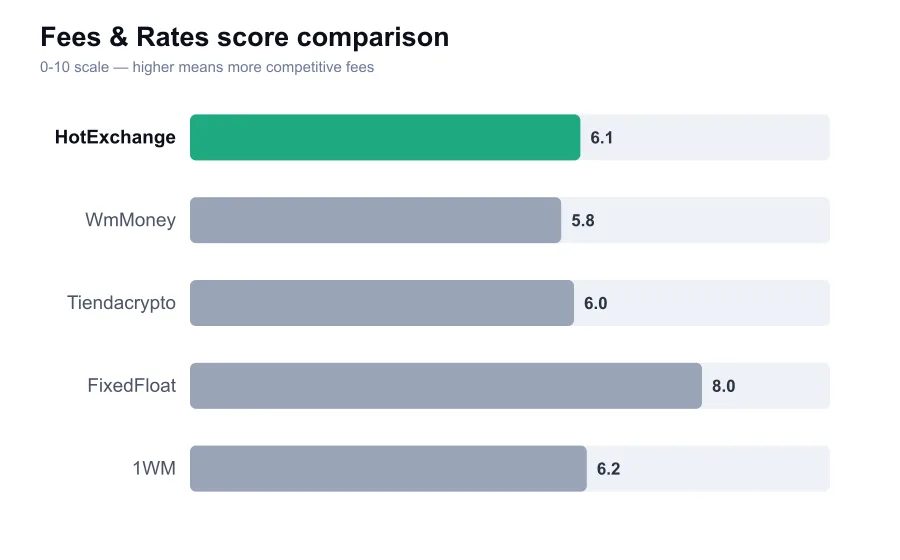
HotExchange's pricing should be read as an all-in transaction quote, not as a transparent percentage commission. With services in this category, the margin is commonly built into the offered rate. That makes a simple statement such as “the fee is 0.5 percent” misleading unless the operator publishes it and the user can verify the exact application. The only comparison that matters is how much you send and how much you actually receive.
On common, liquid crypto pairs, a quote can look reasonable beside other instant exchangers. The picture changes with low-liquidity assets, fiat-linked electronic payment methods, or small orders near the minimum. Those are the situations where spreads and fixed costs can quietly take a bigger bite. HotExchange is not the place to skip comparison shopping. Open several live quotes, include network fees, and do not confuse a favorable displayed exchange rate with a favorable final settlement.
Another fee-related issue is rate protection. Before paying, establish whether an order is fixed-rate or floating-rate, how long the payment window lasts, and what happens if the inbound transfer arrives late. A floating quote can move during blockchain confirmation. A fixed quote may have strict timing and amount requirements. Neither arrangement is inherently unfair, but users need to know which one they accepted. Complaints about “changed rates” often begin with this detail.
Speed is usually the reason people consider HotExchange in the first place. For a straightforward crypto conversion, the exchange can proceed once the incoming payment is detected and receives the necessary confirmations. Networks determine a substantial part of that wait. A USDT transfer on TRON, a Bitcoin transaction during congestion, and a bank payment have very different timelines, regardless of how quickly a support agent replies.
The service is best judged on clean orders. If the amount is exact, the sender and recipient details match the rules, and the network is correct, there is little reason for a simple exchange to become complicated. The trouble starts with underpayments, accidental use of the wrong chain, third-party payments, or a payout method that requires manual review. HotExchange may be fast under ordinary conditions, but it cannot make an irregular payment disappear from a risk queue.
Security here is transactional rather than account-based. The service does not present itself as a place to park a long-term crypto balance, which is preferable to leaving funds on a lightly known platform. Still, every order requires trust. You send funds first and rely on the operator to deliver the other side. That is a more concentrated form of counterparty risk than placing a trade on a deeply liquid, regulated exchange where assets and execution are separated by established systems.
KYC expectations require a realistic view. A low-friction order form does not guarantee that every transaction will be anonymous or exempt from checks. Compliance obligations, anti-fraud systems, suspicious transaction patterns, and payment-provider policies can all lead to a request for documents or source-of-funds information. HotExchange may be attractive to privacy-minded users because it can be less intrusive than a major centralized exchange at entry, but it should not be used on the assumption that verification is impossible.
I am more cautious about HotExchange's reputation than I would be with a long-established global brand. Its public profile is comparatively narrow, and a smaller number of independent references makes it harder to assess consistency across years, market cycles, and difficult support cases. Positive monitoring-site reviews are useful signals, especially if recent and detailed, but they are not a substitute for audited reserves, regulatory supervision, or extensive public incident reporting.
That does not mean every smaller exchanger deserves suspicion. It means the amount of trust should be proportionate to the evidence. Check recent comments relevant to your exact direction, not just the service's aggregate rating. An exchanger can be excellent at routine crypto swaps and weak at card payouts, or the reverse. Look for how disputes were handled, whether delays were explained, and whether users describe receiving the quoted amount after a problem rather than merely praising fast orders.
Customer support is likely to be tested only when something goes wrong, so prepare before that happens. Save the order number, outgoing transaction hash, timestamp, and screenshots of the original quote. A concise message containing those facts is far more effective than a general complaint. HotExchange's support can help with order status, but a smaller operator may not provide instant live assistance in every timezone or a polished escalation structure.
The terms and limits matter more than the interface suggests. Read the rules on sender ownership, wrong amounts, AML holds, cancellation, and refunds. A refund may not be instantaneous if the original inbound payment has already been processed or if blockchain fees must be deducted. Users sometimes treat an exchange order like a reversible shopping-cart checkout. It is not. Crypto transfers are final, and payment-route reversals can create their own fraud controls.
HotExchange is a reasonable candidate for a cautious, experienced user who needs a direct swap and is willing to evaluate each quote on its merits. It is not my first recommendation for a beginner, a business that needs formal invoicing, or a trader who wants deep liquidity and predictable execution. The service can do its narrow job well, but its relatively limited public footprint means risk management should come from the customer, not from assumptions about the brand.
Score Breakdown
| Criterion | Score | Note |
|---|---|---|
| Fees & Rates | 6.1 | Competitive quotes are possible, but no simple universal fee schedule. |
| Transaction Speed | 7.0 | Clean crypto orders can process quickly after confirmations. |
| Security & KYC Policy | 5.6 | Transaction-based service with unavoidable counterparty risk. |
| Reputation & Track Record | 5.2 | Smaller public footprint than established global exchanges. |
| Customer Support | 5.8 | Useful for order issues, but limited evidence of large-scale coverage. |
Pros and Cons
| Pros | Cons |
|---|
Are HotExchange rates fixed?
Check the specific order terms before payment. Instant exchangers may offer fixed or floating quotes, with different deadlines and treatment of late incoming transfers.
Why is my HotExchange order delayed?
Delays can come from blockchain confirmations, a payment-route review, reserve handling, incorrect order details, or compliance checks. Provide the order ID and transaction hash to support.
Is HotExchange suitable for large transfers?
It is safer to test the exact route with a smaller transaction first. For large amounts, compare liquidity, documentation, and support protections with established exchanges.
Editorial independence: our scores and rankings are produced using the fixed criteria above and are not influenced by advertisers. This is an independent ranking site and is not operated by, or affiliated with, any provider we list.
Affiliate disclosure: some links on this page may earn us a commission at no extra cost to you. This does not affect our rankings.