Coinalyze
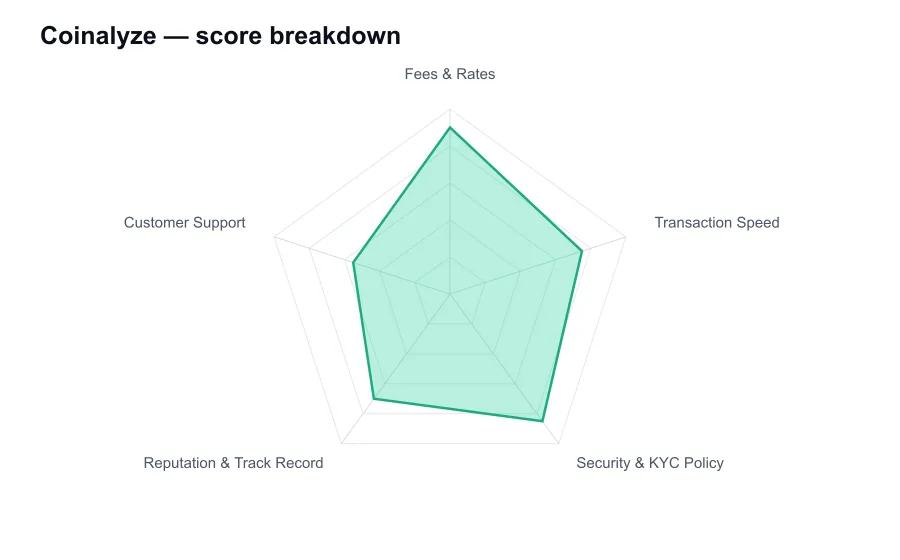
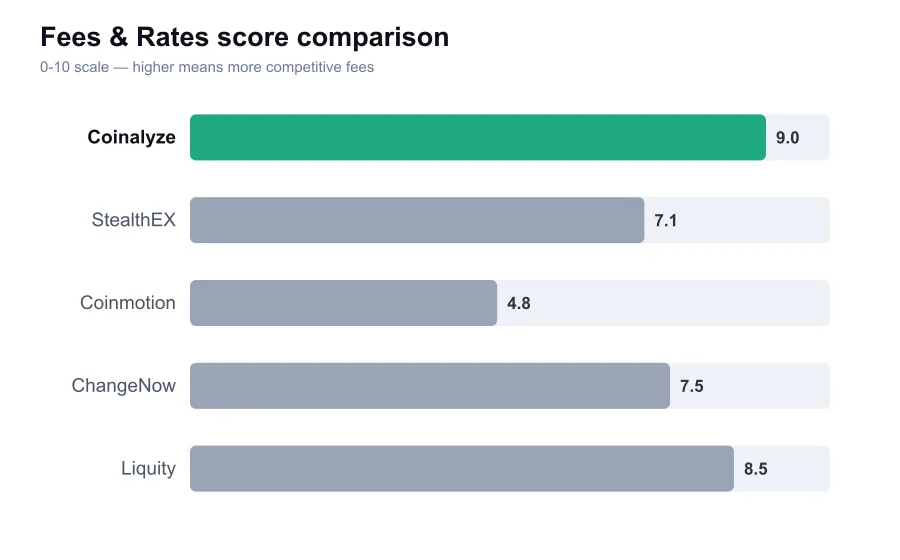
Coinalyze scores 7.6/10 overall in our independent review, measured against every other provider we've compared, strongest on Fees & Rates (9.0/10) and weakest on Customer Support (5.5/10).
7.6/10 ★★★★★ How we score → Status: active (checked 2026-10-13T19:43:31.582Z)| Best for | Not for |
|---|---|
| Useful funding and open interest charts | Not a trading or execution platform |
| No crypto custody risk | Data must be interpreted carefully |
Editorial independence: our scores and rankings are produced using the fixed criteria above and are not influenced by advertisers. This is an independent ranking site and is not operated by, or affiliated with, any provider we list.
Affiliate disclosure: some links on this page may earn us a commission at no extra cost to you. This does not affect our rankings.
What is Coinalyze?
Coinalyze is a crypto market analytics website focused on derivatives information such as funding rates, open interest, volume, and liquidations. It does not hold funds or execute trades. Traders use it to add positioning data to their price chart analysis.
In-Depth Review of Coinalyze
Coinalyze is not an exchange, wallet, or lending platform. It is a market analytics service focused heavily on crypto derivatives data, including open interest, funding rates, liquidations, volume, and price charts. That distinction matters because it should not be judged by whether it can custody coins or process a withdrawal. Its value lies in helping traders see the positioning behind a price move.
The site is most useful for perpetual futures traders who want more than a candlestick chart. A sharp Bitcoin rally accompanied by rising open interest and positive funding tells a different story from a rally driven by short covering and falling open interest. Coinalyze puts those indicators close to price action, which makes it easy to build a quick market read.
Its charts cover spot and derivatives feeds from multiple exchanges, with a practical emphasis on futures venues. Users can compare funding, open interest changes, liquidation events, and volume without opening several exchange tabs. The platform's strength is breadth of trading context, not deep onchain analysis. For wallet flows, token fundamentals, or protocol revenue, another research tool is needed.
Coinalyze has a usable free tier, which is a major positive. Much of the basic charting and market data can be accessed without creating an account or paying a trading fee. The business model is closer to data software than brokerage. There are no deposits, conversion spreads, withdrawal charges, or maker and taker fees because Coinalyze does not execute customer trades.
That makes the fee score deceptively simple. Free access is excellent, but traders should remember that data products can still have costs through subscriptions, API plans, or the opportunity cost of acting on incomplete information. A free dashboard is not a substitute for checking the actual order book and contract specifications on the exchange where you intend to trade.
Speed is good for a browser based analytics product. Charts and derivatives metrics generally update fast enough for discretionary analysis, but nobody should treat a public dashboard as a low latency execution system. Data can have feed delays, exchange outages, aggregation differences, or contract naming quirks. A trader making second by second decisions should rely on their execution venue and professional market data setup, not a web chart alone.
The platform is especially good at making open interest legible. Open interest itself is not bullish or bearish. Rising open interest with price can signal new trend participation, while a sudden collapse can indicate liquidations or position closures. Coinalyze gives traders the raw context, but it cannot tell them whether leverage is informed positioning or crowded late entry.
Liquidation charts are similarly useful and frequently misused. They show completed liquidations reported through exchange feeds, not a guaranteed map of future liquidation levels. Social media traders often build confident narratives around a single liquidation spike. A better use is to compare it with price structure, funding, open interest, and broader market conditions.
Security is a lower stakes issue here than at an exchange because Coinalyze does not hold customer assets. That is a real advantage. There is no custodial balance to lose if the service has a problem. Still, users should protect any account credentials, avoid reusing passwords, and be cautious with API keys if they use data access features. Analytics sites can still be targets for phishing and account abuse.
KYC is generally not part of ordinary public chart viewing. A visitor can inspect market information without submitting exchange style identity documents. If a paid plan, API product, or billing workflow asks for information, that is separate from the core public data experience. This is a useful privacy distinction, though it does not make Coinalyze anonymous if you buy a service with conventional payment details.
Coinalyze has a solid reputation among active crypto derivatives traders, particularly those who want a quick open interest and funding dashboard without building a data stack. It is not as universally cited as TradingView for charting or as specialized in onchain behavior as CryptoQuant or Glassnode. Its niche is narrower, and that is fine. It tends to be most valuable as a companion screen rather than the only tool in a trader's process.
Customer support is functional but not a major selling point. This is a software and data service, not a broker with a staffed trade desk. Documentation and contact options exist, but users should not expect personalized interpretation of a chart or immediate help during a volatile market event. The absence of custody reduces the need for emergency support, though it does not eliminate the frustration of a data issue.
There are also data interpretation pitfalls. Different exchanges list different perpetual contracts, have different collateral types, and can report activity in ways that do not line up neatly. Aggregated open interest may move because of genuine new positioning, a price change in dollar terms, or exchange specific behavior. Traders should inspect the exchange breakdown before making a broad claim about the whole market.
Coinalyze is a good analytics provider for traders who already understand derivatives mechanics. It gives useful data without forcing users into an account or custody relationship, and the free access lowers the barrier to learning. It will not teach a beginner risk management, and it will not protect anyone from overleveraging a perpetual future. Used as one input among several, it is genuinely helpful.
My take is straightforward. Coinalyze earns strong marks for accessible derivatives data and a clean focus, but it should never become a trader's oracle. The lack of trading and custody is a security advantage, while the support experience is necessarily limited. If you trade BTC or ETH perpetuals and want funding, open interest, and liquidation context in one place, it is well worth bookmarking. If you need execution, custody, or fundamental research, look elsewhere.
Score Breakdown
| Criterion | Score | Note |
|---|---|---|
| Fees & Rates | 9.0 | Public market data is available without trading fees |
| Transaction Speed | 7.5 | Useful near real time charts, not an execution feed |
| Security & KYC Policy | 8.5 | No customer asset custody or exchange balances |
| Reputation & Track Record | 7.0 | Well known niche tool for derivatives analytics |
| Customer Support | 5.5 | Software support, not a broker service desk |
Key Facts
Pros and Cons
| Pros | Cons |
|---|
How to Use Coinalyze Safely
- Treat funding and open interest as context, not trade instructions
- Verify exchange specific data before placing a trade
- Do not share exchange API keys unless you understand their permissions
- Use a unique password for any paid analytics account
- Check live order books on your execution venue before trading
Can I buy or sell crypto through Coinalyze?
No. Coinalyze is an analytics platform. It provides market charts and derivatives data, but it does not execute trades or custody crypto assets.
Does Coinalyze charge trading fees?
No, because it does not operate a trading venue. Public chart access does not involve maker, taker, deposit, or withdrawal fees.
What does open interest show on Coinalyze?
Open interest measures the value or number of outstanding derivatives positions. It can help show whether positioning is expanding or closing, but it is not a directional signal alone.
Are liquidation charts a prediction of future liquidations?
No. They generally show reported completed liquidations from exchange data. They should not be confused with a guaranteed future liquidation map.
Does Coinalyze need KYC for basic charts?
Basic public chart viewing does not require exchange style KYC. Paid products or billing arrangements may require ordinary account or payment information.
Why can open interest differ between exchanges?
Exchanges use different contracts, collateral types, reporting formats, and trader bases. Check the venue level data before treating an aggregate figure as a market wide conclusion.
Editorial independence: our scores and rankings are produced using the fixed criteria above and are not influenced by advertisers. This is an independent ranking site and is not operated by, or affiliated with, any provider we list.
Affiliate disclosure: some links on this page may earn us a commission at no extra cost to you. This does not affect our rankings.