SecureShift
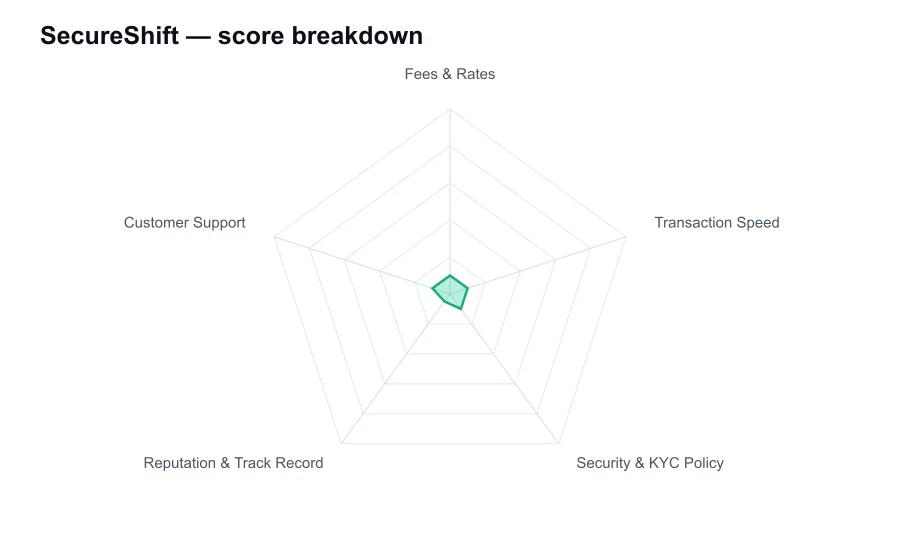
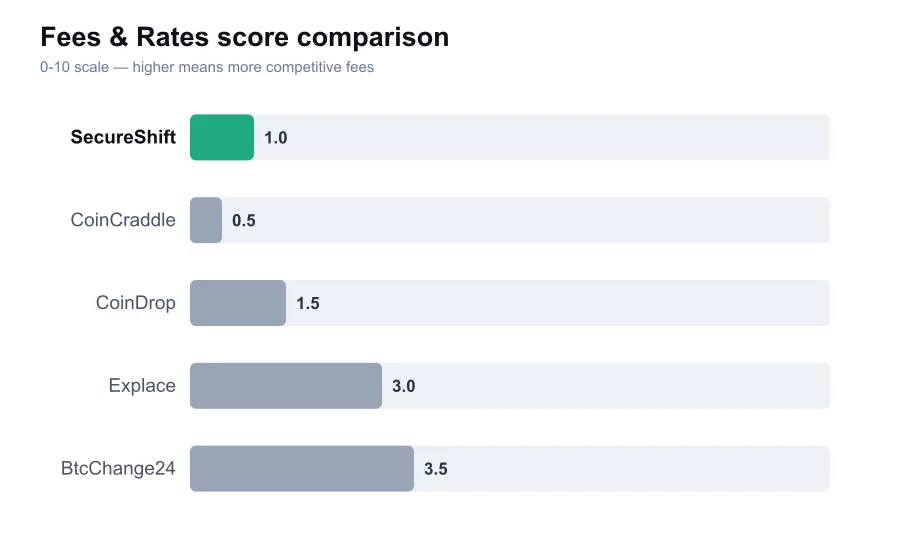
SecureShift scores 0.8/10 overall in our independent review, measured against every other provider we've compared, strongest on Fees & Rates (1.0/10) and weakest on Reputation & Track Record (0.5/10).
0.8/10 ★★★★★ How we score → Status: active (checked 2026-10-13T19:30:38.666Z)| Best for | Not for |
|---|---|
| No verified operational strengths established | Security claims are not substantiated |
| Brand purpose appears easy to understand | No confirmed operator or official domain |
Editorial independence: our scores and rankings are produced using the fixed criteria above and are not influenced by advertisers. This is an independent ranking site and is not operated by, or affiliated with, any provider we list.
Affiliate disclosure: some links on this page may earn us a commission at no extra cost to you. This does not affect our rankings.
What is SecureShift?
SecureShift appears to be branded as a crypto conversion service, likely resembling an instant exchanger. Its actual operator, official web presence, transaction rules, and security practices could not be independently verified. Users should not confuse its name with proof of safety.
In-Depth Review of SecureShift
SecureShift uses a name designed to suggest safe and rapid crypto conversion, yet a reassuring name is not a security control. I could not verify enough attributable public material to establish a dependable official website, legal operator, fee structure, or operating history. That leaves SecureShift in the category of unverified exchange branding rather than a service readers should trust with funds.
Crypto users have learned the hard way that a polished swap page can be assembled quickly. What separates a real service from a risky one is the supporting record: incorporation details, terms of service, privacy and compliance policies, traceable support, wallet practices, and years of third-party discussion. SecureShift does not provide a verifiable record of that kind for this review.
Its apparent focus, inferred from the name, is likely an instant exchange flow rather than a full order-book venue. Instant exchangers can be useful because they reduce the setup required for a simple asset conversion. They also require users to trust the provider's routing, quote, custody window, and compliance decisions, which makes transparency especially important.
No reliable SecureShift rate schedule could be confirmed. A user therefore cannot tell whether a displayed quote includes a fixed fee, a floating spread, routing costs, or a withdrawal charge. Without that information, there is no honest basis for calling the service low-cost or competitive.
This is a sharper problem during volatile conditions. A provider may offer a floating quote that changes between deposit and payout, or a fixed quote that expires after a short window. Both models can be fair if they are stated plainly. SecureShift has not supplied enough independently verifiable terms to show which model applies or what happens if a transfer arrives late.
Execution speed is another unanswered question. Bitcoin transactions can take time to confirm, while transfers on faster networks may settle quickly, but the customer still needs to know how long internal checks and payouts normally take. SecureShift has no verified service-level information or reliable public order history that would support a confident speed rating.
The word Secure in a brand should make a reviewer more demanding, not less. I could not confirm multi-signature custody, cold-wallet procedures, audits, proof of reserves, security testing, insurance, or an incident-response process. Those measures do not guarantee safety, but reputable companies explain what they do to protect user funds.
Its identity-verification approach is also unclear. No-KYC marketing often attracts users, but many providers apply screening after a deposit and may hold an order while asking for documents. If a company does that, customers need clear rules for review time, rejected verification, refunds, and data retention. I could not verify those rules for SecureShift.
There is no meaningful public reputation signal to offset these concerns. I found no established record comparable to the long-running user discussion around Changelly, ChangeNOW, FixedFloat, or major centralized exchanges. Lack of complaints is meaningless where the underlying customer base and corporate identity cannot be established.
Support is where an unknown service can become costly. A delayed swap may be recoverable if a responsive provider can locate a deposit and explain its review process. It can become a dead end if support is anonymous, intermittent, or tied only to a disposable social account. SecureShift has not demonstrated accountable support through accessible public evidence.
I would not use this provider for a large conversion, a first purchase, payroll, merchant settlement, or a time-sensitive transfer. A professional user needs invoices, audit trails, known counterparties, and support that can be escalated. SecureShift does not give a reader enough reason to believe those basics exist.
A person tempted by an attractive quote should stop before sending anything. Check whether the exact domain has a consistent history, whether the terms identify a company, and whether outside sources discuss completed transactions over a meaningful period. A name that sounds secure is not a substitute for those checks.
The fair reading is not that SecureShift has been proven unsafe. It is that it has failed to provide the evidence necessary for a responsible recommendation. In a market with many documented alternatives, uncertainty of this depth is a poor trade for a few basis points of potential price improvement.
SecureShift should remain off a cautious user's shortlist unless verifiable disclosures emerge. Until then, use an exchange with published fees, known compliance policies, strong account security, and a public service history. The burden of proof belongs to the party asking customers to send irreversible assets.
Score Breakdown
| Criterion | Score | Note |
|---|---|---|
| Fees & Rates | 1.0 | No verified fixed fee or spread disclosure |
| Transaction Speed | 1.0 | No verifiable completion-time record |
| Security & KYC Policy | 1.0 | No documented controls or review process |
| Reputation & Track Record | 0.5 | No established attributable operating history |
| Customer Support | 1.0 | No accountable support system confirmed |
Key Facts
| Fact | Value | Source |
|---|---|---|
| Official domain | Not independently verified | - |
| Corporate operator | Not independently verified | - |
| Pricing model | Not independently verified | - |
| Fixed-rate swaps | Not independently verified | - |
| Hold policy | Not independently verified | - |
Pros and Cons
| Pros | Cons |
|---|
How SecureShift Works
- Confirm the operator and exact site independently
- Check whether the quote is fixed or floating
- Read hold and refund terms before depositing
- Send only a negligible test amount if you proceed
- Record the deposit transaction and quoted rate
KYC
| Requirement | tiered |
|---|---|
| Notes | No reliable SecureShift KYC policy was located. Assume screening can occur after a deposit and do not proceed unless you accept that possibility. |
How to Use SecureShift Safely
- Treat security-themed branding as marketing, not evidence
- Verify the company behind the service before funding
- Do not use an unknown swap provider for urgent payments
- Check whether a quote is fixed before sending crypto
- Keep full records in case a transaction is delayed
Is SecureShift a verified crypto exchange?
This review could not verify an attributable operator, a stable official domain, or sufficient public service documentation. It should not be treated as an established exchange.
Does SecureShift publish its swap fee?
No reliable fixed-fee, floating-fee, or spread policy could be verified. A quote cannot be assessed properly without knowing whether costs are embedded in the exchange rate.
What happens if a SecureShift transfer is flagged?
A public hold, review, refund, and document-retention policy could not be verified. That is a major risk because instant-exchange transfers can be paused after a deposit arrives.
Does SecureShift offer fixed-rate swaps?
No reliable documentation could be verified confirming fixed-rate or floating-rate execution. Users should not assume a displayed estimate is guaranteed.
Can SecureShift be used for a time-sensitive payment?
No. Normal processing times, liquidity routing, and support escalation procedures are not independently documented, so there is no dependable basis for planning around its execution.
Editorial independence: our scores and rankings are produced using the fixed criteria above and are not influenced by advertisers. This is an independent ranking site and is not operated by, or affiliated with, any provider we list.
Affiliate disclosure: some links on this page may earn us a commission at no extra cost to you. This does not affect our rankings.