CoinDrop
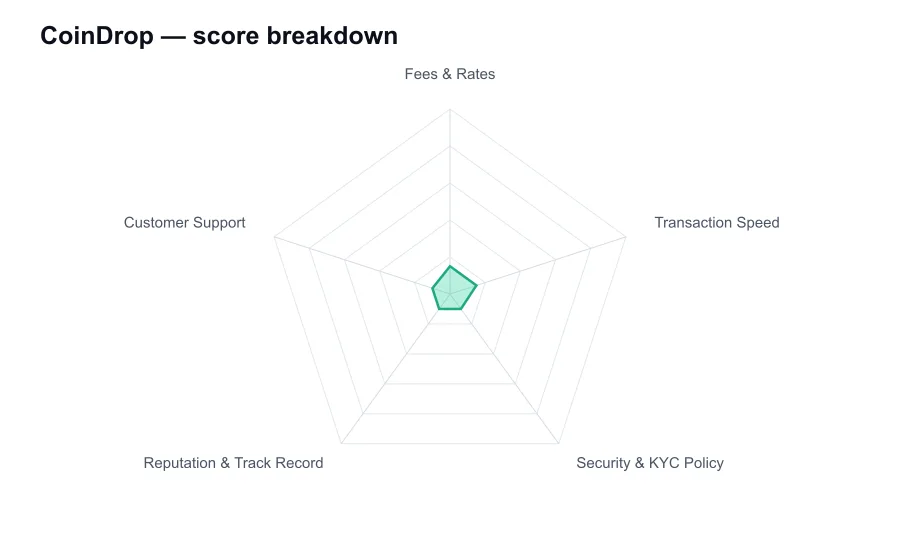
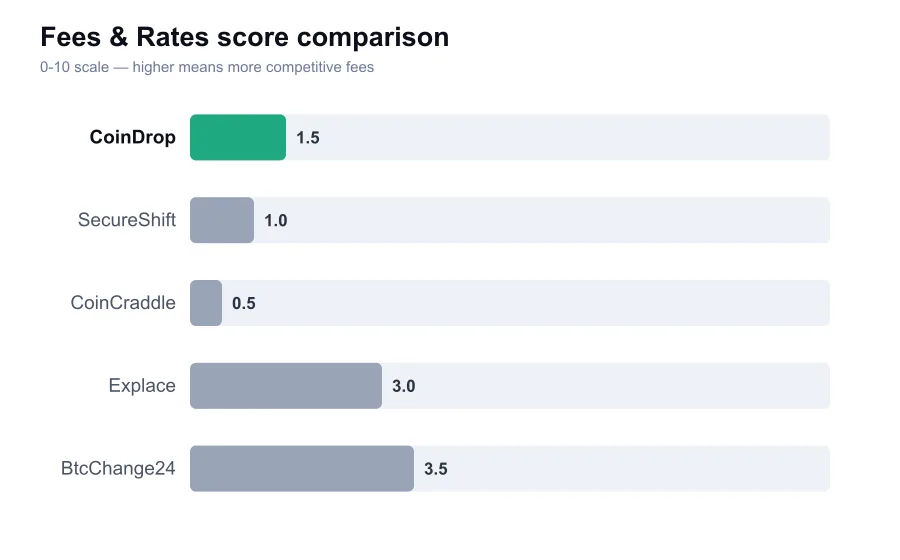
CoinDrop scores 1.2/10 overall in our independent review, measured against every other provider we've compared, strongest on Fees & Rates (1.5/10) and weakest on Customer Support (1.0/10).
1.2/10 ★★★★★ How we score → Status: active (checked 2026-10-13T19:30:38.590Z)| Best for | Not for |
|---|---|
| No confirmed strengths can be credited safely | No verified official website or operator |
| Name is easy to identify in search queries | No public fee schedule confirmed |
Editorial independence: our scores and rankings are produced using the fixed criteria above and are not influenced by advertisers. This is an independent ranking site and is not operated by, or affiliated with, any provider we list.
Affiliate disclosure: some links on this page may earn us a commission at no extra cost to you. This does not affect our rankings.
What is CoinDrop?
CoinDrop is presented as a crypto-related exchange or transfer provider. Publicly attributable information about its operator, service terms, and official web presence is too limited to describe its product flow with confidence. Treat it as an unverified provider rather than an established exchange.
In-Depth Review of CoinDrop
CoinDrop is a name that appears to position itself around crypto exchange or transfer services, but it does not have the public footprint expected from an established exchange. I could not verify a clearly attributable operating company, a stable official service domain, a published fee schedule, or a substantial independent record of customer use. That puts it far outside the class occupied by exchanges such as Kraken, Coinbase, Bitstamp, or even better-known instant swap services.
The first problem is basic identification. A user should be able to establish who runs a service before sending funds, where that business is incorporated, what terms govern a transaction, and which support channel is accountable if something goes wrong. With CoinDrop, those details are not sufficiently documented in publicly attributable material available for this review.
That lack of clarity matters more than a slick interface or a persuasive social post. Crypto transfers generally cannot be reversed. If a provider's legal entity, domain history, support structure, and transaction terms cannot be independently checked, a user has little practical recourse after a delayed payout or an address error.
Fees are impossible to score generously where no reliable public rate card can be confirmed. A genuine exchange should show trading fees, spread treatment, network withdrawal fees, minimums, and any extra charge that applies after a quote is displayed. CoinDrop does not provide enough verifiable disclosure for a reviewer to say whether it is cheap, expensive, or simply unclear.
That distinction is important. Some instant exchangers advertise zero service fees while recovering their margin through the exchange rate. That can be legitimate if the quote is transparent. The issue here is not that CoinDrop necessarily uses a spread. The issue is that prospective customers lack the documentation needed to compare its quote against a reference price on Binance, Kraken, or a self-custodial swap route.
Speed is similarly hard to judge. Blockchain settlement times depend partly on the chain, but a provider still controls its own compliance review, quote execution, liquidity routing, and release of the outgoing transaction. Established services publish expected processing ranges or give customers a transaction identifier. I could not verify a reliable CoinDrop service standard or a public history of completed orders.
Security claims should be treated with particular caution. There is no verified evidence here of cold-storage policy, proof of reserves, third-party penetration testing, a bug bounty, licensing, or named security leadership. No single one of those items makes an exchange safe by itself, but their absence from public materials leaves users unable to assess operational maturity.
KYC is not a minor detail that can be left vague. A service can market a quick exchange flow and still ask for identity documents after funds have been deposited, especially if automated screening flags an address or transfer pattern. CoinDrop does not offer enough reliable policy information to tell users when verification can be triggered, how long a review takes, or how rejected cases are handled.
That creates a real custody risk. If an order is paused for screening, the customer needs a documented process for supplying information, receiving a response, and recovering funds if the transaction cannot proceed. A generic contact form or an anonymous chat account is not an adequate substitute for a published compliance and complaints policy.
Reputation is CoinDrop's weakest area. I found no strong, independently verifiable body of long-running feedback, regulatory disclosures, security reporting, or major industry coverage that would establish a track record. A low profile is not proof of fraud, but in crypto it is a reason to stay cautious rather than an invitation to take a chance.
Customer support cannot be rated as dependable without verifiable support hours, response channels, escalation procedures, or a meaningful public record of cases being resolved. A service handling irreversible financial transfers should make it easy to reach a responsible party. CoinDrop has not demonstrated that standard through accessible public documentation.
For a small test transaction, the lack of verifiable information is still a serious drawback. For a meaningful transfer, it is disqualifying. There are too many established alternatives with published terms, identifiable operators, transparent pricing, and extensive user histories to justify accepting this level of uncertainty.
Anyone encountering CoinDrop should independently confirm the exact domain before visiting it. Search results and social accounts can be copied, and a near-identical name does not prove that a page belongs to the intended operator. Never rely on a payment address received through an unsolicited message.
My view is blunt. CoinDrop has not earned the trust required for a crypto exchange provider because the key evidence is missing, not because of a single documented technical failure. Until it publishes verifiable corporate information, fees, transaction policies, security controls, and responsive support details, readers should use a regulated exchange or a better-documented self-custodial option instead.
Score Breakdown
| Criterion | Score | Note |
|---|---|---|
| Fees & Rates | 1.5 | No verifiable public fee schedule located |
| Transaction Speed | 1.5 | No published processing standard confirmed |
| Security & KYC Policy | 1.0 | Security and KYC controls are not documented |
| Reputation & Track Record | 1.0 | No established independent track record found |
| Customer Support | 1.0 | Accountable support channels could not be verified |
Key Facts
| Fact | Value | Source |
|---|---|---|
| Official domain | Not independently verified | - |
| Legal operator | Not independently verified | - |
| Fee schedule | Not independently verified | - |
| KYC policy | Not independently verified | - |
| Support channels | Not independently verified | - |
Pros and Cons
| Pros | Cons |
|---|
How CoinDrop Works
- Verify the legal operator and exact domain independently
- Read the full fee, KYC, and refund terms before funding
- Use only a tiny test amount if proceeding despite the risks
- Keep transaction IDs and all support correspondence
KYC
| Requirement | tiered |
|---|---|
| Notes | A reliable CoinDrop KYC policy could not be verified. Assume a transaction may be paused for screening until an attributable policy states otherwise. |
How to Use CoinDrop Safely
- Verify the exact domain outside search ads and direct messages
- Do not send a meaningful amount to an unverified provider
- Compare the final quote with a known exchange rate
- Save deposit addresses, transaction IDs, and screenshots
- Never share seed phrases or remote-access credentials
What is CoinDrop?
CoinDrop appears to be presented as a crypto-related exchange or transfer service, but this review could not verify a clearly attributable operator, official service domain, or detailed public product documentation.
Are CoinDrop's fees published?
No reliable public fee table or spread policy could be verified for CoinDrop. Do not assume a quoted rate is competitive without comparing it against a known exchange or market reference.
Can CoinDrop require identity verification after a deposit?
Its KYC policy could not be verified. Many crypto services reserve the right to request documents after a transfer is received, so users should not send funds without reading an attributable policy first.
Is there a verified CoinDrop support team?
This review could not confirm accountable support hours, a ticket system, named operator, or documented escalation route. That makes recovery from a delayed order difficult to assess.
How can I verify a CoinDrop domain?
Do not trust a search ad, social profile, or link sent in a message. Confirm the legal operator and matching official domain through independent corporate and regulatory records before sending crypto.
Editorial independence: our scores and rankings are produced using the fixed criteria above and are not influenced by advertisers. This is an independent ranking site and is not operated by, or affiliated with, any provider we list.
Affiliate disclosure: some links on this page may earn us a commission at no extra cost to you. This does not affect our rankings.