Sanctum
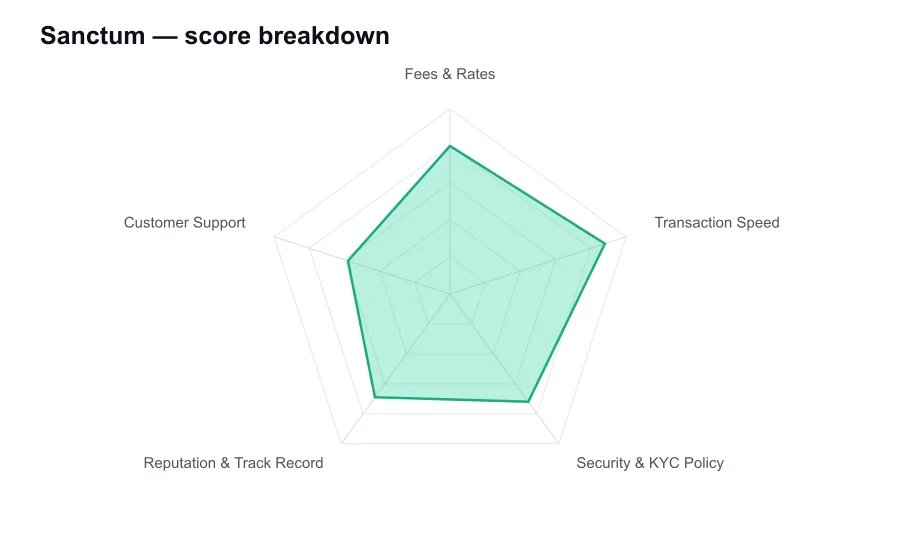
Sanctum scores 7.4/10 overall in our independent review, measured against every other provider we've compared, strongest on Transaction Speed (8.8/10) and weakest on Customer Support (5.8/10).
7.4/10 ★★★★★ How we score → Status: active (checked 2026-10-13T19:41:27.080Z)| Best for | Not for |
|---|---|
| Fast Solana-native liquid staking experience | LSTs can trade below SOL during stress |
| Helps improve liquidity across supported LSTs | Younger protocol than major liquid staking rivals |
Editorial independence: our scores and rankings are produced using the fixed criteria above and are not influenced by advertisers. This is an independent ranking site and is not operated by, or affiliated with, any provider we list.
Affiliate disclosure: some links on this page may earn us a commission at no extra cost to you. This does not affect our rankings.
What is Sanctum?
Sanctum is a Solana protocol focused on liquid staking tokens and liquidity between them. It lets users access staking-linked SOL positions while retaining the ability to swap supported LSTs through on-chain liquidity. It is designed for wallet users, not custodial exchange accounts.
In-Depth Review of Sanctum
Sanctum is a Solana-native liquid staking protocol and liquidity layer built around liquid staking tokens, usually shortened to LSTs. It is not a centralized exchange and it is not a generic cross-chain swap service. Its purpose is to make SOL staking more flexible by allowing users to stake, receive a liquid representation of that stake, and trade or use supported LSTs without waiting through the normal unstaking period. In a Solana ecosystem crowded with staking products, Sanctum's focus on LST liquidity gives it a distinct role.
The basic problem it addresses is familiar to stakers. Native SOL staking can provide rewards, but unstaking has an activation and deactivation process tied to Solana epochs. That makes capital less flexible than a trader or DeFi user may want. Liquid staking solves this by issuing a token that represents staked SOL and accrued rewards. Sanctum tries to improve the experience further by creating shared liquidity and easier swaps between different LSTs.
The protocol became widely known through its Infinity liquidity pool, designed to support swaps among participating Solana LSTs. This matters because Solana has many validator-specific and protocol-specific LSTs, such as JitoSOL, mSOL, bSOL, and others. Without robust liquidity, an LST can be hard to exit at a fair price. Sanctum aims to make the choice of validator or LST less punishing by giving users a better route back to SOL or into another supported receipt token.
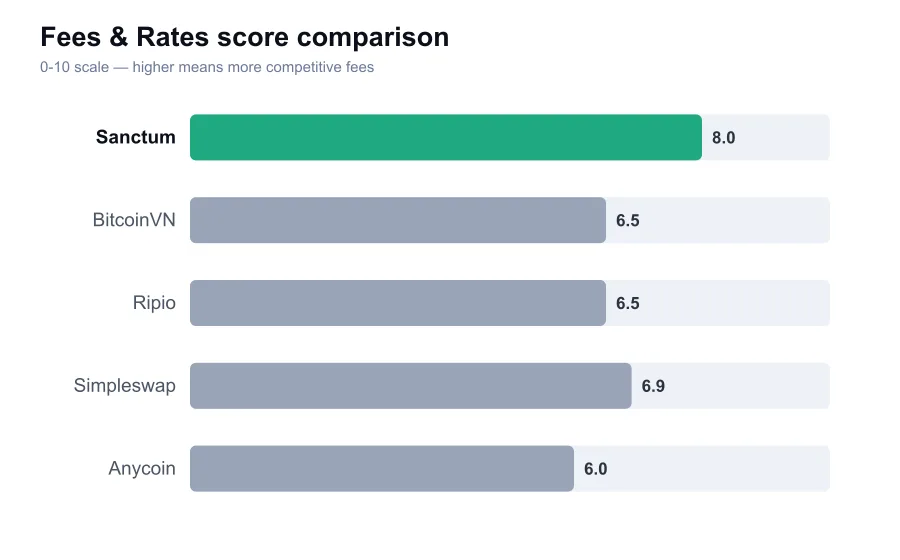
Fees require more attention than a single headline figure suggests. Sanctum itself can offer efficient swapping, but the effective cost depends on the LST, available pool liquidity, price impact, and the redemption path. Solana transaction fees are usually very low compared with Ethereum, which makes small on-chain actions viable. Still, a low network fee does not guarantee a low economic cost. An LST trading below its fair backing value can produce a worse exit than the tiny gas bill implies.
For liquid and well-integrated LSTs, transaction speed is excellent. Solana confirmations are normally quick, and the protocol's user flow feels much closer to an app than a traditional staking portal. That is a major advantage for users who want to shift between staking exposure and DeFi use without waiting days. The caveat is that liquidity does not appear by magic. During market stress, less popular LSTs can trade at a discount, and instant conversion may be less favorable than waiting for native unstaking.
Sanctum's approach is more sophisticated than simply issuing one house-branded liquid staking token. Its ecosystem has supported the idea of LSTs tied to individual validators and user-created or partner LSTs, which can help validators attract stake while giving delegators liquidity. This is interesting infrastructure for Solana's validator economy. It is also more complicated than holding SOL, and users should not stake through a niche validator token merely because an app makes the swap easy.
There is no normal account registration or KYC requirement for the core on-chain protocol. A user connects a Solana wallet, selects the relevant action, and signs. That is appropriate for a decentralized staking application, but it transfers security responsibility to the user. The protocol cannot restore a lost seed phrase, reverse a malicious signature, or compensate a user who sends assets to the wrong address.
The main security questions are smart contract risk, validator performance, depegging risk, and Solana network dependence. A liquid staking token should be backed by stake, but its market price can still drift relative to SOL if liquidity weakens or confidence falls. The fact that an asset is called a liquid staking token does not mean it is interchangeable with SOL at every moment. Users seeking a guaranteed redemption schedule should understand the native staking mechanics behind the token.
Sanctum has gained attention quickly within Solana, partly because its product arrived at a time when liquid staking and point-based incentives were drawing intense interest. Its 2024 launch activity and the CLOUD token distribution brought substantial visibility. That attention has been useful for liquidity and integration, but it also created a speculative crowd around rewards. A user should separate the utility of liquid staking from the short-term economics of points, airdrops, and token incentives.
Reputation is promising rather than fully mature. Sanctum is well known among Solana DeFi users and has attracted integrations across the ecosystem, but it does not have the long operational record of Marinade or the scale and broader track record associated with Jito. That does not make it unsafe. It does mean the protocol should be judged with the caution appropriate to a relatively young DeFi system handling staking-linked assets.
Support is typical for a decentralized protocol. Documentation, community spaces, and wallet transaction records are more useful than expecting a traditional customer-service desk. If a transaction fails, the first diagnostic tools are the Solana explorer, wallet activity, and the exact program interaction. If the issue is a pool price or an LST discount, there may be nothing for support to fix because that is market behavior rather than a technical error.
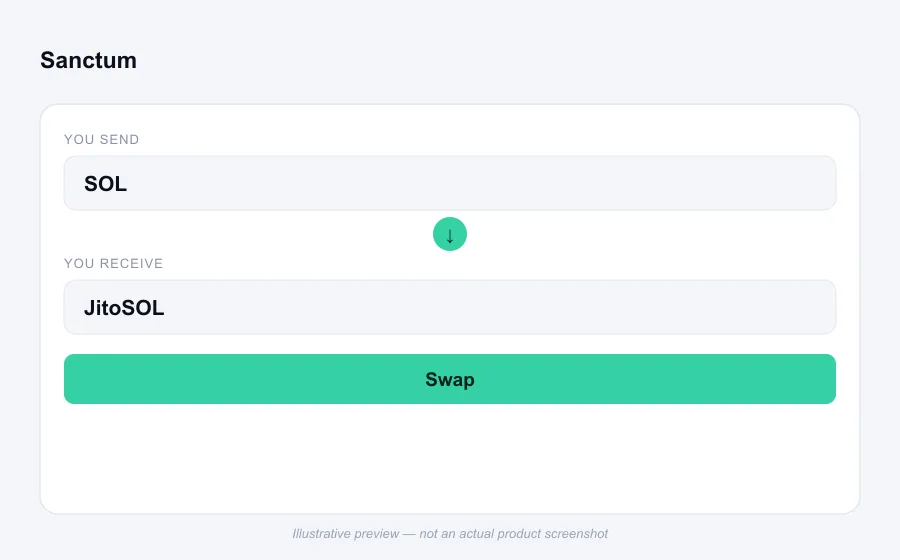
The user experience is good for Solana natives. Connect Phantom or another compatible wallet, choose a SOL or LST action, inspect the quoted output, and sign. The app is quick and readable. The difficult part lies outside the interface: understanding which LST you are receiving, what validator exposure it represents, whether it has credible liquidity, and how you would exit during volatility.
I would be especially cautious with lesser-known validator LSTs. The whole point of Sanctum is to make this fragmented category more usable, but a liquid route can still have finite depth. For a large position, test the price impact first and compare the swap quote with native unstaking alternatives. Do not assume every token in an LST ecosystem has equal liquidity or equal validator risk.
Sanctum is a compelling Solana-specific tool, but it is for users who understand liquid staking rather than people merely looking for a yield button. Low Solana fees and fast settlement make the experience attractive, while the Infinity model addresses a real liquidity problem. Its weak points are youth, ecosystem concentration, and the possibility that an LST's market value temporarily diverges from SOL. I like Sanctum for active Solana users who can evaluate those risks. Conservative holders may be happier with native staking or a larger, longer-established liquid staking provider.
Score Breakdown
| Criterion | Score | Note |
|---|---|---|
| Fees & Rates | 8.0 | Low Solana network costs, LST price impact still applies |
| Transaction Speed | 8.8 | Fast Solana settlement and liquid staking exits |
| Security & KYC Policy | 7.2 | Noncustodial, but smart contract and depeg risk remain |
| Reputation & Track Record | 6.9 | Well known on Solana, but comparatively young |
| Customer Support | 5.8 | Community and documentation, no reversal capability |
Key Facts
Pros and Cons
| Pros | Cons |
|---|
How Sanctum Works
- Connect a compatible Solana wallet
- Choose a SOL staking or supported LST swap action
- Review the LST, quoted output, and price impact
- Sign the transaction in the wallet
- Monitor the resulting SOL or LST balance on Solana
KYC
| Requirement | none |
|---|---|
| Notes | The core Sanctum app uses a connected Solana wallet and does not normally require account registration or KYC. Wallet activity remains publicly visible on-chain. |
Supported Assets
| Notable coins | SOL, JitoSOL, mSOL, bSOL |
|---|---|
| Networks | Solana |
How to Use Sanctum Safely
- Use the official Sanctum domain and verify wallet prompts
- Check the validator and liquidity behind any LST
- Review price impact before swapping a large position
- Keep recovery phrases offline and never share them
- Test an unfamiliar LST route with a small amount
- Do not treat an LST as guaranteed to trade at SOL parity
What does Sanctum do with liquid staking tokens?
Sanctum provides Solana liquid staking functions and liquidity routes between supported LSTs. Its Infinity pool model is intended to make it easier to swap or exit fragmented LST positions.
Does Sanctum require KYC?
The core on-chain app does not normally require account registration or KYC. Users connect a Solana wallet and sign transactions directly.
Can an LST be worth less than SOL?
Yes. An LST can trade below its underlying SOL value if liquidity is weak or market demand falls. Low Solana transaction fees do not remove this price and liquidity risk.
Why use Sanctum instead of waiting to unstake SOL?
A liquid staking token can be swapped without waiting through the normal native stake deactivation process. The trade-off is market price impact and potential LST discount risk.
What is Sanctum Infinity?
Infinity is Sanctum's liquidity infrastructure for supported Solana liquid staking tokens. It is designed to improve swapping and liquidity among different LSTs.
What should I check before receiving a lesser-known LST?
Check the validator or issuer, liquidity depth, current swap quote, price impact, and your planned exit route. A niche LST may have materially different risk from SOL or a major LST.
Editorial independence: our scores and rankings are produced using the fixed criteria above and are not influenced by advertisers. This is an independent ranking site and is not operated by, or affiliated with, any provider we list.
Affiliate disclosure: some links on this page may earn us a commission at no extra cost to you. This does not affect our rankings.