Ripio
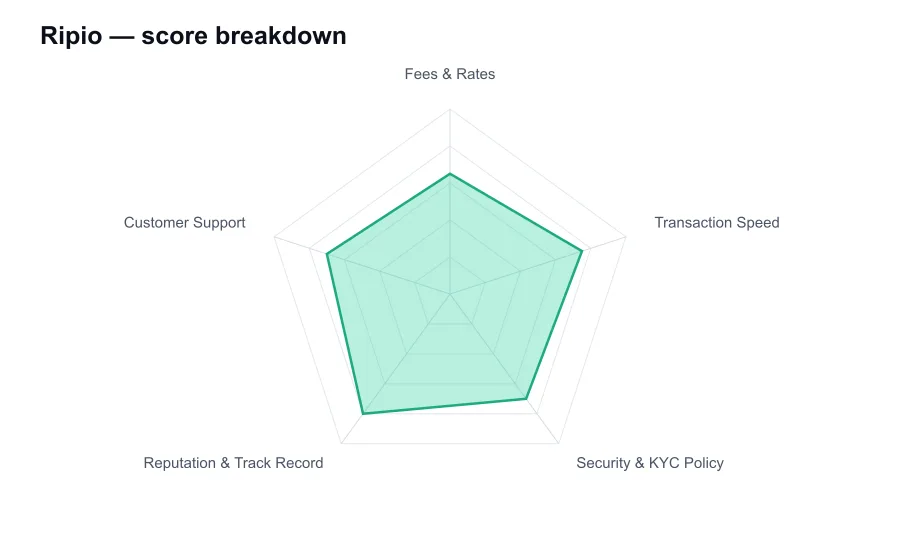
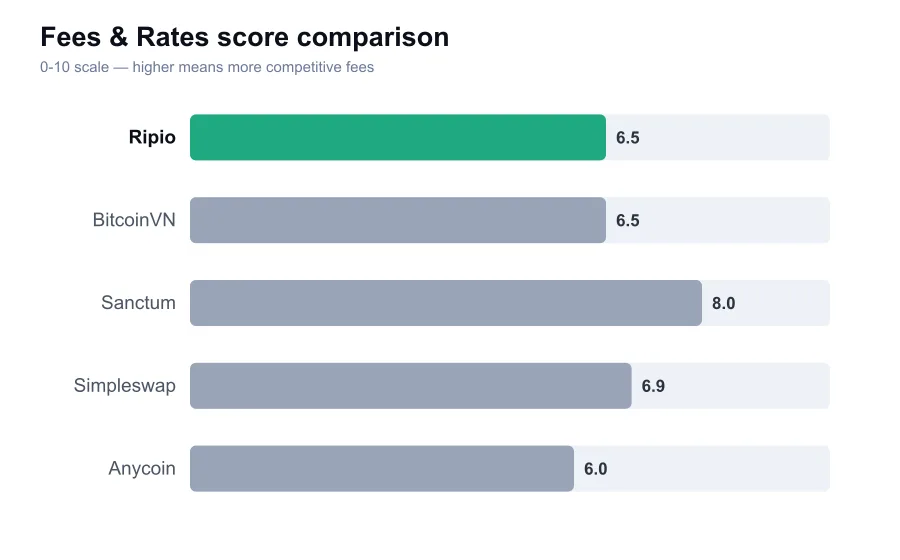
Ripio scores 7.4/10 overall in our independent review, measured against every other provider we've compared, strongest on Reputation & Track Record (8.0/10) and weakest on Fees & Rates (6.5/10).
7.4/10 ★★★★★ How we score → Status: active (checked 2026-10-13T19:45:32.862Z)| Best for | Not for |
|---|---|
| Established Latin American brand founded in 2013 | Retail spreads can exceed professional exchange costs |
| Practical access to bitcoin and stablecoins | Mandatory KYC and centralized custody |
Editorial independence: our scores and rankings are produced using the fixed criteria above and are not influenced by advertisers. This is an independent ranking site and is not operated by, or affiliated with, any provider we list.
Affiliate disclosure: some links on this page may earn us a commission at no extra cost to you. This does not affect our rankings.
What is Ripio?
Ripio is a centralized crypto company founded in Argentina in 2013. Its app lets verified customers buy, sell, store, and transfer selected cryptocurrencies, with a strong focus on Latin American users and local payment methods. It also operates the more trading-oriented Ripio Trade service.
In-Depth Review of Ripio
Ripio is one of Latin America's longest-running crypto companies, founded in Argentina in 2013 and built around making bitcoin and digital dollars accessible to ordinary users. It has expanded from a local bitcoin wallet into a broader app with crypto buying and selling, wallets, payment features, and business services. In regional terms, it carries more history than most rivals.
The company understands a market where crypto is often used for savings, remittances, and protection against currency depreciation. That gives Ripio a practical advantage over exchanges designed around professional trading jargon. Its app is approachable, local payment methods are central to the experience, and stablecoin access is usually a bigger part of the customer story than chasing obscure tokens.
Ripio is not the cheapest venue for frequent trading. Its retail app uses quoted prices, and the spread between buy and sell prices can be more important than a published commission. The company also offers Ripio Trade for customers who need more trading-oriented functionality, but anyone making frequent purchases should compare the executable price with Binance, Bitso, Lemon, Belo, Buenbit, or a local peer before confirming.
A simple app can hide costs surprisingly well. If you buy a stablecoin once each month, convenience may justify a modest spread. If you trade several times a week, the difference compounds. Ripio's pricing is easiest to accept for routine retail conversions and hardest to defend for active users who can use a deeper order book elsewhere.
Speed is generally good for account-to-account activity and purchases funded through supported local rails. External crypto withdrawals move at the pace of the selected blockchain and may be subject to fraud prevention or compliance review. That is normal. The important question is whether the app clearly shows the network, address, and expected status, because a fast withdrawal sent on the wrong chain is still a disaster.
Ripio requires customer verification. It operates as a centralized service with fiat connections and must collect identifying information, apply anti-money-laundering controls, and sometimes request extra documents. This is a poor fit for users seeking anonymous crypto access. For many Latin American customers, though, verification is an acceptable trade for easier deposits, withdrawals, and a company that can be contacted in their language.
Its security posture has the familiar strengths and weaknesses of a custodial exchange. Customers can use account protections such as passwords and two-factor authentication, while Ripio manages the infrastructure and private-key environment behind the scenes. That is more convenient than self-custody for a newcomer. It also means users are exposed to the company's security, policies, and any account restrictions that may arise during reviews.
Ripio's long operating history is its strongest credential. It has continued through several bitcoin cycles, Argentina's recurring financial stress, market crashes, and the collapse of numerous crypto companies. That does not make deposits risk-free, but a company that has lasted since 2013 deserves more credit than a newcomer with a polished interface and no crisis history.
The firm has also expanded beyond Argentina, including operations and services in parts of Latin America and Spain at different times. Geographic availability and product access can differ materially by country. A feature promoted in Brazil or Argentina might not exist for a Colombian or European account. New users should read the local terms instead of assuming a single Ripio app experience applies everywhere.
Ripio's asset menu is broad enough for mainstream users but less compelling for someone whose portfolio revolves around newly launched tokens, DeFi assets, or perpetual futures. That restraint is not necessarily bad. A long list of illiquid coins creates support headaches and risk for a retail platform. Still, sophisticated users will probably maintain another account for wider market access.
Customer support is better positioned than at anonymous offshore exchanges because Ripio has local-market experience and Spanish-language resources. The hard cases remain the same as elsewhere: account verification delays, failed bank transfers, blocked withdrawals, and questions around source of funds can take time. Do not wait until you urgently need money to learn how the support process behaves. Test deposits and withdrawals early.
There is also a practical tax issue. A verified platform can make crypto easier to buy, but it does not make activity invisible. Users should download records, retain receipts, and understand obligations in their country. This is particularly important for people using stablecoins as savings, because a series of seemingly routine conversions can still create reportable events depending on local rules.
Ripio has invested in regional infrastructure rather than presenting itself purely as a trading app. Its business-facing products and wallet history show that the company has tried to build durable rails. That ambition is positive, but retail customers should judge the service by the basics: final exchange rate, ability to withdraw, account security, and responsive help when something goes wrong.
My take is that Ripio is a credible choice for Latin American retail users who want a familiar gateway into bitcoin and stablecoins. Its longevity and regional focus are real advantages. It loses points on retail pricing transparency and cannot match the market depth of the world's biggest exchanges. Use it for convenient local access, but compare quotes and move longer-term holdings into self-custody once you are comfortable doing so.
Score Breakdown
| Criterion | Score | Note |
|---|---|---|
| Fees & Rates | 6.5 | Retail quote spreads can cost more than order-book trading |
| Transaction Speed | 7.5 | Good local app flows, blockchain timing still applies |
| Security & KYC Policy | 7.0 | KYC-based custodial service with standard account controls |
| Reputation & Track Record | 8.0 | Operating since 2013 through multiple crypto cycles |
| Customer Support | 7.0 | Regional and Spanish-language focus, reviews can take time |
Key Facts
Pros and Cons
| Pros | Cons |
|---|
How Ripio Works
- Register an account and complete identity verification
- Secure the account with a strong password and two-factor authentication
- Add funds through an available local payment method
- Choose an asset and review the quoted exchange rate
- Buy, sell, transfer, or withdraw crypto on the correct network
KYC
| Requirement | mandatory |
|---|---|
| Notes | Ripio requires identity verification for its centralized, fiat-linked services and may request further compliance information. |
Supported Assets
| Notable coins | Bitcoin, Ethereum, USDT, USDC, DAI, Litecoin, XRP |
|---|
Availability
| Global? | No |
|---|---|
| Notes | Ripio's services and products vary by country, with its main focus in Latin American markets. |
How to Use Ripio Safely
- Enable two-factor authentication before funding the account
- Compare the final quote with another exchange or broker
- Test a small crypto withdrawal first
- Confirm the blockchain network and address character by character
- Download transaction records for personal accounting
Mobile App
| iOS | Yes |
|---|---|
| Android | Yes |
| Notes | Ripio provides mobile apps for its retail crypto service. |
Does Ripio charge a flat trading fee?
Retail Ripio transactions are commonly presented as quoted buy and sell prices, so users should focus on the final rate and spread. Ripio Trade may have a different fee structure from the consumer app.
Does Ripio require identity verification?
Yes. Ripio is a centralized service with fiat access and requires customer verification. It can also request additional information to meet compliance requirements.
How long has Ripio been operating?
Ripio was founded in 2013 in Argentina. Its long history across several bitcoin cycles is one reason it has a stronger regional track record than newer retail apps.
What is Ripio Trade?
Ripio Trade is Ripio's more trading-oriented offering. It is intended for users who need a market-focused interface beyond the basic retail buy and sell experience.
Can Ripio users withdraw crypto to an external wallet?
Ripio supports crypto withdrawals, subject to the available asset and network options. Always verify the selected chain and receiving address before confirming a transfer.
Is every Ripio feature available in every country?
No. Ripio operates across multiple markets, and services, payment methods, supported assets, and terms can differ by country. Check the local app and terms before funding an account.
Should stablecoins bought on Ripio stay in the app forever?
For long-term storage, consider self-custody if you can safely manage a wallet and recovery phrase. Keeping assets on Ripio means accepting custodial and account-access risk.
Editorial independence: our scores and rankings are produced using the fixed criteria above and are not influenced by advertisers. This is an independent ranking site and is not operated by, or affiliated with, any provider we list.
Affiliate disclosure: some links on this page may earn us a commission at no extra cost to you. This does not affect our rankings.