Spark
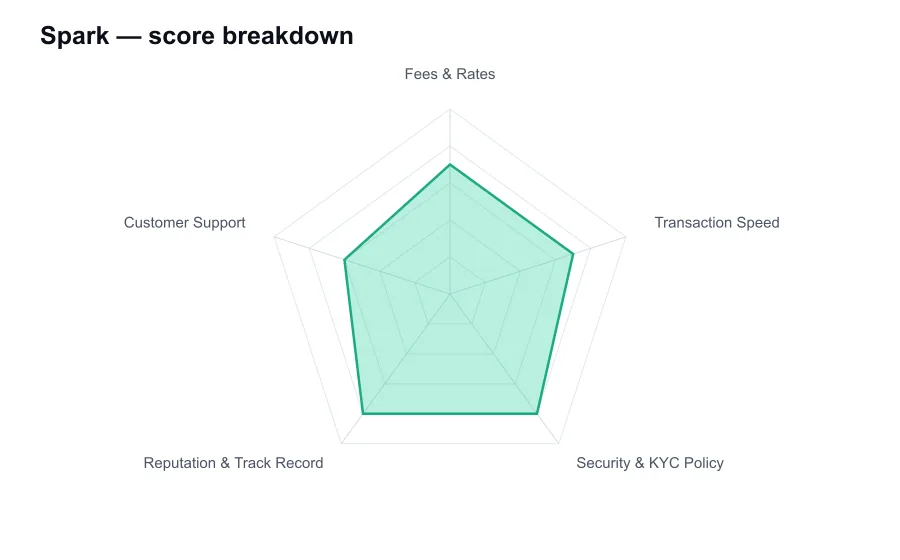
Spark scores 7.4/10 overall in our independent review, measured against every other provider we've compared, strongest on Security & KYC Policy (8.0/10) and weakest on Customer Support (6.0/10).
7.4/10 ★★★★★ How we score →| Best for | Not for |
|---|---|
| Strong Maker and Sky ecosystem lineage | Not a full-service crypto exchange |
| Focused stablecoin lending and savings tools | Liquidation risk for borrowers |
Editorial independence: our scores and rankings are produced using the fixed criteria above and are not influenced by advertisers. This is an independent ranking site and is not operated by, or affiliated with, any provider we list.
Affiliate disclosure: some links on this page may earn us a commission at no extra cost to you. This does not affect our rankings.
In-Depth Review of Spark
Spark is a DeFi lending and savings protocol connected to the Maker ecosystem, now operating in the wider Sky ecosystem. It is built around the idea that stablecoin users should be able to borrow, lend, and access onchain liquidity through infrastructure tied closely to DAI and USDS. Calling Spark an exchange is only partly accurate. It includes swap and liquidity functionality, but its main value lies in stablecoin lending, borrowing, and savings products rather than retail spot trading.
That positioning gives Spark a clearer identity than many DeFi apps. It is aimed at users who hold stablecoins, want to borrow against accepted collateral, or want yield exposure linked to the protocol's savings and lending architecture. A person trying to buy Bitcoin with a bank card or trade dozens of memecoins will find it badly suited. A DeFi user already comfortable with Ethereum wallets and stablecoin mechanics may find it unusually coherent.
Spark's close relationship with Maker-style stablecoin infrastructure is both its principal strength and its central concentration risk. The ecosystem has one of the longest and most consequential histories in DeFi, and DAI has been through several market cycles. That is a substantial advantage over anonymous yield farms. Yet it also means users are exposed to governance decisions, stablecoin reserve policy, collateral composition, smart contracts, and the evolving Sky product structure.
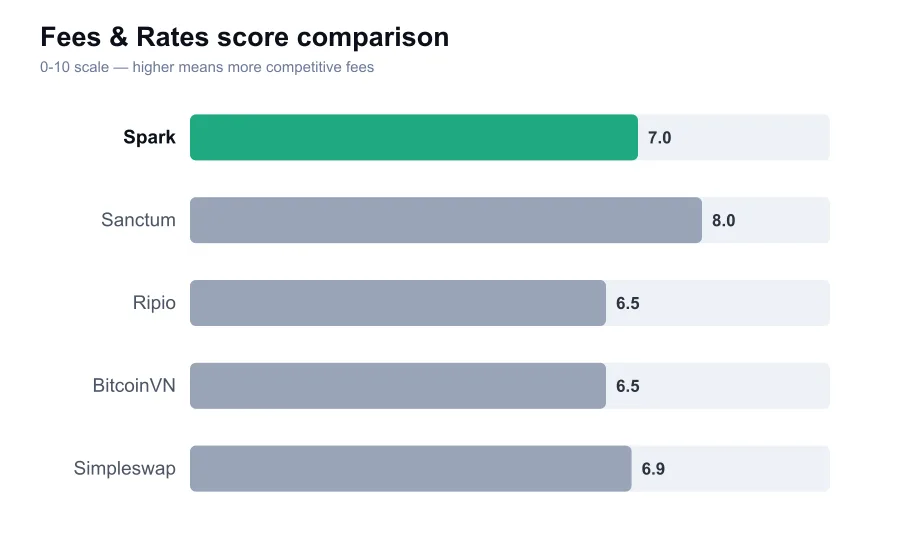
The most important fee point is that Spark does not resemble an exchange with a simple maker-taker fee schedule. Borrowing costs depend on the asset and market. Supplying assets generates variable yield. Swaps and routes can involve pool fees, price impact, and network gas. Savings products have rates set through ecosystem policy rather than a permanent advertised return. Users need to evaluate the exact action they are taking, not search for one universal Spark fee.
For borrowers, the quoted annual percentage rate is only the beginning. Your real cost depends on the collateral you post, the health factor you maintain, whether variable rates change, and what happens in a rapid market decline. Borrowing a stablecoin against ETH can be capital-efficient, but it can also result in liquidation if collateral falls far enough. Spark is not forgiving of users who borrow to the edge of their position.
For depositors, yield has a different character from a bank interest rate. Spark's savings and lending returns can change according to governance parameters, utilization, and the architecture supporting the product. A yield rate may be attractive, particularly for users who already hold DAI or USDS, but it should be viewed as protocol yield with smart-contract and stablecoin exposure. It is not government-insured cash, and it should not be budgeted as guaranteed income.
Speed is generally good at the protocol layer, subject to Ethereum's state and the chain or network being used. Once a transaction is included, balances and positions update onchain. That may take seconds or minutes, not days. But a borrower needing to avoid liquidation must account for congestion and volatility. During a sharp market move, the difference between a transaction submitted and a transaction confirmed can be financially meaningful.
Spark's swap functions can be convenient for moving within a stablecoin-centered DeFi workflow, but convenience should not eliminate comparison shopping. Route quality varies with liquidity, pool conditions, and gas. For a major exchange between stable assets, check the expected output against an aggregator or established DEX route. For large trades, split execution or use a venue with demonstrably deeper liquidity. One-click DeFi is useful, but it is not always best execution.
Security is one of Spark's stronger areas relative to newer DeFi brands, largely because of its Maker ecosystem roots, established governance culture, and the scrutiny applied to core stablecoin infrastructure. That should not become complacency. Audits reduce risk but do not guarantee the absence of bugs. Upgrades, oracle dependencies, liquidations, bridges, wallet approvals, and governance changes all create possible points of failure.
The user also has to manage their own security properly. Spark is wallet-based, so there is no conventional password reset or support agent who can restore lost access. Use a hardware wallet for meaningful value, verify the domain before signing, inspect approvals, and do not grant unlimited allowances casually. Most DeFi losses are not dramatic protocol hacks. They are phishing, malicious approvals, fake interfaces, and overleveraged positions that users could have avoided.
KYC is generally not part of the core permissionless DeFi interaction. You connect a wallet and transact with smart contracts rather than opening a broker account. That does not make every asset or access route universally available, and it does not immunize users from legal obligations in their own jurisdiction. Users seeking a regulated, identity-verified financial service should use one, rather than pretending a permissionless protocol offers the same protections.
Customer support is reasonable for experienced users, with documentation, community channels, and ecosystem resources, but it has the standard DeFi limitation: nobody can undo a valid signed transaction. Support may explain an interface issue or point you toward documentation. It cannot reverse a liquidation caused by insufficient collateral, retrieve tokens sent to an incompatible address, or compensate a user for signing a phishing approval. That is not a Spark-specific flaw, but it is highly relevant to the user experience.
Spark's reputation is meaningfully stronger than most small DeFi lending launches because it is tied to one of the sector's most established stablecoin ecosystems. The Maker and Sky lineage brings credibility, technical experience, and a long history of public governance debate. It also brings complexity and controversy around changing brands, governance direction, real-world asset strategy, and the gradual evolution from the original MakerDAO model. Serious users should follow those changes rather than assuming continuity means immutability.
I like Spark for what it actually is: a focused stablecoin DeFi product with serious ecosystem backing, not a replacement for every kind of exchange. It is a credible place for a technically capable user to explore lending, collateralized borrowing, and stablecoin yield with sensible risk controls. It is not appropriate for someone who cannot explain liquidation risk or who needs customer service with the power to fix mistakes. Use conservative collateral ratios, start small, and judge yields after accounting for the risks that produce them.
Score Breakdown
| Criterion | Score | Note |
|---|---|---|
| Fees & Rates | 7.0 | Rates and costs vary by lending action |
| Transaction Speed | 7.0 | Onchain positions update quickly, network dependent |
| Security & KYC Policy | 8.0 | Strong ecosystem lineage, with DeFi risks intact |
| Reputation & Track Record | 8.0 | Backed by established Maker and Sky infrastructure |
| Customer Support | 6.0 | Good resources, but irreversible self-custody actions |
Pros and Cons
| Pros | Cons |
|---|
Is Spark a centralized crypto exchange?
No. Spark is a wallet-connected DeFi protocol focused on lending, borrowing, stablecoin savings, and related liquidity functions rather than centralized spot trading.
Can I be liquidated when borrowing through Spark?
Yes. If the value of your collateral falls relative to your debt and crosses the relevant threshold, liquidation can occur. Keep a conservative health buffer.
Does Spark require KYC?
Core permissionless protocol interactions generally use a connected wallet rather than a conventional KYC account. Other services used to acquire funds may have their own verification rules.
Editorial independence: our scores and rankings are produced using the fixed criteria above and are not influenced by advertisers. This is an independent ranking site and is not operated by, or affiliated with, any provider we list.
Affiliate disclosure: some links on this page may earn us a commission at no extra cost to you. This does not affect our rankings.