Curve
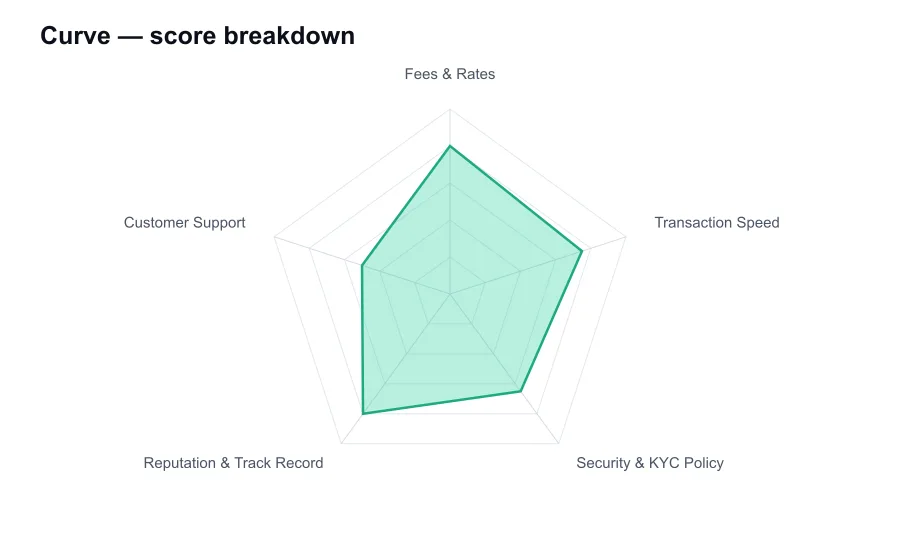
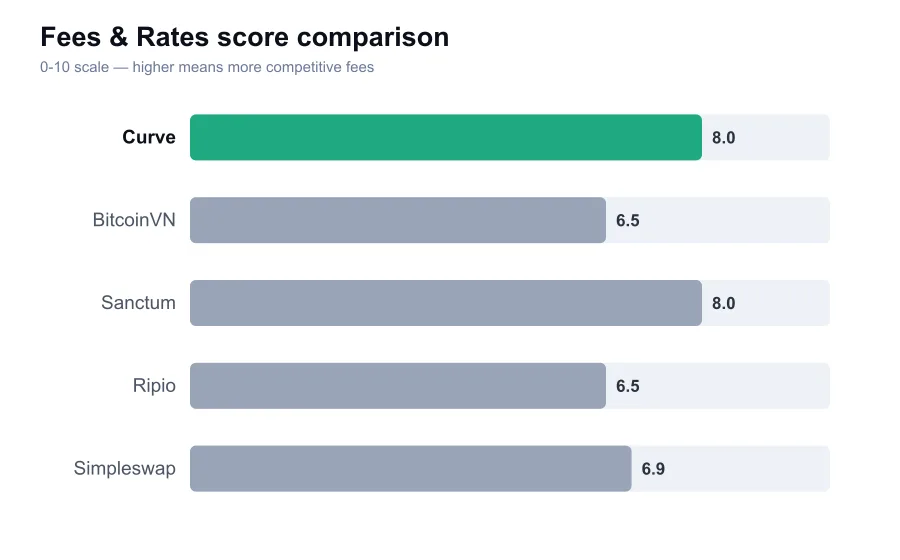
Curve scores 7.4/10 overall in our independent review, measured against every other provider we've compared, strongest on Fees & Rates (8.0/10) and weakest on Customer Support (5.0/10).
7.4/10 ★★★★★ How we score → Status: active (checked 2026-10-13T19:43:31.471Z)| Best for | Not for |
|---|---|
| Excellent pricing for correlated assets | 2023 Vyper exploit damaged confidence |
| Many pools use a 0.04% swap fee | Liquidity provision can create imbalance exposure |
Editorial independence: our scores and rankings are produced using the fixed criteria above and are not influenced by advertisers. This is an independent ranking site and is not operated by, or affiliated with, any provider we list.
Affiliate disclosure: some links on this page may earn us a commission at no extra cost to you. This does not affect our rankings.
What is Curve?
Curve is a decentralized exchange designed mainly for efficient swaps between assets with similar prices, such as stablecoins and tokenized Ether derivatives. Users trade directly from self custody wallets through smart contracts. It also lets users supply liquidity to pools in return for fees and incentives.
In-Depth Review of Curve
Curve is a decentralized exchange built around one job it does exceptionally well, swapping assets that should trade near the same price. Stablecoins, wrapped Bitcoin variants, liquid staking tokens, and similar assets are its natural territory. It is not trying to replace every type of exchange. It is a specialist, and for years that specialization made it core infrastructure for Ethereum DeFi.
The central idea is Curve's StableSwap invariant. Traditional automated market makers can impose painful price impact when swapping one stablecoin for another. Curve concentrates liquidity around parity, so a USDC to DAI swap can be far more efficient than a typical constant product pool. For large stablecoin trades, that difference can be substantial.
Fees are usually attractive. Many classic Curve pools charge a 0.04% trading fee, though pool settings can differ and users also pay network gas. The fee is split between liquidity providers and, where applicable, CRV lockers through the protocol's fee mechanisms. A cheap quoted fee does not automatically mean a cheap trade. Slippage, pool imbalance, routing, and Ethereum gas still matter.
Curve's routing can search across pools and external liquidity sources, which is useful when the direct pool is not the best route. The interface normally gives a clear estimate before confirmation. Still, traders should compare the output with Cow Swap, 1inch, Uniswap, and an aggregator quote for larger orders. Curve is often best for correlated assets, not automatically for every token pair.
Liquidity providers get more complexity than the simple swap screen suggests. Depositing into a balanced pool is one thing. Depositing a single asset can expose the provider to imbalance and leave them holding more of the asset the market no longer wants. High advertised CRV incentives can disguise that risk. Yield farming is not free income if the pool is slowly accumulating a weak asset.
Speed is exactly what you would expect from smart contracts. A swap settles once the underlying network confirms it. On Ethereum, that can mean a few minutes and a meaningful gas bill during busy periods. Curve is also deployed across lower cost networks, where swaps can feel close to immediate. There is no centralized operator delaying a withdrawal, but an onchain transaction still cannot be undone.
Security requires a candid discussion because Curve's record is not spotless. In July 2023, vulnerable Vyper compiler versions enabled reentrancy attacks against several Curve pools. The incident put roughly $70 million at risk, though white hats and recovery efforts reduced the eventual damage. It was a serious reminder that even mature DeFi protocols can be exposed through dependencies outside the visible pool code.
Curve responded through emergency action, pool mitigation, communication, and recovery efforts, but the event should affect how users assess it. The protocol has deep experience and substantial battle testing, yet its large codebase, many pool types, gauge incentives, governance mechanics, and integrations create a bigger operational surface than a basic swap contract. A user should prefer established pools over obscure incentivized ones.
There is no KYC at the protocol layer. Connect a wallet, approve a token, and trade. That privacy and open access remain central to Curve's identity. It also means Curve cannot help if you send funds to the wrong chain, sign a malicious approval, or make a bad swap. Self custody is powerful, but it does not come with an undo button.
Curve's reputation is unusual. It is unquestionably one of DeFi's foundational exchange protocols and has handled enormous stablecoin liquidity over multiple market cycles. Its CRV token and vote escrow governance model helped shape the incentive wars across DeFi. But Curve has also been associated with complicated governance struggles, pool fragmentation, and the 2023 exploit. This is an established protocol, not an uncomplicated one.
Support is community driven. Documentation, Discord, governance forums, and public transaction data are useful, particularly for technically capable users. There is no traditional service desk that can recover funds or process a chargeback. Scam support accounts are common around major DeFi brands, so users should be extremely suspicious of direct messages offering help.
Curve is strongest for stablecoin swaps, liquid staking token exchanges, and users who understand the assets in a pool. It is often less compelling for a casual person buying an uncorrelated altcoin. Uniswap's concentrated liquidity or an aggregator may produce a better result there. The smart move is to treat Curve as a venue to quote, not as a destination that must win every trade.
For liquidity provision, the quality of the underlying assets matters more than the headline APY. A pool involving USDC, DAI, and USDT has a different risk profile from one built around derivative stablecoins or small cap wrapped assets. Read the pool composition, check whether it is balanced, and understand where the incentives come from before depositing.
Curve remains a very good decentralized exchange, especially in the narrow field it helped define. The standard 0.04% pool fee is competitive, its stable asset pricing can be excellent, and the protocol's long record commands respect. Yet the Vyper episode and the complexity of many pools make blind trust foolish. I would use Curve for a well known correlated asset pool, while keeping trade sizes and approvals disciplined.
Score Breakdown
| Criterion | Score | Note |
|---|---|---|
| Fees & Rates | 8.0 | Many classic pools charge a 0.04% swap fee |
| Transaction Speed | 7.5 | Fast settlement on low cost chains, gas on Ethereum |
| Security & KYC Policy | 6.5 | Battle tested, but 2023 Vyper exploit matters |
| Reputation & Track Record | 8.0 | Foundational stable asset DEX with a long record |
| Customer Support | 5.0 | Community support only, no fund recovery desk |
Key Facts
Pros and Cons
| Pros | Cons |
|---|
How Curve Works
- Connect a self custody wallet
- Choose the token pair and network
- Review the quoted output, price impact, and gas cost
- Approve the token if needed
- Confirm the swap onchain
KYC
| Requirement | none |
|---|---|
| Notes | Curve's smart contracts do not require KYC. Website access and wallet provider policies can vary by location. |
Supported Assets
| Notable coins | USDC, USDT, DAI, FRAX, WETH, wstETH, WBTC |
|---|---|
| Networks | Ethereum, Arbitrum, Optimism, Base, Polygon |
How to Use Curve Safely
- Confirm the official Curve domain before connecting a wallet
- Check pool composition and price impact before trading
- Use limited token approvals where your wallet supports them
- Avoid depositing into pools you cannot explain
- Ignore direct messages claiming to be Curve support
What fee does Curve charge for swaps?
Many classic Curve pools use a 0.04% trading fee. Individual pools can have different settings, and network gas is charged separately.
What happened in the Curve Vyper incident?
In July 2023, vulnerabilities in certain Vyper compiler versions enabled reentrancy attacks against several Curve pools. Roughly $70 million was initially at risk.
Why is Curve often good for stablecoin swaps?
Curve's StableSwap design concentrates liquidity around parity, reducing price impact for correlated assets such as USDC, DAI, USDT, and liquid staking derivatives.
Can a Curve liquidity provider end up with one token?
Yes. If a pool becomes imbalanced, liquidity providers can hold more of the asset traders are selling into the pool. This is a core pool risk.
Does Curve require KYC?
No. Curve is a decentralized protocol and its smart contracts do not ask for identity verification. You need a compatible wallet and network gas.
Why might Curve be expensive for a small swap?
The pool fee may be only 0.04%, but Ethereum gas can outweigh that saving for a small transaction. A lower cost Curve deployment may be preferable.
Editorial independence: our scores and rankings are produced using the fixed criteria above and are not influenced by advertisers. This is an independent ranking site and is not operated by, or affiliated with, any provider we list.
Affiliate disclosure: some links on this page may earn us a commission at no extra cost to you. This does not affect our rankings.