Maple
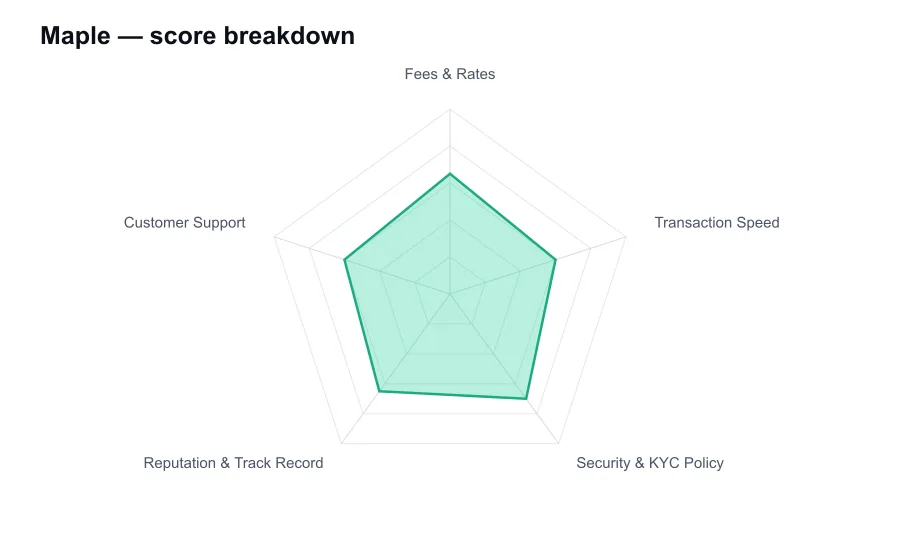
Maple scores 6.5/10 overall in our independent review, measured against every other provider we've compared, strongest on Security & KYC Policy (7.0/10) and weakest on Customer Support (6.0/10).
6.5/10 ★★★★★ How we score →| Best for | Not for |
|---|---|
| Established onchain credit infrastructure | Historic defaults remain a serious warning |
| More disciplined secured-lending direction | Yield can involve credit and liquidity risk |
Editorial independence: our scores and rankings are produced using the fixed criteria above and are not influenced by advertisers. This is an independent ranking site and is not operated by, or affiliated with, any provider we list.
Affiliate disclosure: some links on this page may earn us a commission at no extra cost to you. This does not affect our rankings.
In-Depth Review of Maple
Maple is not a conventional retail crypto exchange, and judging it as one would miss the point. It is an onchain credit and lending protocol built around institutional and accredited-style capital markets, with products that have included secured lending pools and cash-management vaults. Users are not arriving to swap SOL for ETH in a few clicks. They are supplying capital, seeking yield, or participating in structured onchain credit products.
That distinction immediately affects who should care. Maple's natural audience is sophisticated stablecoin holders, crypto treasuries, funds, DAOs, and users who understand that lending yield is compensation for risk. Retail traders looking for fiat on-ramps, spot execution, or a broad menu of tokens should look elsewhere. The protocol has become more accessible through vault products, but its core identity remains credit infrastructure rather than a consumer exchange.
The strongest part of Maple's proposition is that it moved beyond the vague promise of DeFi yield and built products around underwriting, collateral, loan terms, and borrower quality. The current emphasis on secured lending is a meaningful improvement on the undercollateralized lending era that damaged the protocol's reputation in 2022. A lending platform should never need a market crisis to discover that unsecured credit can go very wrong.
Maple's history cannot be discussed honestly without that episode. During the 2022 credit collapse, loans connected to borrowers including Orthogonal Trading defaulted, leaving lenders with material losses. Orthogonal had also served as a delegate in the ecosystem, which made the failure especially ugly. Maple was not alone in being hurt by the collapse of centralized crypto credit, but it was a clear demonstration that due diligence, governance, and counterparty concentration are not abstract concepts.
The protocol's later shift toward more secured products deserves credit, but it does not erase the lesson. Collateral can improve recovery prospects, yet its value can move sharply and liquidation mechanisms can be stressed during market turmoil. Credit risk also remains credit risk, even when it is packaged inside an onchain vault with a polished dashboard. A USDC yield figure should never be treated like a savings-account rate.
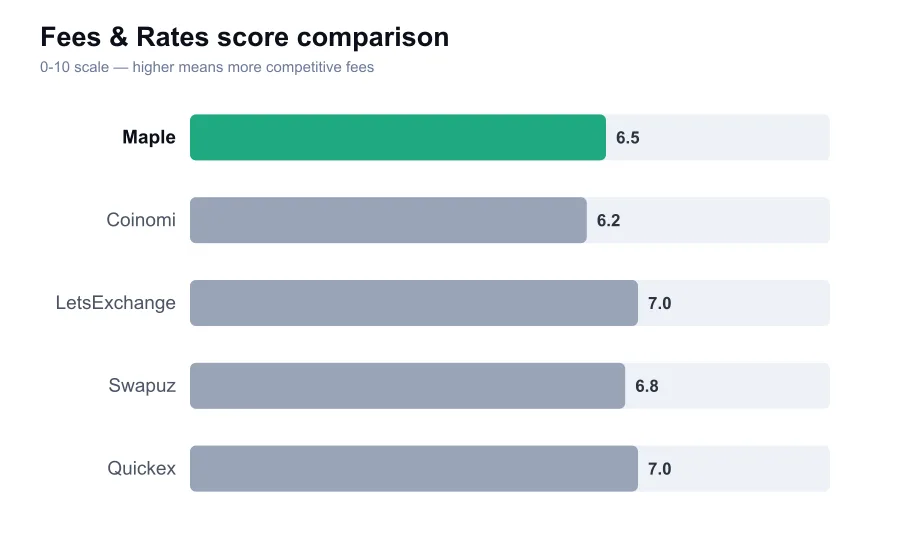
Fees are more complex here than at a simple exchange. Maple users need to distinguish protocol fees, pool or vault management fees, performance fees where applicable, borrowing costs, and the economic effect of any withdrawal restrictions. The exact terms vary by product, chain, and vault, so a single generic fee percentage would be misleading. Read the specific vault documentation and transaction preview, not just the yield headline.
For lenders, the bigger question is net yield after all costs and risks. A vault advertising an attractive annualized return may be compensating depositors for duration, credit exposure, liquidity restrictions, smart-contract risk, and stablecoin risk. The right comparison is not just another DeFi pool. Compare it with tokenized Treasury products, regulated money-market options where available, and the yield available on highly liquid lending markets such as Aave. Higher return is rarely free.
Transaction speed is determined by the chain and by the product's mechanics. Deposits and onchain withdrawals can settle as fast as the underlying network allows, often within seconds or minutes on supported chains. That is not the same thing as instant economic liquidity. A vault can have notice periods, cooldowns, available-liquidity limits, or redemption queues. Users who need guaranteed same-day access to capital should not assume a yield vault functions like a checking account.
Maple has made a serious effort to show more structure than the anonymous borrower model that once dominated DeFi credit. Its institutional focus, borrower information, pool-level documentation, and secured lending direction are all positives. Still, transparency is not a substitute for a legal guarantee. The legal enforceability of claims, the role of service providers, and the jurisdictional details around a specific product matter enormously, especially for substantial deposits.
Security has two separate layers here. First is smart-contract security, where audits and code controls matter. Second is operational and credit security, which covers collateral custody, liquidation arrangements, borrower monitoring, administrators, and the people making credit decisions. Maple is stronger on public protocol sophistication than a lightly documented swap site, but its overall risk profile is inherently more complicated than holding coins in your own wallet.
KYC is product-dependent, not something that can be summarized with a simple yes or no. Access to institutional, permissioned, or regulated offerings may require identity verification, accreditation checks, and jurisdictional screening. Permissionless interactions may have a different experience. Anyone who needs strict privacy should inspect the exact product terms before connecting a wallet, while anyone who wants regulated protections should not assume a DeFi interface supplies them.
Support is competent for a protocol aimed at technically literate capital providers, but it is not the hand-holding service desk of a large retail brokerage. Documentation, governance channels, Discord, and web support can help with mechanics. They cannot reverse a signed blockchain transaction or eliminate a contractual dispute with a borrower. The more money involved, the less sensible it is to rely on community chat as your only operational safety net.
Maple's reputation is now mixed rather than broken. It has survived a brutal stress test, changed its risk posture, and remains one of the more recognizable names in onchain private credit. That is a better position than a protocol that vanished after the cycle turned. But survival is not the same as a clean track record. Conservative allocators should regard the 2022 losses as part of the product's permanent history.
My take is that Maple is one of the few crypto-credit platforms worth studying seriously, precisely because its failures are documented and its present model is more disciplined than its earlier one. It can suit investors who can evaluate yield, collateral, liquidity, and legal structure as one package. It is a poor fit for newcomers chasing passive income or traders who simply need an exchange. Maple offers real infrastructure, not magic yield, and users who forget that distinction may learn it expensively.
Score Breakdown
| Criterion | Score | Note |
|---|---|---|
| Fees & Rates | 6.5 | Product-specific fees require close reading |
| Transaction Speed | 6.0 | Onchain settlement is quick, liquidity may not be |
| Security & KYC Policy | 7.0 | Structured secured lending, with real credit risk |
| Reputation & Track Record | 6.5 | Recognized survivor with 2022 default baggage |
| Customer Support | 6.0 | Best suited to technically capable users |
Pros and Cons
| Pros | Cons |
|---|
Is Maple a crypto exchange?
Not in the usual retail sense. Maple is primarily an onchain credit and lending platform, not a venue for broad spot trading or fiat purchases.
Did Maple lenders lose money in 2022?
Yes. Defaults during the 2022 crypto-credit crisis caused losses in Maple pools. The protocol later placed greater emphasis on secured lending and risk controls.
Can I withdraw from Maple instantly?
Not always. Blockchain settlement can be fast, but a specific vault may have available-liquidity limits, cooldowns, notice periods, or a withdrawal queue.
Editorial independence: our scores and rankings are produced using the fixed criteria above and are not influenced by advertisers. This is an independent ranking site and is not operated by, or affiliated with, any provider we list.
Affiliate disclosure: some links on this page may earn us a commission at no extra cost to you. This does not affect our rankings.