Coinomi
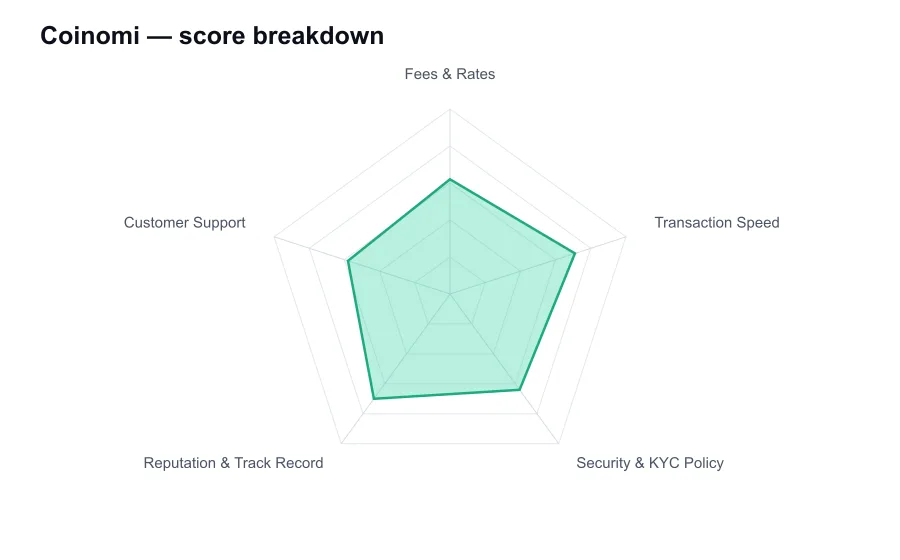
Coinomi scores 6.7/10 overall in our independent review, measured against every other provider we've compared, strongest on Transaction Speed (7.1/10) and weakest on Customer Support (5.8/10).
6.7/10 ★★★★★ How we score → Status: active (checked 2026-10-13T19:27:00.559Z)| Best for | Not for |
|---|---|
| Noncustodial wallet with user-controlled keys | In-app swap prices are often less competitive |
| Available on mobile and desktop systems | Wallet code is not fully open source |
Editorial independence: our scores and rankings are produced using the fixed criteria above and are not influenced by advertisers. This is an independent ranking site and is not operated by, or affiliated with, any provider we list.
Affiliate disclosure: some links on this page may earn us a commission at no extra cost to you. This does not affect our rankings.
What is Coinomi?
Coinomi is a noncustodial cryptocurrency wallet for mobile and desktop devices. It lets users hold and send assets across many blockchains and access third-party exchange and purchase services from inside the app. The user, not Coinomi, controls the recovery phrase.
In-Depth Review of Coinomi
Coinomi is first and foremost a noncustodial cryptocurrency wallet, not an exchange in the usual sense. It has been around since 2014 and built its name by supporting a very broad selection of assets long before multi-chain wallets became commonplace. Its in-app exchange function is useful, but it is powered by third parties. That distinction matters because Coinomi does not execute or custody those swaps itself.
The wallet is available on Android, iOS, Windows, macOS and Linux. That cross-platform reach remains one of its strongest practical advantages. A person holding a mixture of Bitcoin, Ethereum tokens, Litecoin, Dogecoin and more obscure chains can keep them in one interface instead of installing a separate application for every ecosystem.
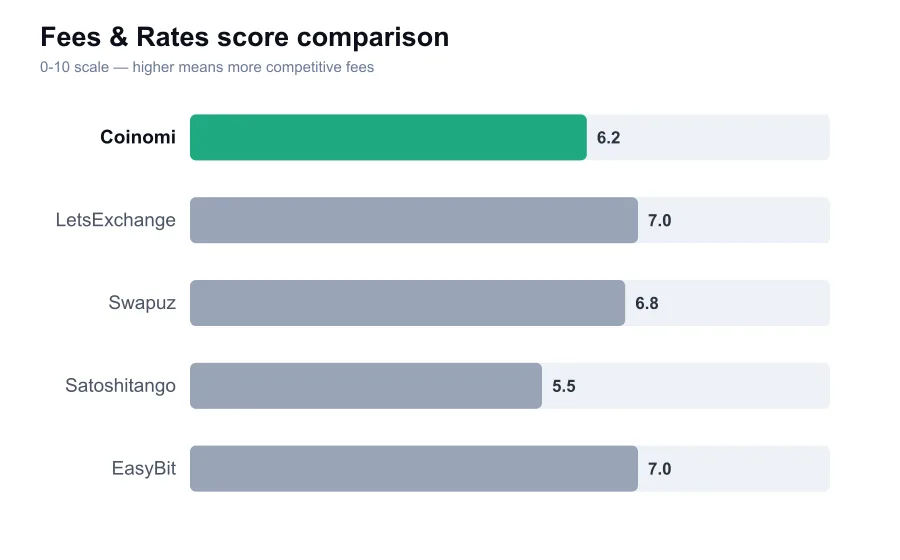
Coinomi's core wallet has no account fee and no direct trading commission. Users pay network fees for blockchain transactions, and those fees vary with the network selected and the urgency chosen. The catch is that an in-app exchange quote includes the provider's spread and, depending on the partner and payment route, an additional service charge. Coinomi makes the transaction convenient, but convenience is rarely the cheapest route.
That is where the product can disappoint price-sensitive buyers. Swapping through an integrated service is usually more expensive than placing an order at a liquid exchange such as Kraken, Coinbase Advanced or Binance, then withdrawing. The final quote matters more than any headline claim about zero wallet fees. Check the received amount before approving, because that is the number that captures the spread, provider charge and network cost together.
Speed is similarly dependent on what you are doing. Sending coins from the wallet is as quick as the underlying blockchain and the selected fee permit. A Bitcoin transfer can take from minutes to considerably longer during congestion, while many Ethereum or Polygon transfers confirm much faster. An in-app conversion has a second layer of delay, since the partner has to receive, process and send the output asset.
Coinomi is generally straightforward for ordinary sends and receives. The exchange screen displays an expected rate, a deposit address and status updates, although a swap can feel opaque if the partner holds it for an extra confirmation or compliance review. This is not an exchange where a trader gets an order book, advanced order types or a clean view of execution quality. It is a wallet with a handy off-ramp to swapping.
The security model is a real strength, with an important qualification. Private keys and the recovery phrase are controlled by the user, rather than held on a central Coinomi account. That sharply reduces the risk of a custodial collapse freezing every customer at once. It also means that losing the recovery phrase is final. Support cannot reset it and Coinomi cannot retrieve coins for you.
The app encrypts wallet data locally and supports a passphrase, biometric access on supported devices and custom transaction fees. Those are useful protections, but Coinomi is not fully open source. Security-conscious wallet users often prefer independently auditable options such as Sparrow for Bitcoin, MetaMask for Ethereum activity, or hardware-wallet software from Ledger and Trezor. Closed source software asks the customer to place more trust in the vendor's engineering process.
Coinomi's history also deserves more scrutiny than its marketing copy sometimes receives. In 2019, researcher claims showed that entering a recovery phrase into the desktop wallet's spell-check field could send that phrase to Google services. Coinomi said the issue was fixed quickly. There was no known theft attributed to the issue, but a seed phrase exposure flaw is serious even when it is patched. It should rule out complacency.
KYC is not required to create or use the Coinomi wallet. The integrated purchase and exchange partners may require identity checks, especially for card purchases, larger transactions or users in regulated jurisdictions. Anyone expecting a private wallet should understand the boundary here. Self-custody can be private, while the fiat purchase or exchange provider can still collect a full identity profile.
Coinomi has a long operating record and an established user base, which is better than trusting an unknown mobile wallet with a polished website. Yet its reputation is mixed among advanced users. The broad asset support earns respect, while the closed-source design, the old spell-check incident and reliance on external swap providers make it less compelling for people who treat wallet security as a discipline rather than a convenience feature.
Customer support is available through its help center and ticket channels, but this is not a concierge service. Most wallet problems are actually seed phrase, wrong-network or blockchain-confirmation problems, and support has limited power to reverse any of them. Reports about exchange-related tickets can be especially frustrating because Coinomi may need to direct the user to the underlying partner.
For a newcomer, the interface is less intimidating than many specialist wallets. It clearly separates receive and send actions, and it handles a wide range of chains without forcing the user to learn every technical detail immediately. Still, the very breadth of support creates risk. Sending an asset to a mismatched network or entering the wrong address can remain irreversible even if the app made the process feel simple.
My view is that Coinomi remains a useful general-purpose software wallet, particularly for people managing several older and newer crypto assets. I would not choose it as the cheapest exchange, a professional trading platform or the sole home for a meaningful long-term holding. Pair it with a hardware wallet for serious savings, verify every swap quote, and keep the recovery phrase offline. Used that way, it is capable and convenient without being asked to do more than it should.
Score Breakdown
| Criterion | Score | Note |
|---|---|---|
| Fees & Rates | 6.2 | Wallet is free, but partner swap spreads can be costly |
| Transaction Speed | 7.1 | Fast wallet sends, exchange timing depends on partners |
| Security & KYC Policy | 6.4 | Self-custody, but closed source and past seed issue |
| Reputation & Track Record | 7.0 | Operating since 2014 with a mixed expert reputation |
| Customer Support | 5.8 | Ticket support, limited help for irreversible errors |
Key Facts
Pros and Cons
| Pros | Cons |
|---|
How Coinomi Works
- Install Coinomi and create a wallet
- Write down the recovery phrase offline
- Add the asset or blockchain account you need
- Receive funds at the displayed address
- Use Send for transfers or Exchange for a partner swap
- Confirm the final address, network and quote
KYC
| Requirement | optional |
|---|---|
| Notes | Creating and using the wallet does not require KYC. Identity checks can apply through integrated purchase and exchange providers. |
Supported Assets
| Notable coins | Bitcoin, Ethereum, Litecoin, Dogecoin, Bitcoin Cash, Dash, ERC-20 tokens |
|---|---|
| Networks | Bitcoin, Ethereum, Polygon |
How to Use Coinomi Safely
- Store the recovery phrase offline, never in a screenshot
- Verify the network before sending tokens
- Compare the final swap amount with an external exchange quote
- Use a device lock and app biometric protection
- Test a new address with a small transaction first
Mobile App
| iOS | Yes |
|---|---|
| Android | Yes |
| Notes | Coinomi provides mobile apps for iOS and Android. |
Does Coinomi require KYC?
No KYC is required to create or use the Coinomi wallet. Third-party card purchase and exchange partners can require verification depending on the transaction and jurisdiction.
Did Coinomi have a seed phrase security incident?
In 2019, a reported desktop spell-check issue could expose a recovery phrase to Google services. Coinomi said it fixed the issue, but users should always update the app and protect their seed offline.
Who sets the exchange rate inside Coinomi?
Coinomi's integrated providers set swap quotes. Coinomi is the wallet interface, so the displayed received amount can include a provider spread and network costs.
Can Coinomi recover a lost recovery phrase?
No. Coinomi is noncustodial, so the recovery phrase controls the wallet. If it is lost and no backup exists, Coinomi support cannot restore access.
Is Coinomi a crypto exchange?
It is primarily a noncustodial wallet. Its exchange and purchase functions connect users to external providers rather than offering Coinomi's own order book.
Can I use Coinomi on a computer?
Yes. Coinomi offers desktop versions for Windows, macOS and Linux, alongside Android and iOS apps.
Editorial independence: our scores and rankings are produced using the fixed criteria above and are not influenced by advertisers. This is an independent ranking site and is not operated by, or affiliated with, any provider we list.
Affiliate disclosure: some links on this page may earn us a commission at no extra cost to you. This does not affect our rankings.