YaObmen
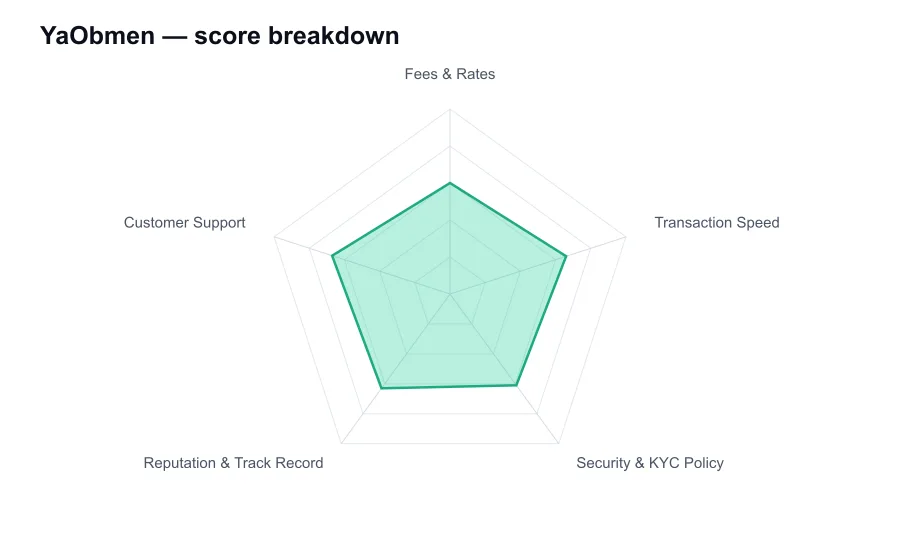
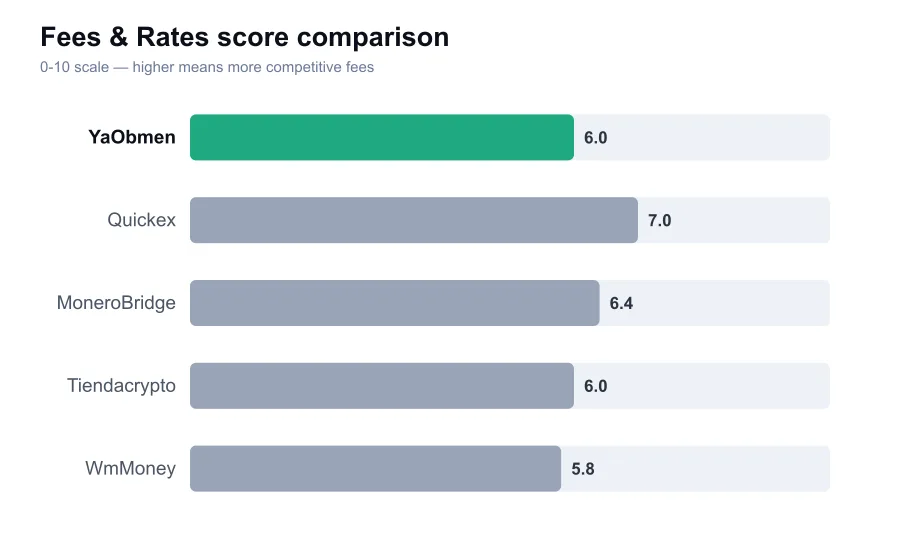
YaObmen scores 6.3/10 overall in our independent review, measured against every other provider we've compared, strongest on Customer Support (6.7/10) and weakest on Fees & Rates (6.0/10).
6.3/10 ★★★★★ How we score → Status: active (checked 2026-10-13T19:28:54.854Z)| Best for | Not for |
|---|---|
| Useful for route-specific payment conversions | Rates are less transparent than exchange trading fees |
| Direct quote-and-order workflow | Reserve availability can affect larger orders |
Editorial independence: our scores and rankings are produced using the fixed criteria above and are not influenced by advertisers. This is an independent ranking site and is not operated by, or affiliated with, any provider we list.
Affiliate disclosure: some links on this page may earn us a commission at no extra cost to you. This does not affect our rankings.
What is YaObmen?
YaObmen is an online exchanger that processes direct conversion orders between cryptocurrencies and selected payment or electronic-money methods. Users receive a quoted payout instead of trading through a public order book.
In-Depth Review of YaObmen
YaObmen is a regional-style online exchanger, built around practical conversions rather than exchange trading. It belongs to the long-running ecosystem of services that exchange cryptocurrency, electronic money, bank-related payment methods, and local transfer options through a quote-and-order workflow. That can be more useful than a global exchange for a customer with a very specific payout need.
The trade-off is that YaObmen should be judged as an exchanger, not as a bank or a major crypto venue. A user does not get an order book, deep public liquidity, audited reserves, or the broad legal infrastructure associated with top-tier centralized exchanges. What they get is a direct route from one payment form to another, if the service has the relevant reserve.
Fees are embedded in the exchange rate, which is normal for this sector but still frustrating. The service may show a clean quote, yet the quote can reflect several costs at once: market spread, reserve pressure, payment-provider fees, blockchain fees, and YaObmen's own margin. There is no honest shortcut here. Compare the exact payout against alternatives at the moment you plan to exchange.
YaObmen can be competitive on routes where local payment systems matter more than international spot-market liquidity. It is less likely to be the obvious low-cost winner for a plain BTC to USDT conversion. For that kind of liquid pair, large exchanges and specialist crypto swap providers have more competition between market makers and usually more transparent pricing.
Reserve availability deserves attention. An exchanger may list a direction that is temporarily constrained by the amount it can pay out through a certain bank or wallet channel. If the available reserve is lower than your desired transaction, the order may need to be split, delayed, or handled by support. That is a routine operational limitation, not necessarily evidence of a problem.
Speed depends heavily on the direction. A crypto deposit can only proceed after the required confirmations. A bank-side payout can depend on a local transfer system, a card issuer, or manual review. YaObmen may complete a normal order quickly, but it should never be treated as having the deterministic speed of an on-chain stablecoin transfer between two self-custody wallets.
The safer way to use it is to read the direction-specific instructions before creating an order. Some payment methods require a payment comment, a particular account format, or a sender name that matches the order information. Ignoring those details can turn a quick exchange into a reconciliation problem.
YaObmen's security model is operational rather than institutional. The customer needs to trust the service with funds during the exchange, even if that period is short. That makes the provider's public record, support responsiveness, and willingness to explain compliance requirements more important than a slick interface.
KYC may be triggered in certain circumstances. This is especially relevant for card-related transactions, larger orders, unusual transaction patterns, or transfers that AML systems consider risky. People sometimes interpret an optional KYC model as a guarantee that documents will never be required. That is not how modern payment compliance works.
I would give YaObmen a middling security score because risk controls are necessary, but customers need clear procedures when an order is paused. A service should state what information is required, how a rejected transaction is handled, and how a refund works. Users should never send funds if they are unable or unwilling to verify their identity should the transaction be flagged.
Reputation is adequate within the exchanger niche, though it does not carry the broad international recognition of Kraken, Coinbase, or Binance. A regional provider can still be reliable, but its review profile should be read carefully. Recent comments about the exact payout method are much more useful than old generic praise.
Support has to carry some weight with YaObmen because local payment routes create edge cases. A good support agent can trace a bank reference or explain a reserve delay. A slow reply can leave the user staring at a completed payment and no payout. That is why I would test the service before relying on it for an important payment.
YaObmen works best as a practical bridge, particularly for someone who already knows the payment method and wants a direct conversion path. It is not a place for passive storage, large speculative trades, or blind transfers. The service demands a little more care from the customer than a polished app-based exchange.
My take is that YaObmen is useful, but only when its specific route earns the business. If the payout is competitive, the instructions are clear, and the amount is within the visible reserve, it can be a sensible choice. If price transparency and institutional protection matter more, use a large exchange and a direct withdrawal route instead.
Score Breakdown
| Criterion | Score | Note |
|---|---|---|
| Fees & Rates | 6.0 | Quoted rates are route-specific and include the exchanger margin |
| Transaction Speed | 6.6 | Timing depends on confirmations, reserves, and payout method |
| Security & KYC Policy | 6.1 | Compliance checks and payment-detail accuracy are important |
| Reputation & Track Record | 6.3 | Recognizable niche exchanger, but not a major global venue |
| Customer Support | 6.7 | Support is important for reserve and payment-reference cases |
Key Facts
| Fact | Value | Source |
|---|---|---|
| Service model | Online currency and crypto exchanger | - |
| Order type | Quoted conversion order | - |
| Pricing model | Rate includes route-specific margin | - |
| Payout constraint | Available reserve by direction | - |
| Processing dependency | Network and payment-rail timing | - |
Pros and Cons
| Pros | Cons |
|---|
How YaObmen Works
- Choose the sending and receiving directions
- Check the quoted rate and available reserve
- Enter the receiving wallet or payment account details
- Follow the payment instructions exactly
- Wait for confirmations and the outbound payout
KYC
| Requirement | optional |
|---|---|
| Notes | A transaction can be subject to verification under AML or fraud controls, particularly where payment cards, higher-risk activity, or unusual transaction details are involved. |
How to Use YaObmen Safely
- Check available reserve before placing a larger order
- Read payment instructions before sending any funds
- Use an account or card in your own name
- Confirm wallet network, memo, and account details
- Save the order number and payment evidence
What is YaObmen mainly used for?
YaObmen is used for quoted conversions between cryptocurrencies, electronic money, and payment-related methods. It is not an order-book trading exchange.
Are YaObmen fees shown separately?
The effective cost is generally reflected in the quoted exchange rate. Compare the final payout with alternatives because the rate can include several route-specific costs.
Why does the available reserve matter?
The reserve represents the provider's ability to make a payout in the selected direction. A larger order may require confirmation with support if the visible reserve is insufficient.
Can a YaObmen order require KYC?
Yes. Verification can be requested for AML, fraud prevention, card-related checks, or a transaction pattern that requires manual review.
What causes a payout delay?
Common causes include blockchain confirmation time, a manual payment check, reserve limits, an incorrect payment reference, or a receiving bank's own processing time.
Should I test YaObmen before a large transfer?
Yes. YaObmen scores 6.6 out of 10 for speed because processing varies by direction, so a small test checks the exact route and payout method.
Editorial independence: our scores and rankings are produced using the fixed criteria above and are not influenced by advertisers. This is an independent ranking site and is not operated by, or affiliated with, any provider we list.
Affiliate disclosure: some links on this page may earn us a commission at no extra cost to you. This does not affect our rankings.