LetsExchange
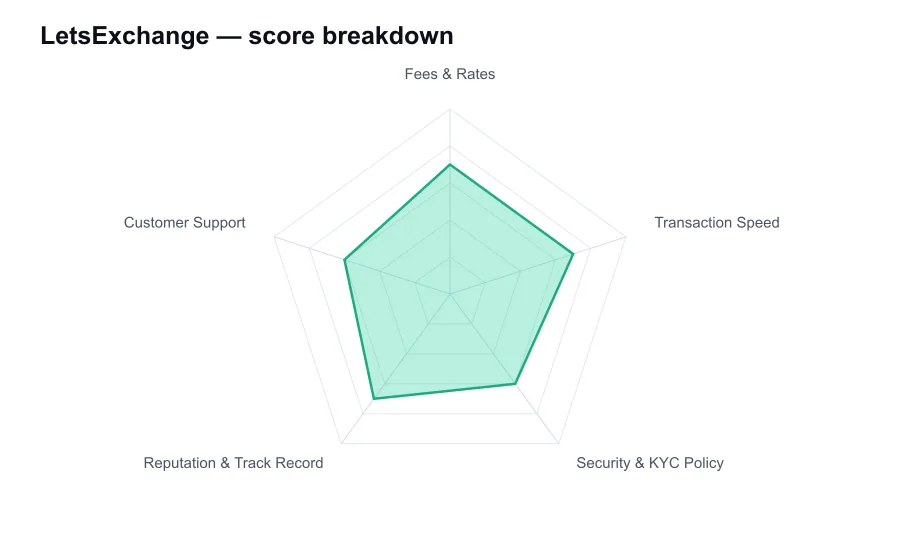
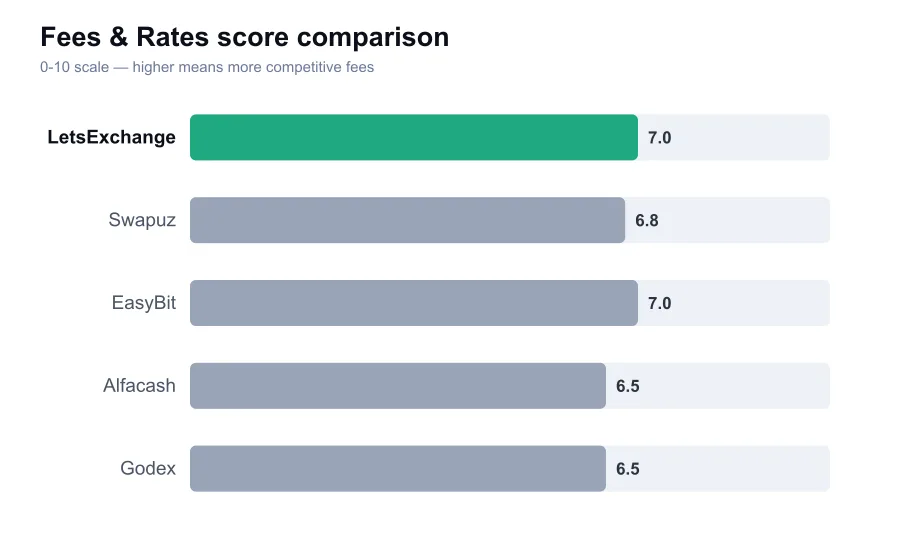
LetsExchange scores 6.7/10 overall in our independent review, measured against every other provider we've compared, strongest on Fees & Rates (7.0/10) and weakest on Customer Support (6.0/10).
6.7/10 ★★★★★ How we score → Status: active (checked 2026-10-13T19:22:23.294Z)| Best for | Not for |
|---|---|
| Supports thousands of listed crypto assets | Final cost is embedded in the quote |
| Floating-rate and fixed-rate swap options | Rates can move on floating transactions |
Editorial independence: our scores and rankings are produced using the fixed criteria above and are not influenced by advertisers. This is an independent ranking site and is not operated by, or affiliated with, any provider we list.
Affiliate disclosure: some links on this page may earn us a commission at no extra cost to you. This does not affect our rankings.
What is LetsExchange?
LetsExchange is an instant cryptocurrency exchange that facilitates wallet-to-wallet swaps. It provides quoted conversions across a large catalog of assets and networks, without functioning as a conventional order-book trading exchange. Users can choose floating or fixed-rate routes where available.
In-Depth Review of LetsExchange
LetsExchange is a well-known instant crypto exchange service, not a conventional custodial trading platform. Its job is to route a conversion between cryptocurrencies while keeping the user focused on a single transaction rather than a permanent exchange account. That places it in the same broad category as ChangeNOW, SimpleSwap, and StealthEX, but LetsExchange has developed a more substantial public presence than many smaller swap sites.
The service is most useful for people who already hold crypto in a wallet and want to move between assets or networks without depositing funds into a centralized exchange. You choose a pair, enter a receiving address, and send the source asset to the address generated for the order. LetsExchange then routes the swap through its liquidity sources and sends the output to your chosen wallet.
Its wide asset coverage is one of the real selling points. LetsExchange advertises support for thousands of cryptocurrencies and a large number of networks, which makes it useful for common pairs as well as less obvious altcoin conversions. The broad catalog should not be confused with universal liquidity, though. A token being listed does not guarantee a tight rate, a large capacity, or a smooth route at every hour.
Fees need a careful reading. LetsExchange does not operate around a simple universal trading commission like a major exchange's maker and taker schedule. The cost is reflected in the offered rate and can include a liquidity spread, network cost, and the conditions of either a floating or fixed-rate route. That is typical for instant exchangers, but it means the only number that really matters is the final amount you will receive.
The platform offers floating-rate and fixed-rate choices on supported swaps. A floating rate follows market movement and may result in a different final output if the market changes while the transaction is confirming. A fixed-rate option offers more certainty, although the quote may include a premium for that protection and is usually time-limited. For volatile assets or a transfer that needs a known output, paying attention to this choice is essential.
LetsExchange's pricing is usually competitive on liquid pairs, but it is not automatically the cheapest route every time. That is normal. Liquidity sources, blockchain fees, and market conditions change continuously. I like that the service presents a direct final quote, yet I still compare it with at least one competitor for larger amounts. Users should be especially skeptical of relying on a single quote for thinly traded tokens.
Speed is generally good for routine swaps. Once the source transaction has the required confirmations and a liquid route is available, many orders finish in minutes rather than hours. The actual time can be much longer for Bitcoin, busy Ethereum conditions, restricted liquidity, or a transaction sent with too little network fee. LetsExchange cannot bypass the confirmation rules of a blockchain, so its speed score reflects strong routing rather than a promise of instant settlement.
The order-tracking experience is useful because it gives users a reference point while a transaction is underway. Still, do not mistake a status tracker for a guarantee. If the sending wallet uses the wrong network, a destination address is incompatible, or a blockchain transaction takes a long time to confirm, the swap may need manual attention. Those cases are where an instant exchanger earns or loses trust.
LetsExchange is often described as registration-free for ordinary swaps. That is a convenience advantage, particularly for users who do not want to open a full exchange account for a one-time conversion. It does not mean every transaction is beyond review. The service's compliance terms allow identity verification or additional checks in circumstances that trigger its anti-money-laundering procedures.
That distinction should be understood before sending money. A user who needs guaranteed anonymity should not interpret a no-account flow as an unconditional promise of no identity request. On the other hand, occasional compliance checks are not unusual in this sector. LetsExchange is more candid than many tiny competitors about operating such policies, though the practical experience during an individual review can still be frustrating.
From a security perspective, the service has a meaningful advantage over leaving assets parked on an exchange. LetsExchange is designed for a transaction flow rather than a long-term custodial account. Your coins are not intended to sit there after the swap. Yet it remains a third-party conversion process, so users must protect themselves from phishing domains, fake support accounts, and incorrect wallet details.
Reputation is one of LetsExchange's stronger areas. It has operated long enough to build a visible footprint across crypto comparison sites, wallet integrations, reviews, and customer discussions. That does not make it immune to complaints. Like every instant exchanger, it receives criticism around rate changes, delays, and compliance holds. The important difference is that there is enough public history to judge it as an established operator rather than a mystery website.
Customer support is respectable but not exceptional. LetsExchange provides round-the-clock contact channels and order-specific assistance, which is what a swap service needs. In routine cases that is usually sufficient. During a complex compliance case or a liquidity issue, users may still find the back-and-forth slower than they would like. That is a common weakness of the instant-exchange model, where the provider may depend on an external liquidity partner.
For most self-custody users, LetsExchange is a credible convenience tool. It is particularly useful for a straightforward wallet-to-wallet conversion, a token swap unavailable at a local exchange, or a fixed-rate quote where certainty is more important than squeezing out every last basis point. I would not use it as a bank, a trading platform, or a substitute for understanding network mechanics.
My judgment is favorable, with conditions. LetsExchange has earned a materially better reputation than obscure swap sites and offers good breadth, sensible rate options, and a functional noncustodial-style flow. It loses points because its fee structure is quote-based rather than fully transparent, and because compliance holds remain possible. Compare quotes, use fixed rate only when it serves a purpose, and it is one of the more defensible choices in the instant-exchange category.
Score Breakdown
| Criterion | Score | Note |
|---|---|---|
| Fees & Rates | 7.0 | Competitive quote-based pricing, but no single flat trading fee. |
| Transaction Speed | 7.0 | Many liquid swaps settle in minutes after required confirmations. |
| Security & KYC Policy | 6.0 | No standing balance model, with compliance checks possible. |
| Reputation & Track Record | 7.0 | Established public footprint across reviews and integrations. |
| Customer Support | 6.0 | Round-the-clock order support, though exceptions can take time. |
Key Facts
Pros and Cons
| Pros | Cons |
|---|
How LetsExchange Works
- Choose the source and destination cryptocurrencies
- Enter the amount and select a floating or fixed rate if offered
- Provide the receiving wallet address
- Review the quote and generated deposit details
- Send the source asset and follow the order status
- Receive the converted asset in your wallet
KYC
| Requirement | optional |
|---|---|
| Notes | Ordinary swaps are presented as registration-free. LetsExchange may request identity or compliance information where its anti-money-laundering controls flag a transaction. |
Supported Assets
| Total coins | 5000 |
|---|---|
| Notable coins | Bitcoin, Ethereum, Tether, USD Coin, Solana, BNB, XRP, Litecoin |
How to Use LetsExchange Safely
- Compare the final received amount before confirming
- Use a fixed-rate quote only if you need output certainty
- Verify the receiving address and blockchain network
- Do not send until you have saved the order ID
- Use the official domain and ignore unsolicited support messages
Does LetsExchange charge a flat fee?
LetsExchange uses quote-based pricing rather than publishing one universal flat trading commission. The displayed output can reflect liquidity spread, network cost, and the selected rate type.
Does LetsExchange require KYC?
Ordinary swaps are generally registration-free, but LetsExchange can request verification where its anti-money-laundering procedures require additional checks.
What is the difference between fixed and floating rates?
A floating rate can change while the order is processing. A fixed rate seeks to lock the quoted output for a limited period on supported swaps, often at a different price.
Why can a LetsExchange swap take longer than expected?
Bitcoin or Ethereum confirmations, network congestion, low transaction fees, liquidity routing, and compliance checks can all extend the processing time.
Can I use LetsExchange without storing funds on the site?
Yes. The service is designed around a one-off swap flow: you send the source asset for an order and receive the destination asset in your own wallet.
How many cryptocurrencies does LetsExchange support?
LetsExchange advertises support for more than 5,000 cryptocurrencies. Actual availability, liquidity, and rate options vary by asset and network.
Editorial independence: our scores and rankings are produced using the fixed criteria above and are not influenced by advertisers. This is an independent ranking site and is not operated by, or affiliated with, any provider we list.
Affiliate disclosure: some links on this page may earn us a commission at no extra cost to you. This does not affect our rankings.