MoneroBridge
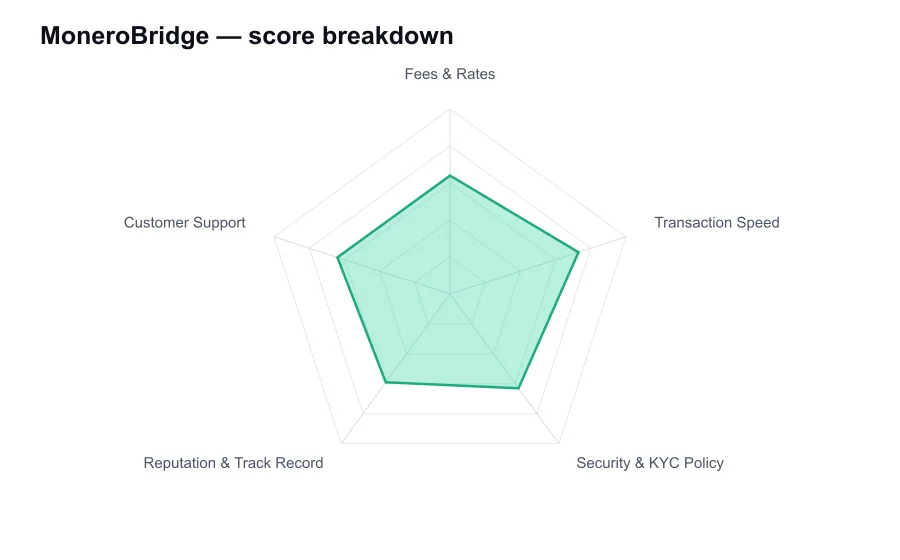
MoneroBridge scores 6.3/10 overall in our independent review, measured against every other provider we've compared, strongest on Transaction Speed (7.3/10) and weakest on Reputation & Track Record (5.9/10).
6.3/10 ★★★★★ How we score → Status: active (checked 2026-10-13T19:39:20.469Z)| Best for | Not for |
|---|---|
| Purpose-built for XMR conversion routes | Shorter track record than leading instant exchangers |
| Simple wallet-to-wallet flow | All-in quotes require careful comparison |
Editorial independence: our scores and rankings are produced using the fixed criteria above and are not influenced by advertisers. This is an independent ranking site and is not operated by, or affiliated with, any provider we list.
Affiliate disclosure: some links on this page may earn us a commission at no extra cost to you. This does not affect our rankings.
What is MoneroBridge?
MoneroBridge is a specialist crypto exchange service built around conversions involving Monero, or XMR. It lets a user send one supported cryptocurrency and receive XMR, or send XMR and receive another supported asset, directly to a wallet address.
In-Depth Review of MoneroBridge
MoneroBridge is a specialist instant-exchange service centered on Monero. Rather than trying to imitate a full cryptocurrency supermarket, it focuses on a problem that matters to XMR users: converting into or out of Monero without using a conventional custodial trading account. That narrow focus gives the service a clearer identity than the average multi-asset swap site. It also means prospective customers should judge it by a tougher standard, because users turning to a Monero-focused provider often care deeply about privacy, execution certainty, and discreet support.
The first point to understand is that MoneroBridge is not the Monero network, a wallet, or a decentralized exchange. It is a service intermediary for swaps. You select a supported input and XMR or choose XMR as the input, provide the receiving address, and fund a transaction-specific deposit address. The provider then delivers the output through its exchange process. That may be less cumbersome than depositing to a centralized exchange, but it is still a trust event during the period your transaction is being handled.
Monero's privacy features make this use case particularly attractive. Many major exchanges have limited XMR support, removed it in certain regions, or attach full account verification to access. A focused swap service can provide a route for a wallet user who simply wants to convert BTC, LTC, ETH, or a stablecoin position into XMR. It can also help someone leaving XMR for a more widely accepted settlement asset. That is the service's real utility. It should not be marketed as a way to evade laws, sanctions, tax obligations, or legitimate compliance duties.
The interface is typically much simpler than a full exchange: select direction, enter amount, paste the destination address, and send the deposit. For Monero transactions, the destination address requires special care. Standard addresses, integrated addresses, and subaddresses have different practical considerations, and a user must make sure their wallet can receive the transaction as expected. If you are sending XMR into the service, use the deposit details exactly as generated. Do not reuse old order information or assume an address remains valid for a new transaction.
MoneroBridge's narrow asset focus is both a benefit and a limitation. The service is useful because it removes the noise of thousands of questionable token pairs. A user looking specifically for an XMR route can get to the point quickly. Yet it is not the right tool for broad portfolio rebalancing, stablecoin management across many networks, or fiat conversion. If you want to exchange a dozen different assets and optimize each route, a larger instant exchanger or a centralized exchange will offer more options, though perhaps with less Monero emphasis.
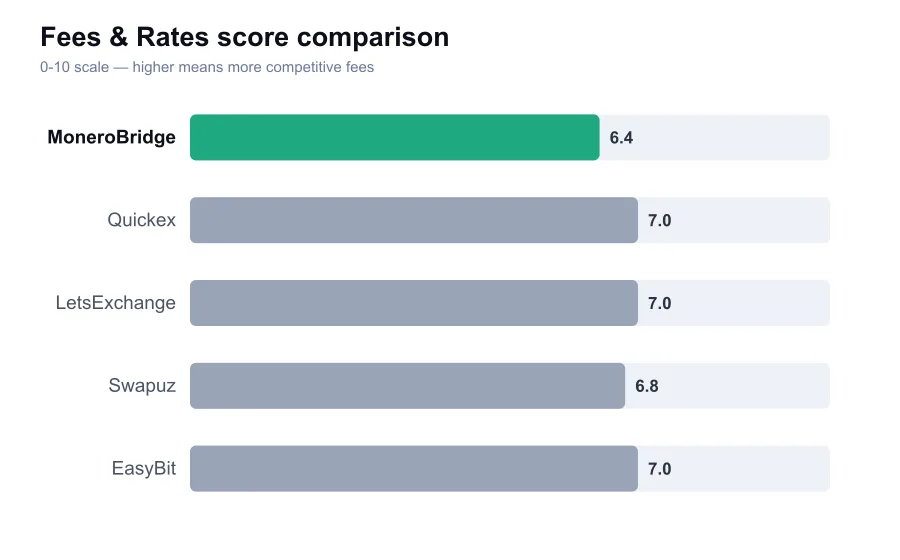
Fees are usually visible through the final exchange quote rather than as an easy universal percentage. This is the right place to be demanding. Monero trading pairs can have meaningfully different liquidity and risk pricing from BTC or USDT pairs, so the provider's quote deserves comparison with alternatives. A fixed fee sounds transparent, but it does not guarantee the best output if the underlying spread is wide. Compare the exact XMR amount you receive, then include the cost of sending your input coin and the network fee for the payout.
For modest XMR conversions, MoneroBridge can be convenient because it avoids a traditional trading-account workflow. For bigger trades, the cost gap against a liquid venue may be substantial. This is especially true if you already have a verified account at an exchange that still supports the pair in your jurisdiction. A specialist exchanger earns its premium through speed and reduced friction, not by matching professional spot-market pricing. If a quote looks unusually generous, double-check the domain and do not let urgency override basic verification.
Transaction speed varies sharply by asset. A Monero transfer itself confirms on the Monero chain, while the input asset may be Bitcoin, Ethereum, Litecoin, or another supported cryptocurrency with entirely different confirmation behavior. A swap that begins with BTC can take longer than a user expects, even if the XMR payout is broadcast promptly after processing. Network congestion and insufficient miner fees can add delays. Anyone needing money at a precise time should send early or choose a route with a confirmed fixed quote and a comfortable payment window.
The privacy question is more complicated than the branding may suggest. Monero protects on-chain sender, recipient, and amount information in its own transaction design. That does not make a swap provider incapable of knowing the deposit details, destination address supplied by the user, IP-derived data, or information required during a compliance review. A user should not assume that using a Monero-oriented exchange somehow makes the entire transaction invisible. Strong privacy begins with wallet hygiene, secure devices, and realistic expectations, not a logo or a no-registration interface.
As with other instant exchangers, MoneroBridge can apply AML controls. A no-account entry flow means fewer routine personal details are collected at the outset, but it is not a promise that every order will remain free of verification. If a transaction is flagged, funds can be paused while the provider asks questions or reviews documentation. This risk is especially important with XMR because users may choose the service specifically to avoid a conventional exchange. If you need assured access to funds, do not send an amount you cannot afford to have delayed.
The security picture is adequate for a transaction tool, not exceptional in the way a large regulated institution might be. There are fewer account-attack surfaces because users are not generally maintaining a stored balance or password-protected trading profile. Yet the main risks shift toward phishing, wrong deposit addresses, fake customer-support contacts, and counterparty execution. Bookmark the official domain, never trust a sponsored search result blindly, and do not provide seed phrases to anyone claiming to assist with an order. No legitimate swap service needs your wallet recovery phrase.
Reputation is where MoneroBridge requires more caution than the better-established all-purpose providers. Its specialization has earned attention among Monero users, but it has a shorter and less independently documented public track record than older brands such as SimpleSwap or ChangeNOW. That does not make it disreputable. It does mean the burden of safe use is higher. Start small, review current third-party feedback, and avoid treating a niche service as though it has the same operational history as a major exchange.
Support is important for this service because Monero-specific questions can be technical. A useful response should address transaction IDs, confirmations, wallet-address formats, and the status of an order without asking the customer to disclose unnecessary sensitive information. The service provides contact channels and order monitoring, but a smaller specialist operation cannot match the staffing depth of a large exchange. If an issue involves a compliance hold or upstream liquidity, resolution may take longer than the clean interface suggests.
I see MoneroBridge as a focused tool for people who already understand self-custody and Monero basics. It can be a convenient way to make an XMR conversion without opening a broad exchange account, and its narrow product focus is refreshing. The compromise is that it has less public operating history, less fee transparency, and less institutional reassurance than mainstream alternatives. Use a test amount, verify every address, and compare the actual output. For experienced XMR users making a modest swap, that is reasonable. For a large first-time transaction, I would favor a more established route.
Score Breakdown
| Criterion | Score | Note |
|---|---|---|
| Fees & Rates | 6.4 | Compare final XMR output closely, as quotes are all-in |
| Transaction Speed | 7.3 | Speed depends heavily on the input chain's confirmations |
| Security & KYC Policy | 6.3 | No routine account flow, but counterparty and AML risk remain |
| Reputation & Track Record | 5.9 | Specialist service with a shorter public track record |
| Customer Support | 6.4 | Order support is useful, though smaller in scale |
Key Facts
| Fact | Value | Source |
|---|---|---|
| Service type | Monero-focused instant exchange | - |
| Primary asset | Monero, XMR | - |
| Account requirement | No routine trading account | - |
| Settlement | Crypto wallet-to-wallet transfer | - |
| KYC model | Possible under compliance review | - |
Pros and Cons
| Pros | Cons |
|---|
How MoneroBridge Works
- Choose whether you are sending XMR or receiving XMR
- Select the supported asset pair and enter the amount
- Paste the receiving wallet address carefully
- Send the requested deposit to the order-specific address
- Wait for confirmations and the payout transaction
KYC
| Requirement | optional |
|---|---|
| Notes | The normal flow does not require a conventional trading account, but AML and compliance checks can lead to an identity or source-of-funds request. |
Supported Assets
| Notable coins | Monero, Bitcoin, Ethereum, Litecoin, USDT |
|---|
How to Use MoneroBridge Safely
- Run a small test swap before any significant XMR conversion
- Use a receiving XMR address from a wallet you control
- Check Bitcoin or Ethereum confirmation expectations before funding
- Never share your Monero wallet seed with support
- Bookmark the official site to reduce phishing risk
Is MoneroBridge a Monero wallet?
No. MoneroBridge is an instant exchange service, not a wallet. You provide your own receiving address and should keep control of your own wallet keys.
Can I use MoneroBridge without creating a trading account?
Its exchange flow is designed to work without a conventional exchange account. That does not prevent the service from requesting verification if a transaction triggers AML or compliance checks.
Why can a BTC to XMR swap take longer than expected?
The service must wait for enough Bitcoin confirmations before processing the exchange. Bitcoin congestion or a low transaction fee can delay the order even if the XMR payout itself is ready quickly.
What XMR address should I enter for a payout?
Use an address generated by a wallet you control and check it carefully. Do not reuse deposit instructions from an old order, and confirm your wallet supports the address format you use.
Does using MoneroBridge make a transaction fully anonymous?
No. Monero has privacy features on its own chain, but an exchange service can still process deposit and payout details and may apply transaction monitoring or compliance checks.
What should I do before sending a large XMR swap?
Make a small test order first, compare the final output with other providers, verify the official domain, and save the order details and transaction hash.
Editorial independence: our scores and rankings are produced using the fixed criteria above and are not influenced by advertisers. This is an independent ranking site and is not operated by, or affiliated with, any provider we list.
Affiliate disclosure: some links on this page may earn us a commission at no extra cost to you. This does not affect our rankings.