Trocador
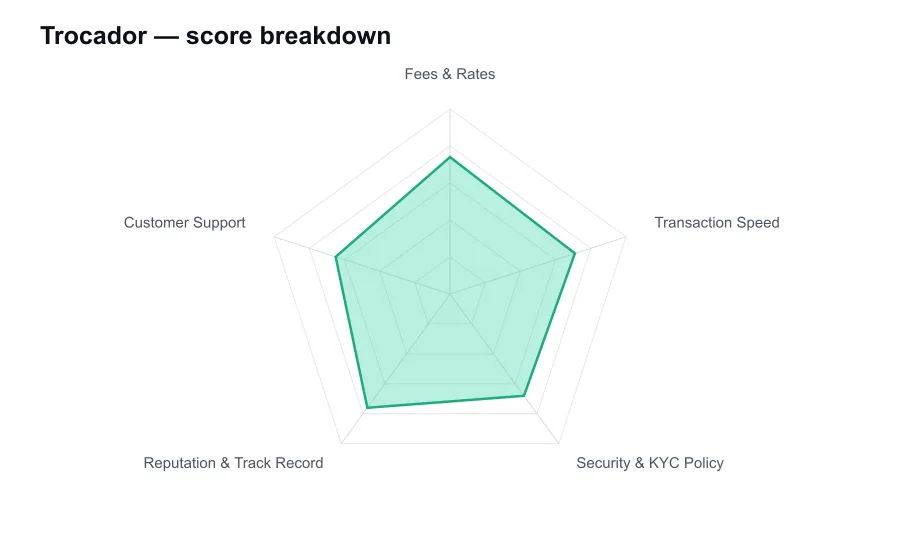
Trocador scores 7.3/10 overall in our independent review, measured against every other provider we've compared, strongest on Reputation & Track Record (7.6/10) and weakest on Customer Support (6.5/10).
7.3/10 ★★★★★ How we score → Status: active (checked 2026-10-13T19:41:25.433Z)| Best for | Not for |
|---|---|
| Compares quotes from multiple instant-exchange partners | Adds a 0.5% platform fee |
| No account needed for standard swaps | Underlying provider may still request KYC |
Editorial independence: our scores and rankings are produced using the fixed criteria above and are not influenced by advertisers. This is an independent ranking site and is not operated by, or affiliated with, any provider we list.
Affiliate disclosure: some links on this page may earn us a commission at no extra cost to you. This does not affect our rankings.
What is Trocador?
Trocador is a crypto swap aggregator that compares offers from third-party instant exchanges. Users select a route, send crypto to the generated address, and receive another asset in a self-custody wallet. It is not a traditional custodial trading exchange.
In-Depth Review of Trocador
Trocador is an instant-exchange aggregator, not an exchange in the conventional custodial sense. It compares quotes from a roster of third-party swap providers, then lets users choose a route for a crypto-to-crypto conversion. That puts it closer to services such as Swapzone and BestChange's exchange listings than to Coinbase or Kraken. Its appeal is straightforward: you can swap coins without opening a trading account or handing a platform long-term custody of your balance.
The site has built a following among privacy-conscious users because the normal flow does not require registration. Choose the pair, enter a destination wallet address, send the deposit, and receive the converted asset. Trocador says it does not hold customer funds itself, though the selected underlying exchange receives the deposit and executes the trade. That distinction matters. Trocador can make route selection easier, but it cannot eliminate the counterparty risk of the provider behind a quote.
Its quote-comparison screen is the product's strongest feature. A user can inspect several providers, see estimated output, compare floating and fixed-rate options, and filter choices according to preferences such as price or rating. For someone swapping LTC into XMR or BTC into USDT, this is meaningfully better than blindly visiting one instant exchanger and accepting its first quote. The interface makes price discovery much less tedious.
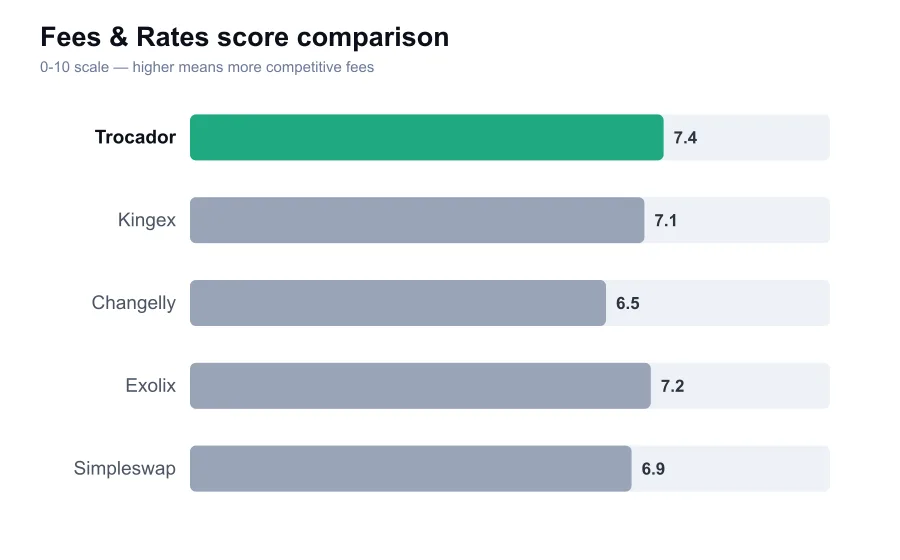
Fees are fairly transparent by instant-swap standards. Trocador states that it adds a 0.5% fee to swaps, although this can be reduced through its affiliate cashback arrangements. The underlying providers also build their own spread and network costs into quotes. That means the visible output amount matters more than the headline 0.5%. A competitor may advertise zero platform fees while offering a worse rate, particularly on small-cap assets or cross-chain pairs.
For large, liquid routes, Trocador's final prices can be competitive. Its aggregation gives it a real edge over a single-provider service such as Changelly, ChangeNOW, or SimpleSwap when one partner is temporarily quoting badly. Still, it is not the cheapest route for every transaction. A direct decentralized exchange swap, a centralized exchange order book, or a bridge can cost less if you already hold assets on the relevant chain and know how to manage gas, slippage, and wallet security.
Fixed-rate quotes deserve careful treatment. They reduce the risk that a moving market will shrink your payout between deposit and settlement, but they generally include a larger buffer and have a short payment window. Floating-rate orders are usually better for users who care about getting the market rate, accept volatility, and can send promptly. The practical trap is treating a displayed estimate as a guarantee. It is not a guarantee unless the selected provider explicitly offers a fixed-rate route and the deposit reaches it within its stated deadline.
Speed depends less on Trocador's interface than on the partner, blockchain confirmation requirements, and the pair selected. A straightforward Litecoin, Bitcoin Cash, or Tron transaction may complete quickly once the deposit is confirmed. Bitcoin deposits can take considerably longer during congestion, and Monero-related swaps may involve additional operational checks at the provider level. Trocador gives expected timing information, but users should treat it as an estimate rather than a service-level promise.
The provider selection model has another consequence: support quality is uneven. Trocador has its own support channel and acts as an intermediary if an order goes wrong, which is better than being left alone with an opaque provider. Yet the exchange partner controls the wallet, transaction review, and release of funds. If a provider requests extra information after receiving a deposit, Trocador cannot simply reverse the trade from its own balance. The best protection is choosing established partners and avoiding unnecessarily complex routes.
KYC is the awkward subject that marketing around no-registration swaps often softens. Trocador itself generally does not ask users to create an account or complete identity verification. However, its partners may apply AML controls and request documents if a transaction triggers their compliance systems. This is not a theoretical exception. Instant exchangers can pause a swap, ask for source-of-funds evidence, or refuse certain transactions under their policies. Anyone who needs certainty that no verification will ever be requested should not send funds through a third-party conversion service.
Trocador has a comparatively good reputation in the privacy-oriented corner of crypto, helped by its focus on Monero-friendly pairs, provider comparison, and relatively plain explanation of how routes work. It has operated since 2019, which is a respectable run in a sector full of short-lived brands. It also has an active public presence and a recognizable identity among users who routinely compare instant-exchange rates. That said, reputation in this category should never be confused with the regulatory safeguards or balance-sheet disclosures available at major regulated exchanges.
Security is strongest when users understand the limited role Trocador plays. It does not ask you to leave a standing account balance on the site, so there is no familiar exchange-custody exposure after a completed swap. But you still send coins to an address controlled by the selected provider. Verify the deposit address and network, save the order ID and transaction hash, and do a small test when using an unfamiliar asset or a large amount.
The route list can include providers with different policies, liquidity, and operational standards. I would not choose solely by the largest estimated payout. A slightly inferior quote from a well-known partner with responsive support is often a sensible trade, especially on a five-figure transfer. Trocador's own provider ratings and order history indicators are useful signals, though they are not a substitute for independent research or a guarantee against a compliance hold.
Customer support is decent for an aggregator but cannot match a full-service exchange with a large internal operations team. The site provides support contact options and can help trace an order through its partner network. Response quality tends to matter most on exceptions, and exceptions are where this business model is weakest. A normal swap is easy. A delayed, underpaid, or flagged order can turn into a multi-party support conversation involving the user, Trocador, and the underlying provider.
My view is that Trocador is one of the more useful tools in the no-account swap category, provided you use it as a quote engine and not as a blind trust machine. Its 0.5% platform fee is acceptable because aggregation can recover that cost through a better underlying quote, though it is not automatically cheap. It is particularly good for experienced self-custody users who value choice and privacy. For frequent traders, very large transfers, or anyone who wants firm consumer protections, a regulated exchange with transparent execution and direct support remains the safer home.
Score Breakdown
| Criterion | Score | Note |
|---|---|---|
| Fees & Rates | 7.4 | 0.5% platform fee, but partner spreads vary |
| Transaction Speed | 7.1 | Fast on simple routes, partner and chain dependent |
| Security & KYC Policy | 6.8 | No standing custody, but partners can hold swaps |
| Reputation & Track Record | 7.6 | Operating since 2019 with a known privacy user base |
| Customer Support | 6.5 | Helpful intermediary, limited control over partners |
Key Facts
Pros and Cons
| Pros | Cons |
|---|
How Trocador Works
- Choose the asset you are sending and receiving
- Compare partner quotes and choose a fixed or floating route
- Enter and verify your receiving wallet address
- Send the exact deposit amount to the generated address
- Track confirmations and receive the converted asset
KYC
| Requirement | optional |
|---|---|
| Notes | Trocador generally does not require registration or identity checks. Its exchange partners can request KYC, source-of-funds evidence, or other information under their own compliance policies. |
Supported Assets
| Notable coins | Bitcoin, Ethereum, Monero, Litecoin, USDT, USDC, Solana |
|---|
How to Use Trocador Safely
- Check the network and receiving address before confirming
- Compare the selected provider, not just the top payout
- Use a small test swap before moving a large amount
- Save the order ID and deposit transaction hash
- Avoid sending funds if you cannot complete a possible KYC review
Does Trocador charge its own fee?
Trocador states that it adds a 0.5% fee to swaps. The selected exchange partner's spread and blockchain network costs can also affect the final amount received.
Does Trocador require KYC?
Trocador normally does not require account registration or KYC. However, a selected partner can request verification or source-of-funds information if its compliance system flags a transaction.
Who receives my deposit during a Trocador swap?
The deposit goes to the address generated for the selected underlying exchange provider. Trocador acts as an aggregator and does not itself execute every conversion from a custodial trading balance.
Can I choose between fixed and floating rates?
Yes. Available routes can include fixed-rate and floating-rate options. Fixed quotes usually have a short payment deadline, while floating quotes can change with the market before settlement.
Why did my Trocador quote change after I sent funds?
A floating-rate route can settle at a different market rate after your deposit confirms. Network delays, price movement, and the underlying provider's liquidity all affect the final result.
What should I save if an order is delayed?
Save the Trocador order ID, your deposit transaction hash, the destination address, and screenshots of the chosen route. These details help both Trocador and the underlying provider trace the swap.
Editorial independence: our scores and rankings are produced using the fixed criteria above and are not influenced by advertisers. This is an independent ranking site and is not operated by, or affiliated with, any provider we list.
Affiliate disclosure: some links on this page may earn us a commission at no extra cost to you. This does not affect our rankings.