Symbiosis
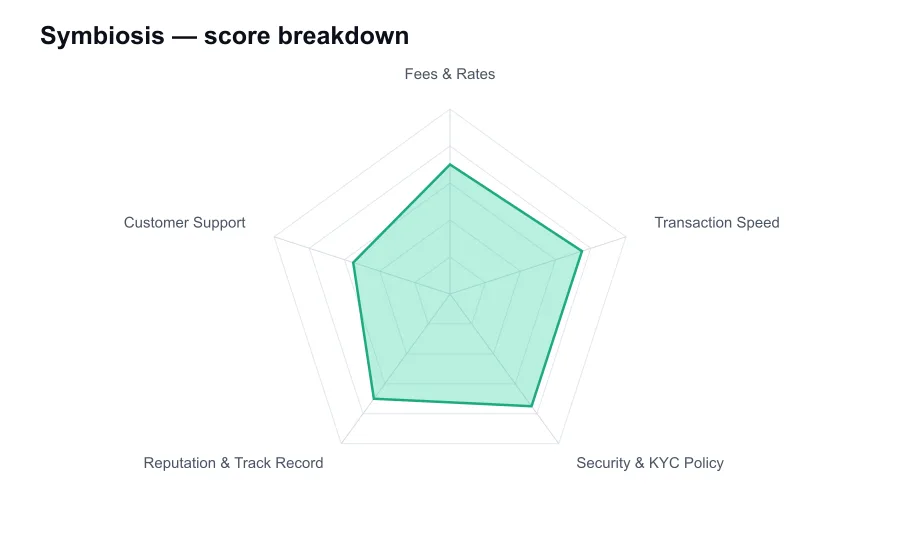
Symbiosis scores 7.1/10 overall in our independent review, measured against every other provider we've compared, strongest on Transaction Speed (7.5/10) and weakest on Customer Support (5.5/10).
7.1/10 ★★★★★ How we score → Status: active (checked 2026-10-13T19:25:09.264Z)| Best for | Not for |
|---|---|
| One flow for swaps across supported chains | Bridge and smart-contract risk remains material |
| Self-custody wallet connection | Ethereum gas can overwhelm small transfers |
Editorial independence: our scores and rankings are produced using the fixed criteria above and are not influenced by advertisers. This is an independent ranking site and is not operated by, or affiliated with, any provider we list.
Affiliate disclosure: some links on this page may earn us a commission at no extra cost to you. This does not affect our rankings.
What is Symbiosis?
Symbiosis is a decentralized cross-chain swap protocol. It lets a user connect a wallet, exchange a token, and receive the output on another supported blockchain through one routed transaction. It is DeFi infrastructure, not a custodial crypto exchange account.
In-Depth Review of Symbiosis
Symbiosis is a cross-chain decentralized exchange protocol. Its purpose is to make a swap across chains feel closer to a normal token trade: connect a wallet, choose the source asset and destination asset, approve the transaction, and receive the result on another network. That places it in a different category from Godex. It is not a company taking a deposit and sourcing a quote off-chain. It is a smart-contract protocol that combines swaps, bridging, and liquidity across supported networks.
The product targets a real annoyance. Moving USDC from Ethereum to BNB Chain, Arbitrum, Polygon, or another supported network often means using a bridge, changing networks, then using a DEX at the destination. Every stage creates a chance to select the wrong token representation or pay more gas than expected. Symbiosis tries to compress that sequence into one user action. For people already comfortable with MetaMask, Rabby, or a mobile Web3 wallet, that can save a surprising amount of friction.
The interface supports token swaps and cross-chain swaps, with routes assembled from liquidity pools and connected DEX liquidity. The route chosen matters more than the branding. A transfer can include source-chain gas, destination-chain gas, liquidity-provider pricing, bridge costs, and price impact. Users should read the expected output rather than focusing only on a displayed protocol percentage. A cheap-looking bridge can become expensive if the chosen token has shallow liquidity on either end.
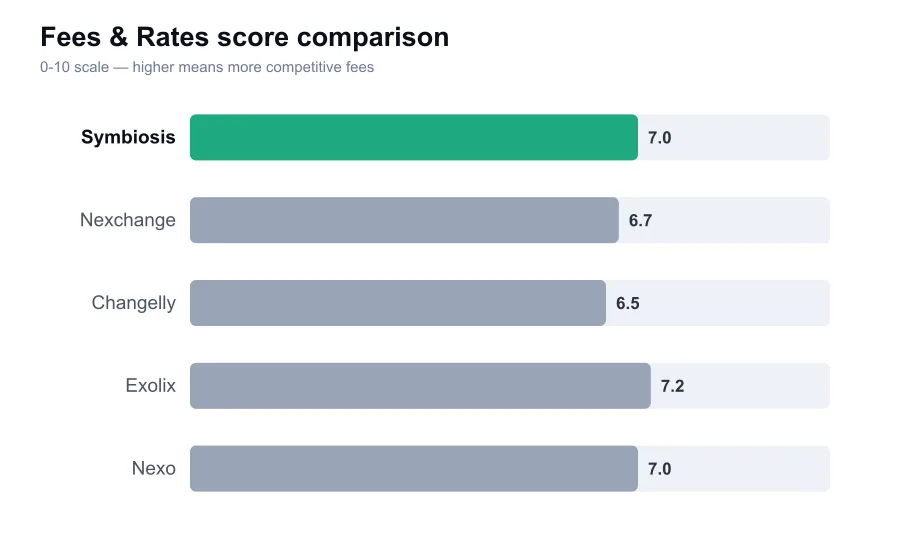
Symbiosis has historically used a 0.3 percent fee structure for swaps, in addition to network costs and route-specific charges. That figure is understandable and more transparent than the embedded spread used by many instant exchangers. It is not necessarily cheap. A stablecoin move across low-cost chains may be reasonably priced, while a small transaction from Ethereum can be dominated by Ethereum gas regardless of the protocol fee. For small amounts, a direct native bridge or a centralized exchange withdrawal may be more economical.
Speed is one of Symbiosis's better qualities, but it is constrained by the chains involved. A transaction between fast, inexpensive networks can complete in a few minutes after wallet confirmation. Routes involving Ethereum can take longer because finality, gas conditions, and relayer processing all matter. The protocol cannot make an Ethereum block arrive faster. It can reduce the number of steps a user takes, which is a meaningful distinction from promising instant settlement.
The best Symbiosis transaction is a simple stablecoin or major-token route between actively supported chains. That is where there is enough liquidity for competitive execution and where the destination token is familiar. The worst use is blindly attempting to move an obscure token because it appears in a menu. Cross-chain token names can conceal different contracts, wrapped representations, and varying redemption assumptions. A user should inspect the destination token contract in the receiving wallet before treating it as equivalent to a native asset.
There is no conventional KYC gate because Symbiosis is a permissionless DeFi protocol. You connect a self-custody wallet instead of creating an exchange profile. That privacy is genuine at the application layer, but users should avoid making exaggerated claims about anonymity. Public blockchains remain public. Wallet activity can be analyzed, and the regulated fiat off-ramp eventually used by a customer may have its own verification requirements.
Security is the central trade-off. Symbiosis does not hold a customer database full of passwords or operate a pooled exchange account in the familiar centralized sense. Yet cross-chain smart contracts, relayers, validators, and liquidity pools create a broader technical attack surface than a plain spot swap on one chain. Bridges have been among crypto's most heavily attacked systems. Audits and public code are useful signals, but neither turns complex bridge risk into bank-grade certainty.
The protocol has published audit material and technical documentation, and that is better than asking users to rely on a black-box bridge. Still, serious users should check the current supported-chain list, contract addresses, and audit references themselves before moving a large sum. DeFi changes quickly. A previously audited contract may be upgraded, a route may use a new integration, or liquidity conditions may have changed. Security is a continuing operational question, not a badge earned once.
Symbiosis has a respectable history in multichain DeFi and is known among users who prefer an application-level route rather than manually stitching together bridges and DEXs. It does not carry the brand strength, liquidity depth, or institutional attention of Uniswap, 1inch, or major canonical bridges. That is not fatal, but it does limit the comfort margin. A protocol can work well for years and still be a poor choice for moving a life-changing amount in a single transaction.
Support is available through community channels and documentation, which is typical of DeFi. It is not the kind of support model where a named agent can reverse a payment or restore a lost account. If a transaction is pending, the relevant evidence is a wallet address, chain, transaction hash, route details, and the exact token contract. Users who expect phone support or a guaranteed recovery process will be disappointed. The protocol's self-custody design gives control, but it also leaves more responsibility with the sender.
A practical issue is approval management. Before swapping, a wallet may ask you to approve a token allowance for a Symbiosis contract. Approving exactly what is needed is safer than granting unlimited spending power by habit. Once the swap is done, review old allowances using a reputable approval-management tool. This is not a Symbiosis-specific flaw. It is simply one of the recurring risks of interacting with ERC-20-style DeFi applications.
I also would not use Symbiosis as a substitute for a portfolio tracker or a long-term bridge strategy. It is a transaction tool. Keep records of source and destination transaction hashes, especially if the route crosses chains and produces a wrapped asset. If you are moving funds for tax reporting, accounting, or business use, that documentation will be more valuable than a vague memory that the transaction seemed to finish in one click.
My opinion is favorable, with a firm size limit. Symbiosis is a useful cross-chain router for technically competent users making routine transfers between supported networks. It cuts down on tedious steps and does so without demanding an exchange account. The fee stack, smart-contract exposure, and uneven support model mean it is less suitable for beginners moving their entire holdings. Start small, inspect the route, and treat it as DeFi infrastructure rather than a guaranteed transfer service.
Score Breakdown
| Criterion | Score | Note |
|---|---|---|
| Fees & Rates | 7.0 | 0.3% swap fee structure, plus gas and route costs |
| Transaction Speed | 7.5 | Fast on low-cost chains, Ethereum routes take longer |
| Security & KYC Policy | 7.5 | Audited DeFi design, with unavoidable bridge risk |
| Reputation & Track Record | 7.0 | Recognized multichain protocol with a narrower profile |
| Customer Support | 5.5 | Documentation and community support, no recovery desk |
Key Facts
| Fact | Value | Source |
|---|---|---|
| Protocol type | Cross-chain DEX and liquidity protocol | Source |
| Swap fee structure | 0.3% plus network and route costs | Source |
| Account requirement | Self-custody wallet connection | Source |
| KYC requirement | No conventional KYC | Source |
| Core use case | Cross-chain token swaps | Source |
Pros and Cons
| Pros | Cons |
|---|
How Symbiosis Works
- Connect a compatible self-custody wallet
- Choose the source chain, token, destination chain, and output token
- Review the expected output, route, gas costs, and token contract
- Approve the token allowance if required
- Confirm the source-chain transaction in your wallet
- Wait for cross-chain processing and confirm receipt on the destination chain
KYC
| Requirement | none |
|---|---|
| Notes | Symbiosis is accessed through a connected self-custody wallet and does not use a conventional account-verification process. |
Supported Assets
| Notable coins | USDC, USDT, Ethereum, Wrapped Bitcoin, BNB |
|---|---|
| Networks | Ethereum, BNB Chain, Polygon, Arbitrum, Avalanche |
How to Use Symbiosis Safely
- Confirm the destination chain and token contract before signing
- Use a small test transfer before moving a large amount
- Review the expected output including gas and price impact
- Approve only the token amount needed where possible
- Save both source and destination transaction hashes
Does Symbiosis require KYC?
No conventional KYC is required to use the protocol. Users connect a self-custody wallet, though blockchain transactions remain publicly visible and later fiat services may require verification.
What fee does Symbiosis charge?
Symbiosis has used a 0.3 percent swap fee structure. The final cost can also include source-chain gas, destination-chain gas, price impact, and route-specific liquidity costs.
Why did I receive a token on another chain?
A cross-chain route can deliver the destination chain's supported version of an asset. Check the token contract and network in your wallet before assuming it is the native version you expected.
Can Symbiosis reverse a transaction sent to the wrong address?
No. On-chain transactions are generally irreversible once confirmed. Symbiosis support can help investigate route status, but cannot recover funds sent to an incorrect wallet address.
Why is my Symbiosis route taking longer than expected?
Cross-chain completion depends on source-chain confirmation, relayer processing, destination-chain conditions, and available liquidity. Ethereum congestion can materially extend a route that is quick on low-cost chains.
Should I approve unlimited token spending?
It is safer to approve only the amount needed for the intended swap where the wallet allows it. Review and revoke unused token allowances after interacting with DeFi applications.
Editorial independence: our scores and rankings are produced using the fixed criteria above and are not influenced by advertisers. This is an independent ranking site and is not operated by, or affiliated with, any provider we list.
Affiliate disclosure: some links on this page may earn us a commission at no extra cost to you. This does not affect our rankings.