Godex
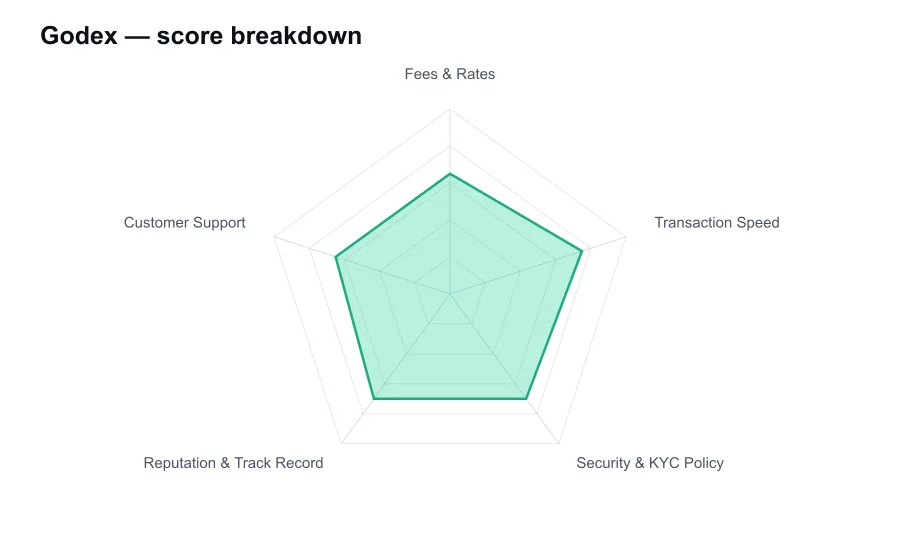
Godex scores 6.9/10 overall in our independent review, measured against every other provider we've compared, strongest on Transaction Speed (7.5/10) and weakest on Customer Support (6.5/10).
6.9/10 ★★★★★ How we score → Status: active (checked 2026-10-13T19:25:09.192Z)| Best for | Not for |
|---|---|
| No routine registration or KYC for standard swaps | All-in fee is embedded in the quote |
| Fixed-rate option for volatile markets | Compliance checks can interrupt a no-KYC swap |
Editorial independence: our scores and rankings are produced using the fixed criteria above and are not influenced by advertisers. This is an independent ranking site and is not operated by, or affiliated with, any provider we list.
Affiliate disclosure: some links on this page may earn us a commission at no extra cost to you. This does not affect our rankings.
What is Godex?
Godex is a crypto instant exchange that converts one asset into another without requiring a conventional trading account. Users send crypto from their own wallet to a one-time deposit address and receive the selected asset at a destination address. It offers floating and fixed-rate swap routes.
In-Depth Review of Godex
Godex is a non-custodial instant exchange service built for people who want to swap coins without opening a trading account. It sits closer to ChangeNOW, SimpleSwap, and StealthEX than to a conventional exchange such as Coinbase or Kraken. You choose a pair, send funds to a generated address, and receive the output coin in your own wallet. That simplicity is its entire appeal. There are no charts, no order book, no recurring buys, and no place to park a portfolio.
The service has been around since 2017, which matters in a corner of crypto filled with short-lived brands. Godex's interface remains deliberately sparse. A newcomer can get from selecting BTC to ETH through to a completed exchange without learning maker and taker terminology. Experienced users will either appreciate that restraint or find it limiting. This is a utility for a specific job, not a platform that tries to become your financial home.
Godex advertises more than 300 supported assets, with a long list that covers large-cap coins and many smaller tokens. The useful part is not merely the count. It can source a swap that might take several trades on a centralized exchange, particularly if the user starts with a coin held in a private wallet. Still, a listed asset is not a permanent promise of liquidity. Less common pairs may disappear temporarily, get a weak rate, or need to be routed through another asset behind the scenes.
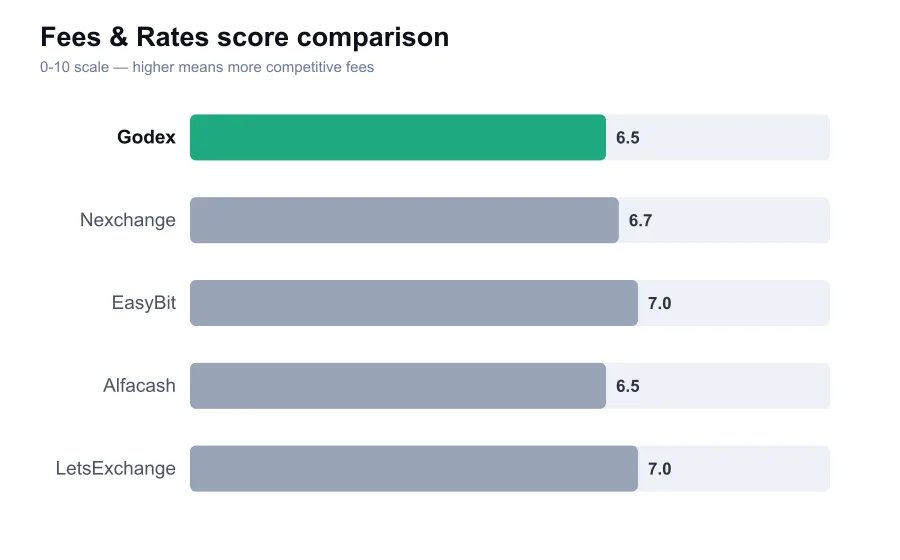
Fees are the first area where the marketing needs translation. Godex does not usually present a neat headline charge such as a 0.25 percent trading fee. Its compensation is included in the quoted exchange rate, alongside liquidity-provider costs and network charges. That is common among instant exchangers, but it means a user cannot calculate the service fee independently from a rate page. Compare the final amount against ChangeNOW, FixedFloat, and an exchange order book before sending. On large, liquid pairs, even a modestly worse quote can cost more than a visible trading commission.
Godex offers floating-rate and fixed-rate exchanges. A floating rate is usually the cheaper-looking option, though the received amount can change while your deposit confirms and the provider executes the trade. Fixed rate is more useful during a sharp market move because it gives the user an agreed output amount within the service's stated deposit window. It is not magic protection from every issue. If you send an incorrect asset, miss the deadline, or use a network that does not match the address, the fixed quote cannot rescue the transaction.
For common transactions, the practical speed is usually driven by the incoming blockchain confirmation rather than the Godex page. A BTC deposit can take materially longer than an ETH or Solana transfer, and a congested chain can make any promise of instant exchange look silly. Once funds are confirmed, ordinary liquid swaps often settle in minutes. A realistic expectation is roughly five to 30 minutes for a straightforward route, with longer waits possible for Bitcoin, privacy coins, thin liquidity, or manual compliance review.
That last qualifier is important. Godex markets itself as registration-free and does not require routine KYC before a normal swap. There is no account dashboard to verify and no need to upload an identity document just to obtain a quote. But no-KYC does not mean no compliance controls. The service's terms allow it to stop an exchange and request information if transaction-monitoring systems flag a deposit. Anyone using an instant exchanger should understand that this is an operational risk, especially for unusually large or traceable funds.
Godex is non-custodial in the narrow, useful sense that it does not hold an ongoing account balance for customers. Your funds are under your control before the swap and after the payout. During execution, though, the service and its liquidity partners necessarily receive the deposit. This is not a self-custody protocol where a smart contract atomically settles every route. You are trusting a company to complete the conversion after your transfer arrives, so sending a small test amount remains sensible on unfamiliar pairs.
The security model has advantages and blind spots. No user account means no password-reset fraud, no account takeover through a stolen email, and no exchange balance waiting to be hacked. It also means there is no 2FA setting, withdrawal whitelist, or internal account history to protect you from your own mistake. The main threats move outward: phishing copies of the site, clipboard malware replacing a deposit address, and sending assets over the wrong network. Godex cannot reverse a confirmed blockchain transfer.
Reputation is decent for a service in this category, though it does not have the transparency or regulatory footprint of a major centralized exchange. Godex has processed swaps for years and is commonly listed among no-registration exchange options. That longevity carries weight. Still, its public corporate disclosure is lighter than what a cautious user would get from a regulated venue, and its rate construction is less transparent than executing a trade on a visible order book. I would call it established, not institution-grade.
Customer support is available around the clock through live chat and email, and the transaction ID is the key thing to keep if a swap stalls. In ordinary cases, support can identify a deposit and explain whether it is waiting for confirmations, liquidity, or a payout transaction. The harder cases are compliance holds and wrong-network deposits. Those can take time, may require cooperation from a receiving platform, and are not problems a chat agent can simply fix in five minutes. The quality of help is best judged by difficult cases, not a quick pre-sale question.
There are also limits to the product's convenience. Godex is poor for price discovery, unsuitable for limit orders, and not ideal for frequent traders. A trader making several swaps each week will usually get more control and often lower all-in costs through Kraken, Coinbase Advanced, Binance where available, or a reputable on-chain DEX. Godex makes more sense when moving from one wallet-held asset to another matters more than extracting the last basis point from a trade.
The lack of mandatory account creation is particularly useful for a traveler, a privacy-conscious holder, or someone who needs a one-off conversion without leaving coins on an exchange. It is less attractive for a business that needs formal statements, predictable service-level commitments, named account management, or a clear compliance process before funds are sent. Those users should not confuse an anonymous-looking interface with a business-grade settlement provider.
My view is that Godex is a credible convenience tool with an acceptable record, provided you use it with realistic expectations. Check the final quote, verify the chain twice, and retain the exchange ID until the payout lands. For a normal wallet-to-wallet swap, it is far easier than depositing into a full exchange. For a large or urgent conversion where the exact cost and execution path matter, I would use a transparent venue instead.
Score Breakdown
| Criterion | Score | Note |
|---|---|---|
| Fees & Rates | 6.5 | Fees are embedded in the quoted exchange rate |
| Transaction Speed | 7.5 | Most liquid swaps settle in minutes after confirmations |
| Security & KYC Policy | 7.0 | No account custody, but AML reviews can pause swaps |
| Reputation & Track Record | 7.0 | Operating since 2017 with a meaningful user track record |
| Customer Support | 6.5 | 24/7 chat and email, difficult cases can take time |
Key Facts
Pros and Cons
| Pros | Cons |
|---|
How Godex Works
- Choose the asset to send and the asset to receive
- Select floating or fixed rate if both are available
- Enter and verify your destination wallet address
- Send the exact requested asset to the generated deposit address
- Track the swap with its exchange ID until payout arrives
KYC
| Requirement | optional |
|---|---|
| Notes | Routine swaps do not require registration or identity verification. Godex may request information if its transaction-monitoring process flags a deposit. |
Supported Assets
| Total coins | 300 |
|---|---|
| Notable coins | Bitcoin, Ethereum, Tether, USDC, Litecoin, Monero, Solana |
| Networks | Bitcoin, Ethereum, Solana, Tron |
How to Use Godex Safely
- Use the official godex.io domain, not an ad or cloned page
- Match the deposit network to the network shown in the quote
- Check the destination address before confirming the swap
- Keep the exchange ID and transaction hash until payout arrives
- Test an unfamiliar asset or network with a small amount
Does Godex require identity verification?
Godex does not require routine registration or KYC for a standard exchange. Its compliance policy can still request information or pause a transaction that is flagged by monitoring systems.
How long does a Godex swap take?
A liquid swap often completes in about five to 30 minutes after the deposit receives the needed blockchain confirmations. Bitcoin congestion, thin liquidity, or a review can extend that time.
What is the difference between fixed and floating rate?
Floating rate means the output can move during execution. Fixed rate locks the quoted output if you send the correct asset and amount within the stated deposit window.
Can Godex recover a payment sent on the wrong network?
Recovery is not guaranteed. A wrong-network transfer may require manual work and can be impossible, which is why the network label and deposit address should be checked before sending.
Where can I find a stalled transaction?
Use the exchange ID from the confirmation page or email when contacting Godex support. It lets support identify the deposit, confirmation state, and outgoing payout transaction.
Does Godex keep a wallet balance for customers?
No. Godex is designed for one-off exchanges rather than an ongoing custodial account. Funds are sent from your wallet and paid out to the destination wallet you provide.
Editorial independence: our scores and rankings are produced using the fixed criteria above and are not influenced by advertisers. This is an independent ranking site and is not operated by, or affiliated with, any provider we list.
Affiliate disclosure: some links on this page may earn us a commission at no extra cost to you. This does not affect our rankings.