Nexchange
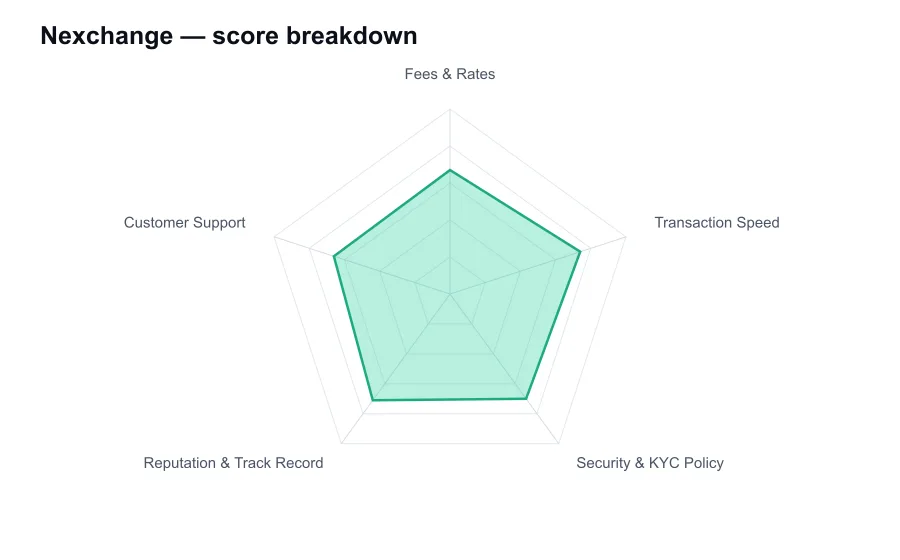
Nexchange scores 7.0/10 overall in our independent review, measured against every other provider we've compared, strongest on Transaction Speed (7.4/10) and weakest on Customer Support (6.6/10).
7.0/10 ★★★★★ How we score → Status: active (checked 2026-10-13T19:34:49.981Z)| Best for | Not for |
|---|---|
| Established instant-exchange operating history | No visible order book or advanced trading tools |
| API and exchange widget capability | Quote-based costs can be hard to compare |
Editorial independence: our scores and rankings are produced using the fixed criteria above and are not influenced by advertisers. This is an independent ranking site and is not operated by, or affiliated with, any provider we list.
Affiliate disclosure: some links on this page may earn us a commission at no extra cost to you. This does not affect our rankings.
What is Nexchange?
Nexchange is an instant cryptocurrency conversion provider with a retail swap interface and tools for businesses to integrate exchange functionality. A user sends one cryptoasset and receives another at a quoted rate. It is not a traditional exchange built around customer balances and visible order books.
In-Depth Review of Nexchange
Nexchange is an instant crypto exchange built around direct conversions rather than conventional trading screens. It has historically appealed to users and businesses that want a clean exchange widget or API-driven swap flow, without asking every customer to maintain a full exchange account. In that sense it sits closer to an exchange infrastructure provider than to a retail trading venue such as Coinbase or Kraken.
The consumer experience is straightforward. Pick a pair, enter a receiving address, send the input asset to the deposit address, and wait for settlement. The platform's task is to obtain the output asset and deliver it to the chosen address. This gives users a simple route between wallets, but it also means they do not control execution through a visible order book. The quality of the quote and the reliability of processing are therefore central.
Nexchange's strongest point is that it has long presented itself as more than a basic swap page. Its API and exchange-widget orientation make it relevant to wallet developers, merchants, and services that want to embed conversion capability. That is a serious use case. A provider trusted inside another product has to offer stable technical documentation, consistent rate responses, and sensible failure handling. Those are less glamorous strengths than a huge token list, but they matter.
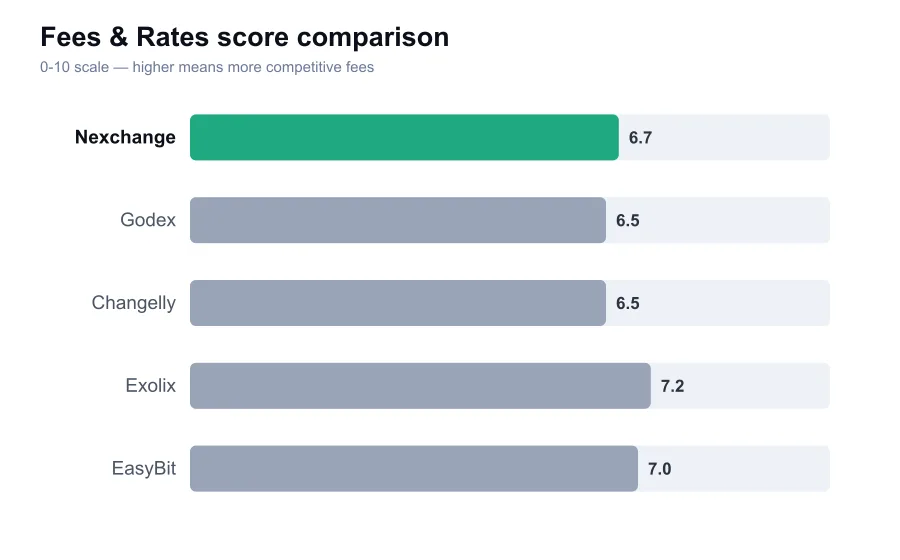
Fees are quote-based. Nexchange has not been a platform where a retail user can rely on a simple maker and taker schedule like the one found on a spot exchange. The final output amount includes the economics of routing, liquidity, and network delivery. For a wallet user, that can be fine because there is one number to compare. For a frequent trader, it is a weakness because the true cost is less visible and can change between orders.
The right way to evaluate Nexchange pricing is empirical. Request a quote for the exact amount and network you need, then compare it with StealthEX, ChangeHero, and a liquid centralized exchange after withdrawal costs. Tiny swaps can be disproportionately expensive because network charges dominate. Large swaps can suffer from a wider spread if a route has limited liquidity. A quote that looks good for a few hundred dollars is not necessarily good for several thousand.
Speed is generally respectable for mainstream assets, but the word instant should not be taken literally. The service has to wait for the incoming blockchain transaction and may require confirmations before conversion. Bitcoin and Ethereum congestion can slow the process. Liquidity sourcing may add another delay. In a normal case, the user should expect a period of minutes, not an immediate balance update like an internal exchange trade.
Nexchange has an advantage over anonymous-looking swap sites because its technical and business-facing identity has been visible for years. It is not a newcomer with no history. Still, it has not reached the mainstream retail recognition of the largest consumer brands. That middle position is important. There is enough history to take it seriously, but not enough public financial disclosure or regulatory transparency to treat it as a substitute for a major licensed exchange.
The service's non-custodial style also needs accurate wording. Nexchange does not ask users to park a long-term account balance before making a typical conversion. Yet the asset is in the service's execution path after it is sent. A failed order, wrong network, incorrect destination address, or compliance review can still leave the customer dependent on Nexchange support. Self-custody before and after a swap is helpful, but it is not the same as eliminating counterparty risk.
KYC is usually not part of the initial consumer flow, which is one reason these services appeal to privacy-minded users. But a risk-based review policy is standard in this sector, and Nexchange users should assume suspicious or legally sensitive transfers can attract questions. Anyone who requires contractual certainty that a transaction cannot be reviewed should use a different arrangement. That is not a realistic promise from centralized swap routing.
I like Nexchange more for normal, well-supported pairs than for obscure assets. Its infrastructure focus inspires more confidence in routine routing than a random new swap page does. But a service with APIs and partner integrations can still be affected by an external liquidity problem. If you are swapping a long-tail token, inspect the quoted rate carefully and avoid assuming the platform has deep proprietary inventory.
Support is a mixed practical category. Technical providers can be very good at handling API and transaction identifiers, while feeling less hand-holding than a consumer-first exchange. That is not necessarily poor support. It does mean retail users should arrive prepared. Include the order ID, source hash, pair, network, and destination address in the first message. Vague messages such as "my swap is missing" slow down every investigation.
The platform is a better candidate than Goexme for someone who values a visible operating history and an infrastructure-minded product. It remains less compelling than a full exchange for active trading, fiat on-ramps, or custody features. You will not get detailed charting, advanced orders, or the rich compliance protections of a regulated broker. Nexchange does one job, and it should be judged on that job.
For larger swaps, I would still split the decision into two questions. First, is the quote competitive after every network cost? Second, can you tolerate a delay if a transaction needs manual attention? If either answer is no, use a major exchange or arrange an OTC route. Instant exchange services are at their best when the amount is meaningful enough that convenience matters, but not so critical that a support ticket would create a serious problem.
Nexchange is a credible mid-tier instant exchange with a useful technology angle and a reasonably mature identity. It does not offer the fee transparency or execution control of a proper trading venue, and it should not be marketed as a risk-free private swap tool. For ordinary wallet conversions, though, it is a more defensible choice than lesser-known alternatives. Compare quotes, respect network details, and use it for what it is built to do.
Score Breakdown
| Criterion | Score | Note |
|---|---|---|
| Fees & Rates | 6.7 | Quote-based pricing rather than a transparent trading schedule |
| Transaction Speed | 7.4 | Good routine routing, subject to blockchain confirmations |
| Security & KYC Policy | 7.0 | No standing retail balance, but execution risk remains |
| Reputation & Track Record | 7.1 | Established technical and exchange-widget presence |
| Customer Support | 6.6 | Best suited to users who can provide order details |
Key Facts
| Fact | Value | Source |
|---|---|---|
| Service type | Instant crypto exchange | - |
| Integration tools | API and exchange widget | - |
| Rate model | Quote-based conversion | - |
| Trading model | No retail order-book flow | - |
| Custody model | Direct wallet settlement | - |
Pros and Cons
| Pros | Cons |
|---|
How Nexchange Works
- Select the cryptocurrency pair and amount
- Provide a compatible destination address
- Review the quoted output and deposit instructions
- Send the input asset to the assigned address
- Track confirmations until the output reaches your wallet
KYC
| Requirement | optional |
|---|---|
| Notes | Routine swaps generally do not begin with account registration, but risk-based compliance review can apply to transactions that are flagged. |
How to Use Nexchange Safely
- Compare the final quote with a spot exchange and another swap provider
- Check confirmation requirements before sending Bitcoin
- Use the exact network specified in the order
- Provide the order ID and transaction hash in any support request
- Avoid sending funds from an address with unresolved compliance concerns
Is Nexchange a trading exchange with an order book?
No. Nexchange is primarily an instant conversion service. Users receive a quoted output amount rather than placing visible limit or market orders on an order book.
Does Nexchange offer an API?
Yes. Nexchange has been known for API and exchange-widget use cases, making it relevant to wallet and service integrations.
Why can an Nexchange swap take longer than expected?
The service must detect the deposit and wait for network confirmations. Bitcoin or Ethereum congestion, liquidity routing, and a low-fee deposit can extend settlement.
Can I leave a long-term balance on Nexchange?
The normal product flow is a direct conversion between wallet addresses, not a custodial account intended for storing a standing balance.
Is KYC always required at Nexchange?
It is generally not part of the initial swap flow, but users should expect risk-based compliance checks to be possible for flagged transactions.
Who benefits most from the Nexchange widget?
Wallet developers and services that want to present a conversion flow inside their own product are the clearest fit for its API and widget approach.
Editorial independence: our scores and rankings are produced using the fixed criteria above and are not influenced by advertisers. This is an independent ranking site and is not operated by, or affiliated with, any provider we list.
Affiliate disclosure: some links on this page may earn us a commission at no extra cost to you. This does not affect our rankings.